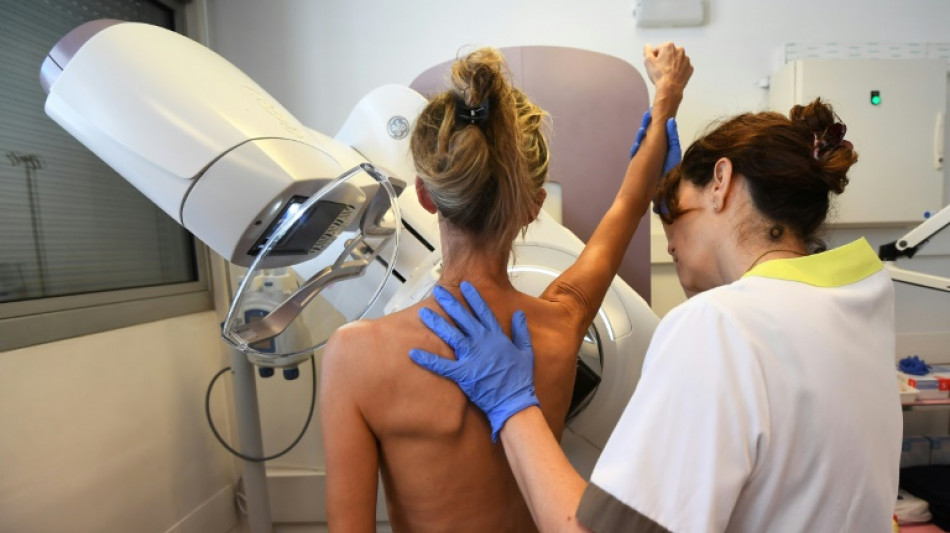
US panel recommends all women receive breast cancer screening from 40 / Photo: ANNE-CHRISTINE POUJOULAT - AFP/File

 Multi-Asset Trading Venue Monochrome Exchange Announces IEO of Its Native Token, $MCR

 South Korea break Japan hearts to win Asian Games basketball gold

 Acosta takes first victory at Austrian MotoGP

 PSG president Nasser al-Khelaifi under investigation in France for conflict of interest

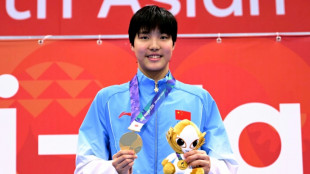 China swim sensation, 13, sets Games record after Japan win early

 Drones hit Moscow as Russians go to the polls

 New England boss Fleming says 'wrong' to ask Stokes to end retirement

 Germans vote in elections threatening fresh blow to Merz

 US fears rapid escalation in Mideast after Houthis attack Riyadh

 Japan triathlete Hojo wins first gold of Asian Games

 IOC president impressed by 'beautiful' Asian Games wooden huts

 First Asian Games gold goes to Japan as China's 13-year-old Yu lights up pool

 Data centre command hub keeps AI up and running

 Pope Leo in France: the issues on the table

 Packing for a pope: behind the scenes on foreign trips

 Republicans find transgender issues a powerful political weapon in midterm campaigning

 German state elections threaten new shock waves for Merz

 Chile's Bachelet quits race to be next UN chief

 Raphinha treble fires perfect Barca to win at Sevilla

 Thiam makes winning heptathlon return at Decastar meet

 Czechs beat USA to qualify for Davis Cup finals

 Dortmund sink Stuttgart to climb to Bundesliga summit

 Trump says will not tolerate attempts to slow AI growth

 'It has to stop': runners protest women's murders in S.Africa district

 Fire erupts near Riyadh airport as Houthis claim strikes

Women should get screened for breast cancer every other year starting from the age of 40 to reduce their risk of dying from the disease, an influential US body recommended on Tuesday.
The US Preventive Services Task Force, an independent panel of experts that receives federal funding, previously said that women in their 40s should make an individual decision about when to start mammograms based on their health history and reserved its mandatory recommendation for people turning 50.
Its new guidance was based on a review of evidence and a modeling study published in the Journal of the American Medical Association, and finalizes a draft recommendation proposed last year.
"More women in their 40s have been getting breast cancer, with rates increasing about 2 percent each year, so this recommendation will make a big difference for people across the country," Task Force chair Wanda Nicholson said in a statement.
"By starting to screen all women at age 40, we can save nearly 20 percent more lives from breast cancer overall."
Breast cancer is the second most common cancer and the second most common cause of cancer death for women in the United States, with more than 43,000 deaths last year.
Black women are 40 percent more likely to die of the disease than white women, and so ensuring they start screening at 40 "has even greater potential benefit for Black women," said Nicholson.
The new recommendation applies to nearly all women -- those who are at average risk of breast cancer, as well as those with a family history of breast cancer, and those with dense breasts.
Nearly half of all women have what's known as dense breast tissue, which they generally only find out during their first mammogram. Dense breast tissue increases their risk for breast cancer and means that mammograms may not work as well for them.
"Unfortunately, there is not yet enough evidence for the Task Force to recommend for or against additional screening with breast ultrasound or MRI," the experts said, urgently calling for more research.
The new recommendation doesn't apply however to those with a personal history of the disease, or those at very high rise due to certain genetic markers, or who have a lesion detected on previous biopsies -- they could benefit from more regular screening, in consultation with their doctor.
The new recommendation applies up until the age of 74, after which the balance of benefit-to-risk becomes uncertain, the task force said.
While screening is a powerful tool in the fight against cancer, there are also limits, the task force said, explaining why it is not recommending annual mammograms. Over-testing increases the number of harms, such as false positives, or receiving treatment that wasn't required.
E.Raimundo--PC