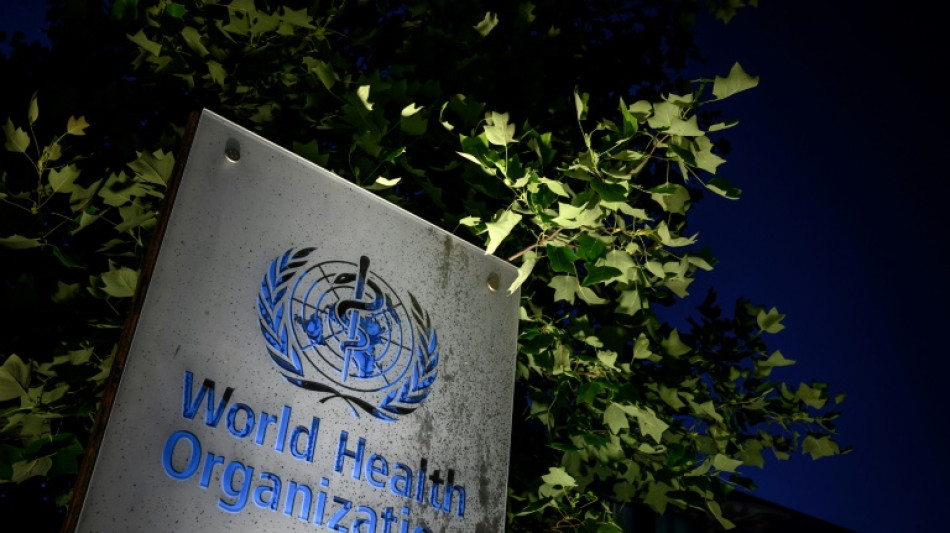
'Get this done', WHO chief tells pandemic accord talks / Photo: Fabrice COFFRINI - AFP

 Multi-Asset Trading Venue Monochrome Exchange Announces IEO of Its Native Token, $MCR
 South Korea break Japan hearts to win Asian Games basketball gold

 Acosta takes first victory at Austrian MotoGP
 PSG president Nasser al-Khelaifi under investigation in France for conflict of interest
 China swim sensation, 13, sets Games record after Japan win early
 Drones hit Moscow as Russians go to the polls

 New England boss Fleming says 'wrong' to ask Stokes to end retirement

 Germans vote in elections threatening fresh blow to Merz

 US fears rapid escalation in Mideast after Houthis attack Riyadh

 Japan triathlete Hojo wins first gold of Asian Games

 IOC president impressed by 'beautiful' Asian Games wooden huts

 First Asian Games gold goes to Japan as China's 13-year-old Yu lights up pool

 Data centre command hub keeps AI up and running

 Pope Leo in France: the issues on the table

 Packing for a pope: behind the scenes on foreign trips

 Republicans find transgender issues a powerful political weapon in midterm campaigning

 German state elections threaten new shock waves for Merz

 Chile's Bachelet quits race to be next UN chief

 Raphinha treble fires perfect Barca to win at Sevilla

 Thiam makes winning heptathlon return at Decastar meet

 Czechs beat USA to qualify for Davis Cup finals

 Dortmund sink Stuttgart to climb to Bundesliga summit

 Trump says will not tolerate attempts to slow AI growth

 'It has to stop': runners protest women's murders in S.Africa district

 Fire erupts near Riyadh airport as Houthis claim strikes

WHO chief Tedros Adhanom Ghebreyesus on Friday told countries negotiating a global agreement on handling future pandemics to "get this done", as they hit the half-way stage in last-ditch talks.
World Health Organization member states have spent the last two years drafting an international accord on pandemic prevention, preparedness and response, but negotiations are fast running out of time.
At what should have been the final round of talks in March, countries drifted even further apart than before, with disputes widening over access to emerging pathogens for research in the next pandemic, and tools like vaccines.
But they decided to return Monday to the WHO headquarters in Geneva for a fortnight of extra talks to try to break the deadlock.
Each of the draft agreement's 37 articles is being thrashed out in turn, with country negotiators breaking off into working groups to try to figure out a consensus.
Five days in, Tedros acknowledged that countries still had their differences, but seemed to be closer together than before.
The UN health agency's director-general said all countries wanted to make the world safer from pandemics, but warned against indifference and inaction.
And he said that while for some, the agreement is either too specific, not specific enough, too strong or too weak, he urged naysayers not to block everyone else from coming to a deal.
"Please, get this done," Tedros said, in a direct plea to diplomats in the negotiating room.
"I appreciate that it has been a difficult and sometimes painful process, and that it's not over. I appreciate that all of you are making compromises you did not want to make.
"I recognise that there may be delegations who despite their good faith efforts, may not be in a position to join a consensus, but they have a choice: they can choose not to block consensus."
- 'A safer future' -
The goal of the talks, which are lasting 12 hours a day and run until May 10, is to get an agreement ready for adoption at the WHO's annual assembly of member states, which starts May 27.
In December 2021, the raw sting of Covid-19 -- which killed millions, shredded economies and crippled health systems -- motivated countries to seek a binding framework of commitments aimed at preventing another such disaster.
But big differences quickly emerged on how to go about it.
The main disputes revolve around access and equity: access to pathogens detected within countries; access to pandemic-fighting products such as vaccines produced from that knowledge; and equitable distribution of not only counter-pandemic tests, treatments and jabs but the means to produce them.
Tedros urged countries to protect future generations from the suffering witnessed in the last pandemic.
"Give yourselves a reason to be proud," said Tedros.
"Give the people of the world, the people of your countries, the people you represent, a safer future.
"So I have one simple request: please, get this done, for them."
V.F.Barreira--PC