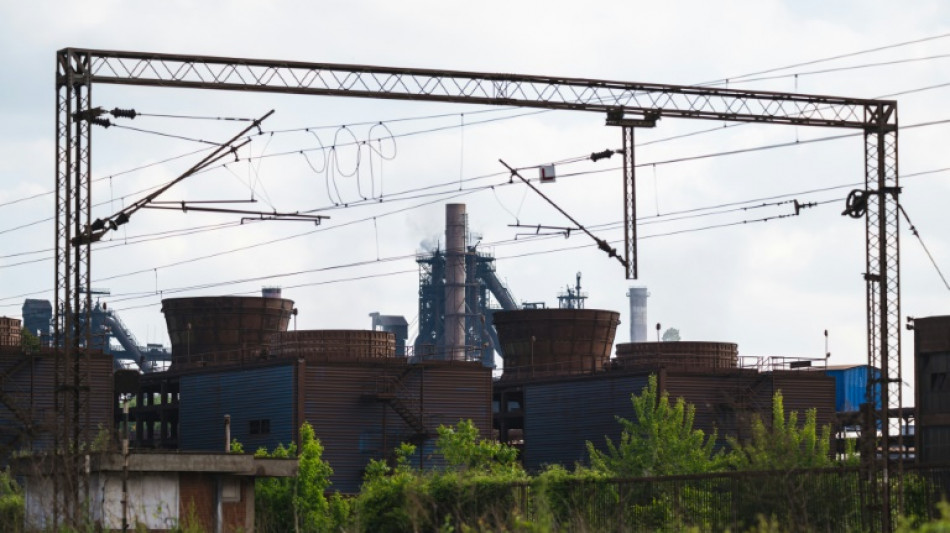
Chinese mill blamed for turning Serbia village red with pollution / Photo: Andrej ISAKOVIC - AFP

 Multi-Asset Trading Venue Monochrome Exchange Announces IEO of Its Native Token, $MCR
 South Korea break Japan hearts to win Asian Games basketball gold
 Acosta takes first victory at Austrian MotoGP

 PSG president Nasser al-Khelaifi under investigation in France for conflict of interest

 China swim sensation, 13, sets Games record after Japan win early

 Drones hit Moscow as Russians go to the polls

 New England boss Fleming says 'wrong' to ask Stokes to end retirement

 Germans vote in elections threatening fresh blow to Merz

 US fears rapid escalation in Mideast after Houthis attack Riyadh

 Japan triathlete Hojo wins first gold of Asian Games

 IOC president impressed by 'beautiful' Asian Games wooden huts

 First Asian Games gold goes to Japan as China's 13-year-old Yu lights up pool

 Data centre command hub keeps AI up and running

 Pope Leo in France: the issues on the table

 Packing for a pope: behind the scenes on foreign trips

 Republicans find transgender issues a powerful political weapon in midterm campaigning

 German state elections threaten new shock waves for Merz

 Chile's Bachelet quits race to be next UN chief

 Raphinha treble fires perfect Barca to win at Sevilla

 Thiam makes winning heptathlon return at Decastar meet

 Czechs beat USA to qualify for Davis Cup finals

 Dortmund sink Stuttgart to climb to Bundesliga summit

 Trump says will not tolerate attempts to slow AI growth

 'It has to stop': runners protest women's murders in S.Africa district

 Fire erupts near Riyadh airport as Houthis claim strikes

In the eight years since Chinese company HBIS bought a steel mill near the eastern Serbian city of Smederevo, locals say they have been plagued by heavy air pollution and thick red dust.
"There are times of the day when breathing normally is impossible," said Zvezdan Veljkovic, from the village of Radinac, where the mill is based.
Radinac has become known as "red village", because everything is permanently coated in a layer of red dust. Locals say cancer cases have rocketed and that the dust contains high levels of arsenic, chromium and lead.
Dragana Milic told AFP her grandchildren don't like coming to visit her anymore. "They won't play outside," she said.
HBIS -- one of the world's largest steel producers -- bought the mill in 2016 in a high-profile deal marked by a visit from Chinese President Xi Jinping, on his last official trip to Serbia.
Xi is to arrive in Serbia on Tuesday on another official visit, one of only three countries he is flying into on his first European trip since the Covid pandemic.
China has invested billions in Serbia and neighbouring Balkan countries in recent years, with Beijing and Belgrade signing a free trade agreement last year.
But locals around Smederevo blame Chinese investment for the increased pollution.
In the three villages near the mill, residents say that they have experienced throat irritation, unpleasant smells and continual soot coating their houses, clothes and bodies.
Milic said the only thing villagers can do to protect themselves is to stay indoors.
- Cancer cases quadrupled -
The Serbian Environmental Protection Agency has ranked Smederevo repeatedly among the country's most polluted cities, classified as having "excessively polluted air".
Nikola Krstic, an activist at NGO Tvrdjava ("Fortress"), said pollution has soared since the Chinese takeover.
"We don't know the reason why... whether it's high production, technology failure, lack of maintenance or non-compliance," he said.
Tvrdjava carried out an analysis of the dust produced by the factory in 2021, together with the scientific group National Environmental Association.
The analysis, seen by AFP, found high concentrations of heavy metals including arsenic, chromium and lead, which the report warned are among "the most toxic and carcinogenic metals when present in ambient air".
"(HBIS) have saved this steel mill in economic terms, but in environmental terms they have caused great damage to this city," said Krstic.
Data from the state-run Smederevo Health Centre found a four-fold increase in cancer cases between 2011 and 2019, which activists believe is due to increased pollution.
The group filed a criminal complaint against the company in Smederevo, but it was rejected on the basis of lack of evidence.
They now plan to take their case to the European Court of Human Rights.
- Special relationship -
The steel mill employs about 5,000 people, with thousands more employed indirectly.
Once a state-owned enterprise, it was privatised in 2003 and sold to US Steel. But the American corporation pulled out in 2012 after a steel market crash, and the Serbian government bought it back for one dollar.
In April 2016, the plant was sold for 46 million euros ($49 million) to China's HBIS, heralded as a sign of the "friendship" between the two countries.
Chinese-owned companies were among Serbia's top three exporters last year -- including HBIS, whose exports topped 549 million euros.
Tomislav Momirovic, Serbia's trade minister, told state broadcaster RTS that "no other country in the region or Europe" enjoys a similar level of cooperation with China.
Smederevo is one of several big investments by Chinese companies in Serbia, including a $3.8 billion investment by Chinese state-owned company Zijin Mining near the eastern city of Bor.
Stefan Vladisavljev, of the Foundation BFPE for a Responsible Society, said claims Chinese investment "saved" Serbia are "exaggerated".
"What is true is that Chinese companies were willing to take over the management and ownership of certain industrial systems for which Serbia had no other solution," he added.
HBIS did not respond when contacted by AFP.
But earlier this year its Serbia director Vladan Mihailovic told RTS that the company plans to build a wall around its open raw material storage and construct a new processor to reduce the dust.
Milic, who has been living in Radinac for 37 years, has little hope this will solve the issue.
"I think there is no other solution" but for everyone to move, she said.
G.M.Castelo--PC