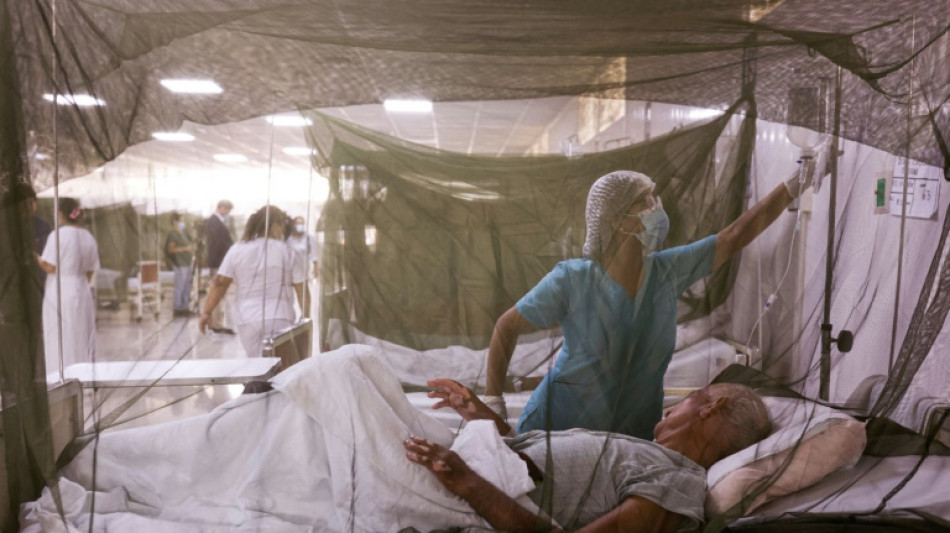
Pandemic talks extended as deadline passes / Photo: Juan Carlos CISNEROS - AFP

 Multi-Asset Trading Venue Monochrome Exchange Announces IEO of Its Native Token, $MCR
 South Korea break Japan hearts to win Asian Games basketball gold

 Acosta takes first victory at Austrian MotoGP
 PSG president Nasser al-Khelaifi under investigation in France for conflict of interest
 China swim sensation, 13, sets Games record after Japan win early
 Drones hit Moscow as Russians go to the polls

 New England boss Fleming says 'wrong' to ask Stokes to end retirement

 Germans vote in elections threatening fresh blow to Merz

 US fears rapid escalation in Mideast after Houthis attack Riyadh

 Japan triathlete Hojo wins first gold of Asian Games

 IOC president impressed by 'beautiful' Asian Games wooden huts

 First Asian Games gold goes to Japan as China's 13-year-old Yu lights up pool

 Data centre command hub keeps AI up and running

 Pope Leo in France: the issues on the table

 Packing for a pope: behind the scenes on foreign trips

 Republicans find transgender issues a powerful political weapon in midterm campaigning

 German state elections threaten new shock waves for Merz

 Chile's Bachelet quits race to be next UN chief

 Raphinha treble fires perfect Barca to win at Sevilla

 Thiam makes winning heptathlon return at Decastar meet

 Czechs beat USA to qualify for Davis Cup finals

 Dortmund sink Stuttgart to climb to Bundesliga summit

 Trump says will not tolerate attempts to slow AI growth

 'It has to stop': runners protest women's murders in S.Africa district

 Fire erupts near Riyadh airport as Houthis claim strikes

Countries trying to strike a landmark global agreement on handling future pandemics decided to keep negotiating for another fortnight after their deadline passed on Friday.
Scarred by the devastation caused by Covid-19 -- which killed millions, shredded economies and crippled health systems -- the World Health Organization's 194 member states have spent two years trying to hammer out binding commitments on pandemic prevention, preparedness and response.
The process was aimed at getting an agreement finalised by the WHO's annual assembly which opens on May 27.
A final talks session in March got nowhere near consensus, so an additional fortnight of talks was crammed in. However, despite progress on several fronts, the talks broke up on Friday without sealing a deal.
"They have worked very hard to get as far as they could on agreement and we are not there yet. So we will continue our work," co-chair Roland Driece told reporters at the WHO headquarters in Geneva.
"We worked very hard and there's just so many issues that we need to agree upon which are technical and political, and they take time."
- Keeping up the momentum -
The talks will keep going with intermittent meetings in person and online until the World Health Assembly (WHA).
Driece and his co-chair Precious Matsoso are to issue a schedule in coming days. They have to report to the May 27-June 1 annual assembly, regardless of how far the talks get.
In a statement, WHO chief Tedros Adhanom Ghebreyesus added: "During more than two years of intensive negotiations, WHO's member states have shown unwavering commitment to forging a generational agreement to protect the world from a repeat of the horrors caused by the Covid-19 pandemic.
"I welcome the determination that all countries have shown to continue their work and fulfil the mission on which they embarked."
Despite a showing desire for commitments aimed at preventing another Covid-style disaster, big differences have emerged between country blocs on how to acheive them.
The talks were held behind closed doors at the WHO headquarters in Geneva.
Fuelled by trolleys full of coffee, bananas, biscuits and sandwiches, negotiators have been pulling long hours since April 29 to try to reach agreement.
- Thorny issues -
The main disputes revolve around access and equity: access to pathogens detected within countries and to pandemic-fighting products such as vaccines produced from that knowledge; and equitable distribution of counter-pandemic tests, treatments and jabs, along with the means to produce them.
Each of the draft agreement's 37 articles has been individually thrashed out, with country negotiators breaking off into working groups to try to reach a consensus.
While general agreement has been found on some articles -- without formally signing them off -- the core aspects remain deadlocked.
"It's fair to say there's progress made. If you look at the outline of the agreement, all the important themes are there," Medicines Law and Policy director Ellen 't Hoen told reporters.
"But there remain a significant number of thorny issues that simply need more time."
James Love, the director of Knowledge Ecology International, added: "There is some room for negotiating right now. I don't think we're really there yet."
He said it was hardly "the worst outcome" to take more time.
A.Santos--PC