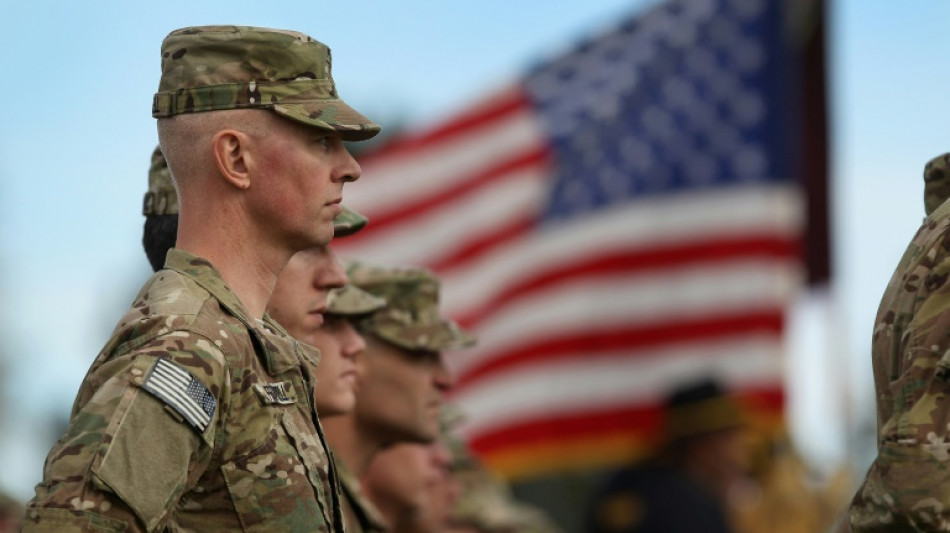
Military rank affects medical care, offering societal insights: study / Photo: JOHN MOORE - GETTY IMAGES NORTH AMERICA/AFP/File

 Multi-Asset Trading Venue Monochrome Exchange Announces IEO of Its Native Token, $MCR

 South Korea break Japan hearts to win Asian Games basketball gold

 Acosta takes first victory at Austrian MotoGP

 PSG president Nasser al-Khelaifi under investigation in France for conflict of interest

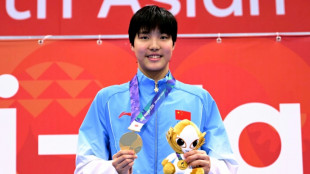 China swim sensation, 13, sets Games record after Japan win early

 Drones hit Moscow as Russians go to the polls

 New England boss Fleming says 'wrong' to ask Stokes to end retirement

 Germans vote in elections threatening fresh blow to Merz

 US fears rapid escalation in Mideast after Houthis attack Riyadh

 Japan triathlete Hojo wins first gold of Asian Games

 IOC president impressed by 'beautiful' Asian Games wooden huts

 First Asian Games gold goes to Japan as China's 13-year-old Yu lights up pool

 Data centre command hub keeps AI up and running

 Pope Leo in France: the issues on the table

 Packing for a pope: behind the scenes on foreign trips

 Republicans find transgender issues a powerful political weapon in midterm campaigning

 German state elections threaten new shock waves for Merz

 Chile's Bachelet quits race to be next UN chief

 Raphinha treble fires perfect Barca to win at Sevilla

 Thiam makes winning heptathlon return at Decastar meet

 Czechs beat USA to qualify for Davis Cup finals

 Dortmund sink Stuttgart to climb to Bundesliga summit

 Trump says will not tolerate attempts to slow AI growth

 'It has to stop': runners protest women's murders in S.Africa district

 Fire erupts near Riyadh airport as Houthis claim strikes

Human relationships are inherently shaped by power dynamics, yet quantifying their impact has remained a scientific challenge.
Now, a large new study published Thursday in the journal Science reveals that military doctors give more attention to higher-ranked patients, providing concrete evidence about the privileges that come with elevated status, frequently at the expense of the less powerful.
"One of the things we are trying to show is that this is not a military-specific analysis," said co-author Manasvini Singh of Carnegie Mellon University, arguing the findings are just as relevant to civilian life as they are to the rigid chain-of-command structures of the armed forces.
For their research, Singh and co-author Stephen Schwab of the University of Texas at San Antonio examined 1.5 million doctor-patient encounters in the US military health service's records.
Rather than exploring how doctors might respond differently to, say, generals versus privates, they chose a more nuanced approach: comparing how soldiers of equal rank, for example two majors, were treated in emergency departments (EDs) by physicians who either outranked them or were outranked by them.
The "high-power" patients who outranked their doctors received 3.6 percent more effort and resources, as measured by tests, diagnosis and treatment codes, time spent with the physician, and opioids prescribed. High-power patients also had better outcomes, with a 15 percent lower likelihood of hospital admission in the following 30 days.
Further analysis revealed an unwitting spillover effect: low-power patients often received less attention from doctors who had just seen a high-powered patient, possibly due to the extended effort invested in the prior visit.
To ensure their results were generalizable to the population at large, the researchers considered demographic factors like age, race, and sex, which impact outcomes in wider society.
"We found if a patient walks into an ED and is assigned to a white physician who is higher rank than them, the patient is better off being white than black," said Singh.
A Black patient that outranks their white physician receives more effort than if they were lower ranked than their doctor, but still less effort than equivalent white patients. Black physicians on the other hand put in very high effort for high-ranking Black patients.
While the military's ranking system differs from civilian life, Singh argues that other factors, like increased camaraderie and kinship, could mitigate this effect.
The paper's findings even generalize beyond medicine, helping explain why Black students do better under Black teachers or why landlords are more likely to evict vulnerable tenants even when the cash value of missed payments is constant, she said.
In a related commentary, Laura Nimmon of the University of British Columbia said the research raised important questions about whether medical education sufficiently addresses status, authority, and class bias.
"Efforts remain necessary to better understand facets of power, including the failures of education and health care systems to address the myth that physicians are perfectly altruistic and not corrupted by power," she said.
L.Carrico--PC