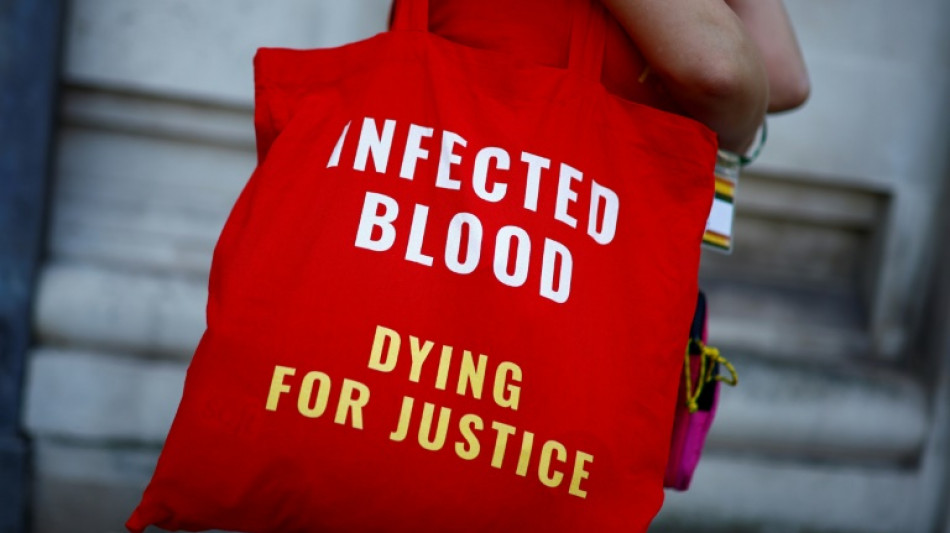
UK PM sorry for institutional cover-up in infected blood scandal / Photo: BENJAMIN CREMEL - AFP

 US warns of rapid escalation in Mideast war
 Iran 'put hearts on the court' to win Asian Games basketball bronze

 School girl Yu helps China dominate in Asian Games swimming openers

 Myanmar win first Asian Games teqball gold as Spain great Puyol watches

 China's 13-year-old Yu scorches to first major gold at Asian Games

 Russians vote on last day of parliamentary elections

 Hong Kong pays final respects to former city leader Tung

 Typhoon put people off Asian Games opening ceremony, official says

 China's 13-year-old Yu cruises as Asian Games swimming begins

 AI 'warning shots' focus Beijing on national security risks

 Philippine tribe in limbo over US-led tech hub

 Leo XIV, first US pope transcends his restrained style

 Singer Ed Sheeran says Gaza situation 'unjustifiable' following controversy

 In 'Tenzing', a Sherpa mountaineer gets his due

 Ed Sheeran set to return to stage after Palestinian controversy

 Toulouse edge Vannes, Lyon beat Pau to take Top 14 summit

 Germans arrested for Louvre stunt in Mona Lisa hall

 Saudi-led coalition says Houthis fired ballistic missile at Riyadh

 France's debt climbs to highest since 1978: ministry

 McIlroy two shots off the lead at Wentworth after eagle on 18

 Martinez brace saves Inter in Serie A top-two clash with Roma

 Rosenior abused but guides Paris FC past old club Strasbourg

 Seven-try Lyon beat Pau, climb to Top 14 summit

 Brighton defeat a 'big lesson' against complacency for Arsenal, says Arteta

 Thousands protest inaction over climate crisis in Switzerland

UK Prime Minister Rishi Sunak on Monday apologised to thousands of people infected with contaminated blood in a decades-long scandal that a damning report concluded was covered up and largely could have been avoided.
More than 30,000 people were infected with viruses such as HIV and hepatitis after being given the tainted blood in Britain between the 1970s and early 1990s, the Infected Blood Inquiry concluded.
Victims included those needing blood transfusions for accidents and in surgery, and those suffering from blood disorders such as haemophilia who were treated with donated blood plasma products, as well as the partners of those infected.
Some 3,000 people died, and more will follow, in what has been described as the biggest treatment disaster in the eight-decade history of the state-run National Health Service (NHS).
"I am truly sorry," Sunak told the House of Commons, calling the findings of the long-awaited report "a day of shame for the British state".
"Time and again people in positions of power and trust had the chance to stop the transmission of those infections and failed to do so", he added, promising "whatever it costs" to compensate victims.
The total figure is expected to be above £10 billion ($12 billion) when the government announces the package on Tuesday.
- Pervasive -
The report, running to more than 2,500 pages, laid bare a "catalogue of failures" with "catastrophic" consequences for victims and their loved ones.
In some instances, children with bleeding disorders were treated as "objects for research".
At one school where 122 pupils with haemophilia were given infected blood products between 1970 and 1987, only 30 now survive, the report said.
"I have to report that it could largely, though not entirely, have been avoided," concluded its author, judge Brian Langstaff.
His team found that successive governments and health professionals failed to mitigate risks despite it being apparent by the early 1980s that the cause of AIDS could be transmitted by blood.
Blood donors were not screened properly and blood products were imported from abroad, including from the United States where drug users and prisoners were used for donations.
Too many transfusions were also given when they were not necessarily needed, the report added.
There were even attempts to conceal the scandal, including evidence that officials in the health department destroyed documents in 1993.
"Viewing the response of the NHS and of government overall, the answer to the question, 'Was there a cover-up?' is that there has been," the report stated.
"Not in the sense of a handful of people plotting in an orchestrated conspiracy to mislead, but in a way that was more subtle, more pervasive and more chilling in its implications.
"In this way there has been a hiding of much of the truth," it added.
- 'Vindicated' -
On top of the 3,000 patients who died, many more were left with lifelong health problems.
Langstaff said that "the scale of what happened is horrifying" and said people's suffering had been compounded by repeated denials and false assurances that they had received good treatment.
When victims were told the truth, sometimes years later, this was sometimes done in "insensitive" and "inappropriate" ways.
"What I have found is that disaster was no accident. People put their trust in doctors and the government to keep them safe and that trust was betrayed," Langstaff told reporters.
Former prime minister Theresa May launched the inquiry -- one of the country's largest -- in 2017.
Campaigners hailed the report as the culmination of a decades-long struggle but noted that it came too late for many of the victims who will never see justice.
Andy Evans, chairman of the Tainted Blood campaign group, described the report as "momentous" and that he felt "validated and vindicated".
"We have been gaslit for generations... Sometimes we felt like we were shouting into the wind during the last 40 years," he told reporters.
G.M.Castelo--PC