WHO agency says talc is 'probably' cancer-causing / Photo: FREDERIC J. BROWN - AFP/File

 US warns of rapid escalation in Mideast war

 Iran 'put hearts on the court' to win Asian Games basketball bronze

 School girl Yu helps China dominate in Asian Games swimming openers

 Myanmar win first Asian Games teqball gold as Spain great Puyol watches

 China's 13-year-old Yu scorches to first major gold at Asian Games

 Russians vote on last day of parliamentary elections

 Hong Kong pays final respects to former city leader Tung

 Typhoon put people off Asian Games opening ceremony, official says

 China's 13-year-old Yu cruises as Asian Games swimming begins

 AI 'warning shots' focus Beijing on national security risks

 Philippine tribe in limbo over US-led tech hub

 Leo XIV, first US pope transcends his restrained style

 Singer Ed Sheeran says Gaza situation 'unjustifiable' following controversy

 In 'Tenzing', a Sherpa mountaineer gets his due

 Ed Sheeran set to return to stage after Palestinian controversy

 Toulouse edge Vannes, Lyon beat Pau to take Top 14 summit

 Germans arrested for Louvre stunt in Mona Lisa hall

 Saudi-led coalition says Houthis fired ballistic missile at Riyadh

 France's debt climbs to highest since 1978: ministry

 McIlroy two shots off the lead at Wentworth after eagle on 18

 Martinez brace saves Inter in Serie A top-two clash with Roma

 Rosenior abused but guides Paris FC past old club Strasbourg

 Seven-try Lyon beat Pau, climb to Top 14 summit

 Brighton defeat a 'big lesson' against complacency for Arsenal, says Arteta

 Thousands protest inaction over climate crisis in Switzerland

The World Health Organization's cancer agency on Friday classified talc as "probably carcinogenic" for humans, however an outside expert warned against misinterpreting the announcement as a "smoking gun".
The decision was based on "limited evidence" talc could cause ovarian cancer in humans, "sufficient evidence" it was linked to cancer in rats and "strong mechanistic evidence" that it shows carcinogenic signs in human cells, the WHO's International Agency for Research on Cancer (IARC) said.
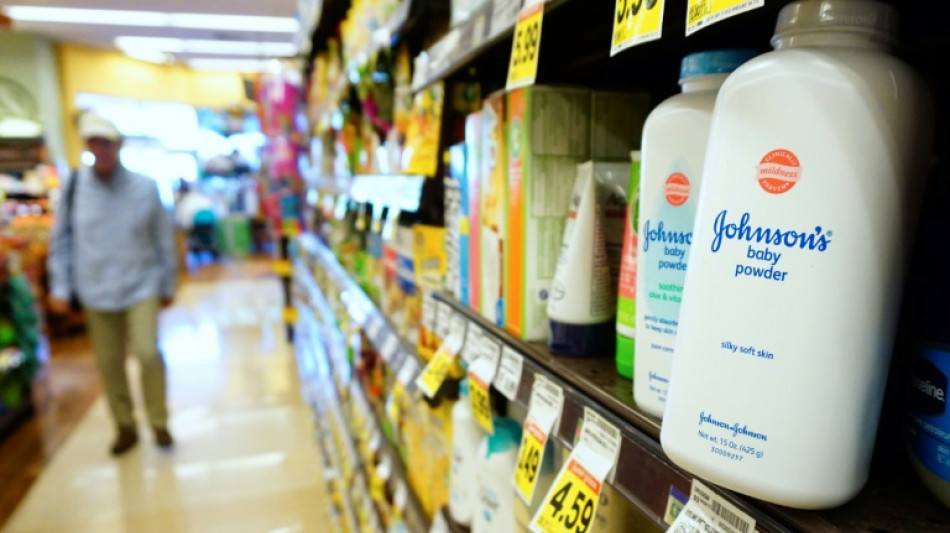
Talc is a naturally occurring mineral which is mined in many parts of the world and is often used to make talcum baby powder.
Most people are exposed to talc in the form of baby powder or cosmetics, according to the Lyon-based IARC.
But the most significant exposure to talc occurs when talc is being mined, processed or used to make products, it added.
The agency said there were numerous studies which consistently showed an increase in the rate of ovarian cancer in women who use talc on their genitals.
But it could not rule out that the talc in some studies was contaminated with cancer-causing asbestos.
"A causal role for talc could not be fully established," according the agency's findings published in The Lancet Oncology.
Kevin McConway, a statistician at the UK's Open University not involved the research, warned that for the IARC's evaluation, the "most obvious interpretation is actually misleading".
The agency is only aiming "to answer the question of whether the substance has the potential to cause cancer, under some conditions that IARC do not specify," he said.
Because the studies were observational and so could not prove causation, "there isn’t a smoking gun that the talc use causes any increased cancer risk," he added.
The announcement comes just weeks after US pharmaceutical and cosmetics giant Johnson & Johnson agreed to pay $700 million to settle allegations it misled customers about the safety of its talcum-based powder products.
Johnson & Johnson did not admit wrongdoing in its settlement, even though it withdrew the product from the North American market in 2020.
A summary of studies published in 2020 covering 250,000 women in the United States did not find a statistical link between the use of talc on the genitals and the risk of ovarian cancer.
Also on Friday, the IARC classified acrylonitrile, a chemical compound used to make polymers, as "carcinogenic to humans", its highest warning level.
It cited "sufficient evidence" linking acrylonitrile to lung cancer.
The polymers made with acrylonitrile are used in everything from fibres in clothes to carpets, plastics and other consumer products.
L.Mesquita--PC