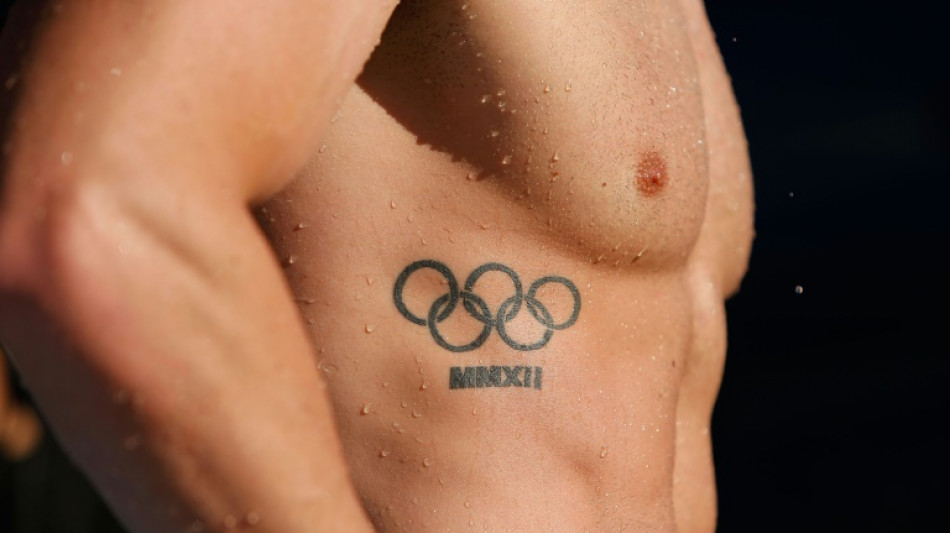
'Extremely dangerous': Health experts slam doping-friendly Enhanced Games / Photo: Lachlan Cunningham - GETTY IMAGES NORTH AMERICA/AFP/File

 US warns of rapid escalation in Mideast war

 Iran 'put hearts on the court' to win Asian Games basketball bronze
 School girl Yu helps China dominate in Asian Games swimming openers

 Myanmar win first Asian Games teqball gold as Spain great Puyol watches

 China's 13-year-old Yu scorches to first major gold at Asian Games

 Russians vote on last day of parliamentary elections

 Hong Kong pays final respects to former city leader Tung

 Typhoon put people off Asian Games opening ceremony, official says

 China's 13-year-old Yu cruises as Asian Games swimming begins

 AI 'warning shots' focus Beijing on national security risks

 Philippine tribe in limbo over US-led tech hub

 Leo XIV, first US pope transcends his restrained style

 Singer Ed Sheeran says Gaza situation 'unjustifiable' following controversy

 In 'Tenzing', a Sherpa mountaineer gets his due

 Ed Sheeran set to return to stage after Palestinian controversy

 Toulouse edge Vannes, Lyon beat Pau to take Top 14 summit

 Germans arrested for Louvre stunt in Mona Lisa hall

 Saudi-led coalition says Houthis fired ballistic missile at Riyadh

 France's debt climbs to highest since 1978: ministry

 McIlroy two shots off the lead at Wentworth after eagle on 18

 Martinez brace saves Inter in Serie A top-two clash with Roma

 Rosenior abused but guides Paris FC past old club Strasbourg

 Seven-try Lyon beat Pau, climb to Top 14 summit

 Brighton defeat a 'big lesson' against complacency for Arsenal, says Arteta

 Thousands protest inaction over climate crisis in Switzerland

Athletes at the Paris Olympics later this month will be tested for performance-enhancing drugs, but at a competition plotting to rival the Games, doping will be the point.
The Enhanced Games, currently planned for late next year, will not test competitors for drugs but instead encourage them to take advantage of medical advancements to break world records.
The organisers say that by freeing athletes from the tyranny of anti-doping agencies and embracing technology, the Enhanced Games aim "to safely evolve mankind into a new superhumanity".
But researchers who have studied the effects of performance-enhancing drugs told AFP they fear the Games will push athletes to dope at such extreme levels they could risk heart attack, stroke or even death.
It remains unclear if the Enhanced Games will actually be held at all. World Athletics president Sebastian Coe has dismissed the whole idea as "bollocks".
But momentum seems to be building after retired Australian Olympic swimmer James Magnussen signed up earlier this year and the competition announced millions of dollars in funding from investors including US libertarian billionaire Peter Thiel.
Astrid Kristine Bjornebekk, a researcher at Oslo University Hospital, said she was shocked to find out there was a even a chance this "extremely dangerous" idea could become reality.
- 'Juice to the gills ' -
Bjornebekk, who has studied how anabolic steroids damage the brains of weightlifters, warned that the Games would "trigger use with no boundaries".
Illustrating how the concept could incentivise such use, Magnussen told a podcast he will "juice to the gills" to get the $1 million (920,000 euros) on offer for breaking the 50-metre freestyle world record.
As well as swimming, the Games also plan to host track and field events, gymnastics, weightlifting and combat sports.
Bjornebekk warned that mixing steroids and combat sports such as mixed martial arts "significantly escalates" the risk of someone dying during the competition.
To avoid such risks, a spokesman for the Enhanced Games told AFP that all athletes will be "continually supervised" once they sign up.
This will include health checks, psychological screening and monitoring using new tech such as a "real-time portable echocardiogram," the spokesman said.
However Dominic Sagoe of Norway's University of Bergen, who has led research finding that one in three steroid users become addicted, warned the consequences of a successful Enhanced Games "could spill into society".
He feared that children inspired by their sporting heroes could seek out steroids, or that 'roid rage-induced violence by aspiring athletes could be pushed into the streets.
"We cannot even fathom the consequences," he said. "It's not something to laugh at."
Anabolic steroids would likely be the most commonly used drug at the Games, the experts said.
Excessive use of these steroids has been found to cause liver or kidney damage, high blood pressure and cholesterol, infertility, mental health problems, and a higher risk of cancer.
But athletes would likely take a cocktail of drugs potentially including growth hormones, blood doping using erythropoietin (EPO), insulin and more, including some treatments to offset the side effects of others, Sagoe said.
The most "dangerous combinations of drugs likely will land the best performances," Bjornebekk warned.
- 'Tool for coercion' -
The Enhanced Games spokesman said that "side effects and adverse events" from performance-enhancing drugs "could arguably be avoided with proper clinical supervision and expert guidance".
A new medical commission and scientific advisory board are still hammering out exactly how the competition will monitor athlete safety, he added.
John William Devine, an expert in sports ethics at UK's Swansea University, said that -- despite billing itself as increasing athlete freedom -- the Games could turn into a "tool for coercion".
"If you remove the limit on performance-enhancing drugs, will athletes be pressured by coaches, by teammates, by governments or even by sponsors to take risks that they otherwise wouldn't have taken?" he asked.
Matthew Dunn, a steroid researcher at Australia's Deakin University, was concerned about athletes getting drugs on the black market and using them without supervision.
But he acknowledged that despite best efforts, competitions like the Olympics "are not 100 percent clean".
"It would also be interesting to see what the human body can achieve when it is 'enhanced'," he added.
So could the Enhanced Games one day overtake the Olympics?
"I think the general public still likes the idea of achievements occurring through ability, hard work and dedication -- and not through a syringe," Dunn said.
O.Gaspar--PC