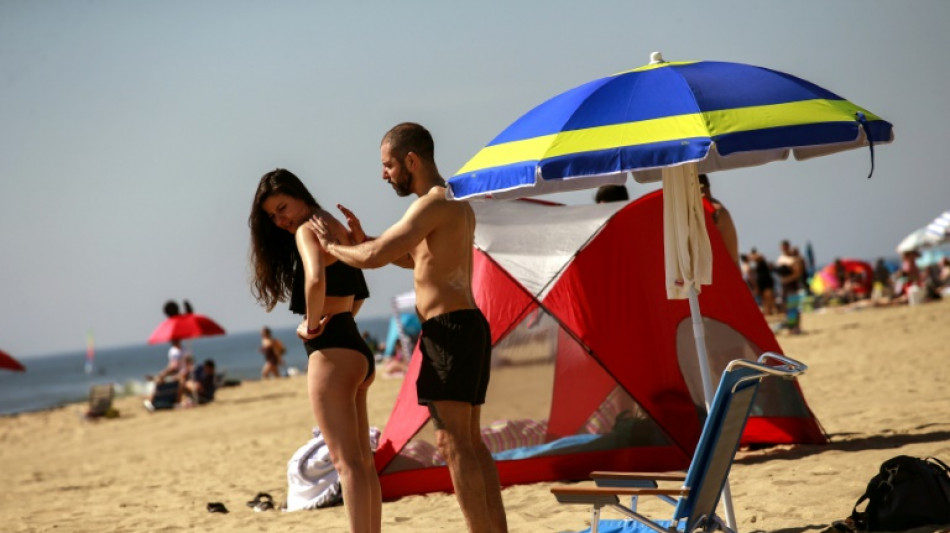
In raging summer, sunscreen misinformation scorches US / Photo: KENA BETANCUR - GETTY IMAGES NORTH AMERICA/AFP

 US warns of rapid escalation in Mideast war

 Iran 'put hearts on the court' to win Asian Games basketball bronze
 School girl Yu helps China dominate in Asian Games swimming openers

 Myanmar win first Asian Games teqball gold as Spain great Puyol watches

 China's 13-year-old Yu scorches to first major gold at Asian Games

 Russians vote on last day of parliamentary elections

 Hong Kong pays final respects to former city leader Tung

 Typhoon put people off Asian Games opening ceremony, official says

 China's 13-year-old Yu cruises as Asian Games swimming begins

 AI 'warning shots' focus Beijing on national security risks

 Philippine tribe in limbo over US-led tech hub

 Leo XIV, first US pope transcends his restrained style

 Singer Ed Sheeran says Gaza situation 'unjustifiable' following controversy

 In 'Tenzing', a Sherpa mountaineer gets his due

 Ed Sheeran set to return to stage after Palestinian controversy

 Toulouse edge Vannes, Lyon beat Pau to take Top 14 summit

 Germans arrested for Louvre stunt in Mona Lisa hall

 Saudi-led coalition says Houthis fired ballistic missile at Riyadh

 France's debt climbs to highest since 1978: ministry

 McIlroy two shots off the lead at Wentworth after eagle on 18

 Martinez brace saves Inter in Serie A top-two clash with Roma

 Rosenior abused but guides Paris FC past old club Strasbourg

 Seven-try Lyon beat Pau, climb to Top 14 summit

 Brighton defeat a 'big lesson' against complacency for Arsenal, says Arteta

 Thousands protest inaction over climate crisis in Switzerland

Dismissively tossing a tube of sunscreen over his shoulder, a bare-chested TikTok influencer declares that the cream causes cancer. He instead promotes "regular sun exposure" to his 400,000 followers -- contradicting US dermatologists fighting a surge in such dubious misinformation.
In the midst of a blazing summer, some social media influencers are offering potentially dangerous advice on sun protection, despite stepped-up warnings from health experts about over-exposure amid rising rates of skin cancer.
Further undermining public health, videos -- some garnering millions of views -- share "homemade" recipes that use ingredients such as beef tallow, avocado butter and beeswax for what is claimed to provide effective skin protection.
In one viral TikTok video, "transformation coach" Jerome Tan discards a commercial cream and tells his followers that eating natural foods will allow the body to make its "own sunscreen."
He offers no scientific evidence for this.
Such online misinformation is increasingly causing real-world harm, experts say.
One in seven American adults under 35 think daily sunscreen use is more harmful than direct sun exposure, and nearly a quarter believe staying hydrated can prevent a sunburn, according to a survey this year by Ipsos for the Orlando Health Cancer Institute.
"People buy into a lot of really dangerous ideas that put them at added risk," warned Rajesh Nair, an oncology surgeon with the institute.
- 'No safe tan' -
As influencers increasingly cast doubt on commercial sunscreen products, another US survey showed a dip in their use, with some 75 percent of Americans using sunscreen regularly, down from 79 percent in 2022.
The findings coincide with other trends showing rising public mistrust of established medical guidance -- including on Covid-19 and other vaccines -- and increasing reliance on influencers with little or no scientific knowledge.
Dermatologists are scrambling to disabuse people of the increasingly popular perception that higher levels of sun exposure are good for the skin.
"There is no safe tan," Daniel Bennett, a dermatologist and professor at the University of Wisconsin School of Medicine and Public Health, told AFP.
"The evidence that ultraviolet light exposure is the primary preventable driver of skin cancer is overwhelming," he added.
Many of the misleading or false claims come from influencers seeking to monetize their content on social media platforms, an echo chamber where sensational and false claims often drive engagement, experts say.
Some content creators are leveraging "sunscreen skepticism" to "sell their own supplements or endorse alternative all-natural sunscreens," Eric Dahan, founder of the influencer marketing agency Mighty Joy, told AFP.
- 'Sun paranoia' -
Dahan pointed out one Instagram post that advised against "wearing sunscreen constantly" while promoting a range of skincare products.
"Say goodbye to sun paranoia," the emoji-laden post said. "Catch some (guilt-free) rays this summer."
Clutching a surfboard on a beach, another bare-chested Instagram influencer says he rejects sunscreen.
"Do I worry about skin cancer? I do not," he posted, while promoting "animal-based sunscreen" made from beef tallow.
Tallow -- essentially rendered, purified beef fat -- alone has no ability to block ultraviolet radiation, said Megan Poynot Couvillion, a dermatologist practicing in Texas.
"I don't see a problem with using it on the skin as an emollient, but absolutely not as a sunscreen," she told AFP.
The US Food and Drug Administration has called for more research into the ingredients in commercial sunscreens, but it does recommend their use, noting that excessive sun exposure is a major contributor to skin cancer.
Homemade sunscreens "lack effective sun protection," leaving users vulnerable to sunburn, premature skin aging and skin cancer, the American Academy of Dermatology warns.
Some influencers' recipes include zinc oxide, a known sun protector. But concocting sunscreen at home that will effectively block UV radiation is unrealistic, said Adam Friedman, professor at the George Washington University School of Medicine and Health Sciences.
"There's no way you're making this in your basement," Friedman told AFP.
S.Caetano--PC