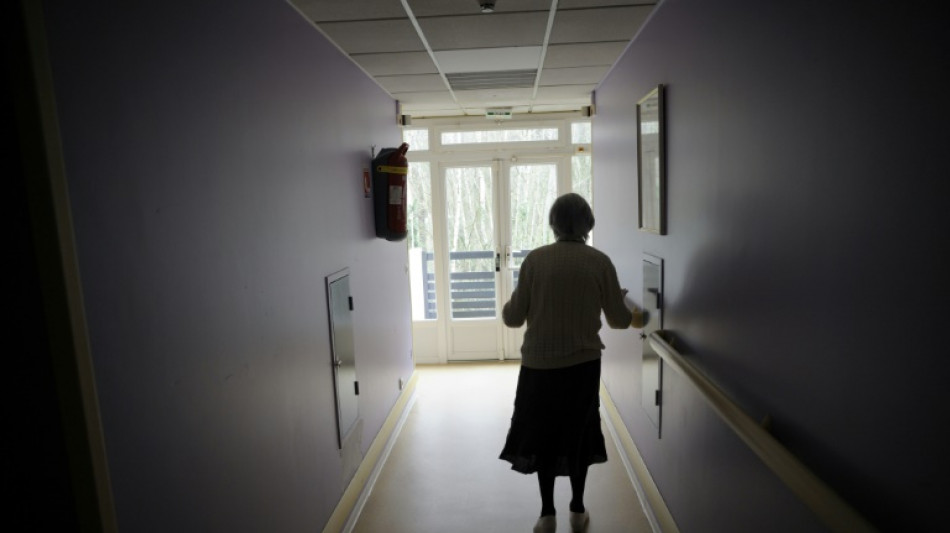
Many dementia cases could be prevented, but far from all: study / Photo: SEBASTIEN BOZON - AFP/File

 US warns of rapid escalation in Mideast war

 Iran 'put hearts on the court' to win Asian Games basketball bronze

 School girl Yu helps China dominate in Asian Games swimming openers

 Myanmar win first Asian Games teqball gold as Spain great Puyol watches

 China's 13-year-old Yu scorches to first major gold at Asian Games

 Russians vote on last day of parliamentary elections

 Hong Kong pays final respects to former city leader Tung

 Typhoon put people off Asian Games opening ceremony, official says

 China's 13-year-old Yu cruises as Asian Games swimming begins

 AI 'warning shots' focus Beijing on national security risks

 Philippine tribe in limbo over US-led tech hub

 Leo XIV, first US pope transcends his restrained style

 Singer Ed Sheeran says Gaza situation 'unjustifiable' following controversy

 In 'Tenzing', a Sherpa mountaineer gets his due

 Ed Sheeran set to return to stage after Palestinian controversy

 Toulouse edge Vannes, Lyon beat Pau to take Top 14 summit

 Germans arrested for Louvre stunt in Mona Lisa hall

 Saudi-led coalition says Houthis fired ballistic missile at Riyadh

 France's debt climbs to highest since 1978: ministry

 McIlroy two shots off the lead at Wentworth after eagle on 18

 Martinez brace saves Inter in Serie A top-two clash with Roma

 Rosenior abused but guides Paris FC past old club Strasbourg

 Seven-try Lyon beat Pau, climb to Top 14 summit

 Brighton defeat a 'big lesson' against complacency for Arsenal, says Arteta

 Thousands protest inaction over climate crisis in Switzerland

Millions of cases of dementia could be prevented or delayed by reducing a range of risk factors such as smoking or air pollution, according to a major new study, though outside experts warn that such measures can only go so far.
The debilitating condition, which progressively robs people of their memories, cognitive abilities, language and independence, currently affects more than 55 million people across the world.
Dementia is caused by a range of diseases, the most common of which is Alzheimer's.
A huge review of the available evidence published in The Lancet journal on Wednesday said that the "potential for prevention is high" in the fight against dementia.
The study follows a previous report in 2020 that also emphasised the importance of prevention.
At the time, the international team of researchers estimated that 40 percent of dementia cases were linked to 12 risk factors.
The factors included people having a lower level of education, hearing problems, high blood pressure, smoking, obesity, depression, physical inactivity, diabetes, excessive drinking, traumatic brain injury, air pollution and social isolation.
The latest update adds two more risk factors: vision loss and high cholesterol.
"Nearly half of dementias could theoretically be prevented by eliminating these 14 risk factors," the study said.
- EU turns down new drug -
Decades of research and billions of dollars have failed to produce a cure or truly effective drug for dementia.
But since the start of last year, two Alzheimer's treatments have been approved in the United States: Biogen's lecanemab and Eli Lilly's donanemab.
They work by targeting the build-up of two proteins -- tau and amyloid beta -- considered to be one of the main ways the disease progresses.
However, the benefits of the drugs remain modest, they have severe side effects, and they are often very expensive.
In contrast to the US, the European Union's medicine watchdog last week refused to approve lecanemab, and it is still considering donanemab.
Some researchers hope the fact that the new drugs work at all means they will pave the way for more effective treatments in the future.
Others prefer to focus on ways to prevent dementia in the first place.
Masud Husain, a neurologist at the UK's University of Oxford, said that focusing on risk factors "would be far more cost effective than developing high-tech treatments which so far have been disappointing in their impacts on people with established dementia".
- 'How much more could we do?' -
The Lancet study was welcomed by experts in the field, among whom the importance of prevention is hardly debatable.
However, some said the idea that nearly half of all dementia cases could be prevented should be put in perspective.
It has not been proven that the risk factors directly cause dementia, as the authors of the study acknowledged.
For example, could it be dementia that is causing depression, rather than the other way around?
It is also difficult to separate the risk factors from each other, though the researchers tried.
Some could be intrinsically linked, such as depression and isolation, or smoking and high blood pressure.
Above all, many of the risk factors are societal scourges that have long proven near impossible to fully address.
The study lays out different recommendations ranging from the personal -- such as wearing a helmet while cycling -- to governmental, such as improving access to education.
"It is not clear whether we could ever completely eliminate any of these risk factors," Charles Marshall, a neurologist at Queen Mary University of London, told AFP.
"We already have public health programmes to reduce smoking and hypertension (high blood pressure), so how much more could we do?"
Tara Spires-Jones, a neuroscientist at the University of Edinburgh, said it was important that "we do not blame people living with dementia for their brain disease".
That is because "it is clear that a large portion of dementias could not be prevented due to genes and things beyond people's control, like opportunities for education as children", she added.
T.Vitorino--PC