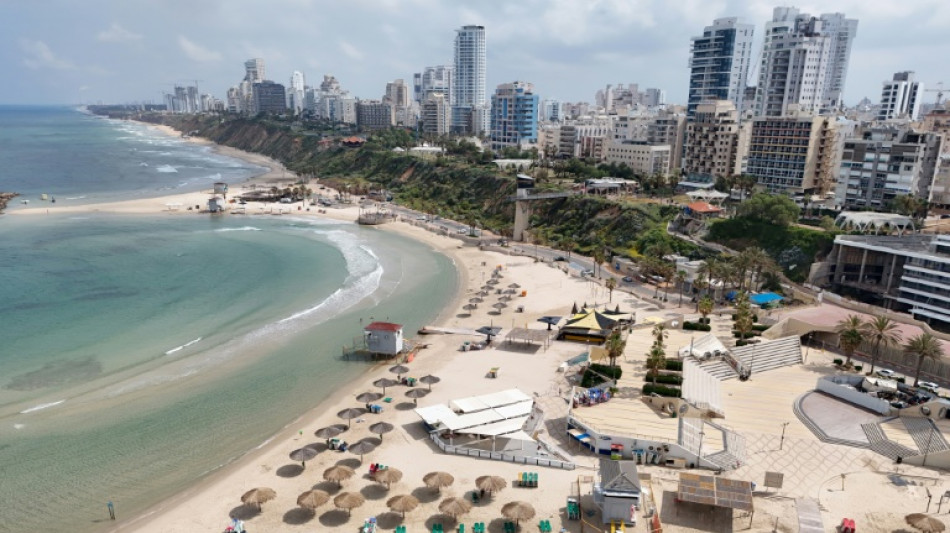
Addictions on the rise in wartime Israel / Photo: JACK GUEZ - AFP/File

 US warns of rapid escalation in Mideast war

 Iran 'put hearts on the court' to win Asian Games basketball bronze

 School girl Yu helps China dominate in Asian Games swimming openers

 Myanmar win first Asian Games teqball gold as Spain great Puyol watches

 China's 13-year-old Yu scorches to first major gold at Asian Games

 Russians vote on last day of parliamentary elections

 Hong Kong pays final respects to former city leader Tung

 Typhoon put people off Asian Games opening ceremony, official says

 China's 13-year-old Yu cruises as Asian Games swimming begins

 AI 'warning shots' focus Beijing on national security risks

 Philippine tribe in limbo over US-led tech hub

 Leo XIV, first US pope transcends his restrained style

 Singer Ed Sheeran says Gaza situation 'unjustifiable' following controversy

 In 'Tenzing', a Sherpa mountaineer gets his due

 Ed Sheeran set to return to stage after Palestinian controversy

 Toulouse edge Vannes, Lyon beat Pau to take Top 14 summit

 Germans arrested for Louvre stunt in Mona Lisa hall

 Saudi-led coalition says Houthis fired ballistic missile at Riyadh

 France's debt climbs to highest since 1978: ministry

 McIlroy two shots off the lead at Wentworth after eagle on 18

 Martinez brace saves Inter in Serie A top-two clash with Roma

 Rosenior abused but guides Paris FC past old club Strasbourg

 Seven-try Lyon beat Pau, climb to Top 14 summit

 Brighton defeat a 'big lesson' against complacency for Arsenal, says Arteta

 Thousands protest inaction over climate crisis in Switzerland

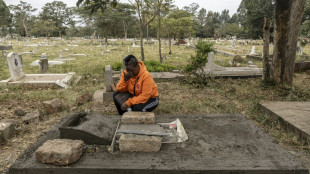
At 19, Israeli man Yoni has to put aside his plans to join the military and instead enter rehab for drug abuse that has worsened since Hamas's October 7 attack.
Health professionals said Yoni's case is not an exception in wartime Israel, noting a surge in drug and alcohol abuse as well as other addictive behaviours.
Yoni, who asked to use a pseudonym to protect his privacy, told AFP he had started taking drugs recreationally before, but "after the war it seemed to really get worse".
"It's just a way to escape from reality, this whole thing," said the resident of Beersheba in southern Israel who lost a friend, Nir Beizer, in the Hamas attack that sparked the ongoing Gaza war.
Psychiatrist Shaul Lev-Ran, founder of the Israel Center on Addiction, said that "as a natural reaction to emotional stress and as a search for relief, we've seen a spectacular rise in the consumption of various addictive sedative substances."
A study carried out by his team, based in the central city of Netanya, found "a connection between indirect exposure to the October 7 events and an increase in addictive substances consumption" of about 25 percent.
Lev-Ran told AFP they have identified a rise in the use of "prescription drugs, illegal drugs, alcohol, or addictive behaviour like gambling".
One in four Israelis have increased their addictive substance use, according to the study, which was conducted in November and December on a representative sample of 1,000 Israelis. In 2022, before the war, one in seven struggled with drug addiction.
Contacted by AFP, the Palestinian Authority said there was no equivalent data on addiction and mental health for the Palestinian territories.
- 'Shock' -
The October 7 attack, when Palestinian militants stormed into southern Israel and attacked towns, communities, army bases and an outdoor rave, caused a real "shock" in Israeli society, Lev-Ran said.
The study found that "the closer individuals were to the trauma on October 7, the higher the risk" of addictive behaviours.
The Hamas attack resulted in the deaths of 1,198 people, mostly civilians, according to an AFP tally based on official Israeli figures.
Militants also seized 251 people, 111 of whom are still captive in Gaza, including 39 the Israeli military says are dead.
Israel's retaliatory military campaign in the Gaza Strip has killed at least 39,790 people, according to health ministry of the Hamas-run territory, which does not give details of civilian and militant deaths.
The Israel Center on Addiction study found an increase in addictive substance consumption among survivors of the October 7 attack, but also among Israelis displaced since then from communities near the Gaza border or in the north, near Lebanon.
"Some who had never consumed addictive substances started using cannabis, some used substances but increased their use, and some were already treated for addiction and relapsed", said Lev-Ran.
- 'Forget' -
Lev-Rab said Israel was already "at the outset of an epidemic in which large swathes of the population will develop an addiction to substances".
The study found that the use of sleeping pills and painkillers has also skyrocketed, by 180 percent and 70 percent respectively.
The psychiatrist gave the example of one of his patients, a man who demanded "something" to help him cope and be able to sleep while his son was fighting in Gaza.
At a bar in Jerusalem, Matan, a soldier deployed to the Palestinian territory who gave only his first name for privacy concerns, told AFP that using drugs "helps forget" the harsh reality.
Yoni said that in the early months of the war, his friends and him would take "party drugs like ecstasy, MDMA, LSD" recreationally "in order not to be bored and not to be afraid".
Then, Yoni started taking drugs "alone at home", which he said eventually led him to realise "that I need to go to rehab".
Once out, he wants to complete his military service, Yoni said, to "prove to myself, prove to the family, that I am indeed capable of more, and (can) contribute to the community like everyone else".
P.Serra--PC