WHO seeks mpox vaccine production surge / Photo: GUERCHOM NDEBO - AFP

 US warns of rapid escalation in Mideast war

 Iran 'put hearts on the court' to win Asian Games basketball bronze

 School girl Yu helps China dominate in Asian Games swimming openers

 Myanmar win first Asian Games teqball gold as Spain great Puyol watches

 China's 13-year-old Yu scorches to first major gold at Asian Games

 Russians vote on last day of parliamentary elections

 Hong Kong pays final respects to former city leader Tung

 Typhoon put people off Asian Games opening ceremony, official says

 China's 13-year-old Yu cruises as Asian Games swimming begins

 AI 'warning shots' focus Beijing on national security risks

 Philippine tribe in limbo over US-led tech hub

 Leo XIV, first US pope transcends his restrained style

 Singer Ed Sheeran says Gaza situation 'unjustifiable' following controversy

 In 'Tenzing', a Sherpa mountaineer gets his due

 Ed Sheeran set to return to stage after Palestinian controversy

 Toulouse edge Vannes, Lyon beat Pau to take Top 14 summit

 Germans arrested for Louvre stunt in Mona Lisa hall

 Saudi-led coalition says Houthis fired ballistic missile at Riyadh

 France's debt climbs to highest since 1978: ministry

 McIlroy two shots off the lead at Wentworth after eagle on 18

 Martinez brace saves Inter in Serie A top-two clash with Roma

 Rosenior abused but guides Paris FC past old club Strasbourg

 Seven-try Lyon beat Pau, climb to Top 14 summit

 Brighton defeat a 'big lesson' against complacency for Arsenal, says Arteta

 Thousands protest inaction over climate crisis in Switzerland

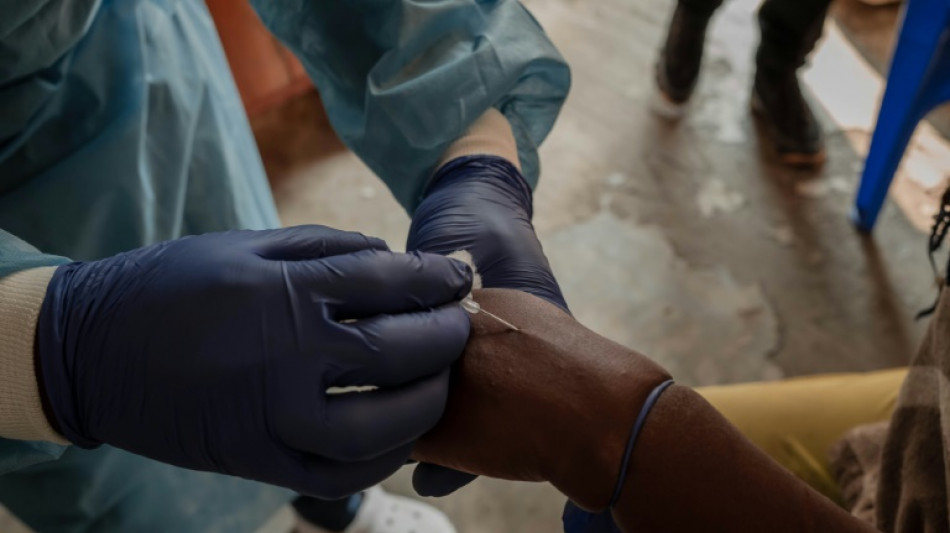
The World Health Organization on Friday urged manufacturers to ramp up production of mpox vaccines to rein in the spread of a more dangerous strain of the virus.
The WHO on Wednesday declared the mpox surge a public health emergency of international concern -- its highest alert level -- with Clade 1b cases soaring in the Democratic Republic of Congo and spreading beyond its borders.
"We do need the manufacturers to really scale up so that we've got access to many, many more vaccines," WHO spokeswoman Margaret Harris told reporters.
The WHO is asking countries with mpox vaccine stockpiles to donate them to countries with ongoing outbreaks.
Two mpox vaccines have been used in recent years -- MVA-BN, produced by Danish drugmaker Bavarian Nordic, and Japan's LC16.
Harris said there were 500,000 MVA-BN doses in stock, while an additional 2.4 million doses could be produced quickly, if there was a commitment from buyers.
For 2025, an additional 10 million doses could be produced, upon a firm procurement request.
"LC16 is a vaccine that is not commercialised but produced on behalf of the government of Japan. There is a considerable stockpile of this vaccine," Harris added, saying the WHO was working with Tokyo to facilitate donations.
- 'Drop in the bucket' -
The Doctors Without Borders charity said countries with vaccine stockpiles but no outbreaks "must donate as many doses as possible" to affected countries in Africa.
It urged Bavarian Nordic to lower its prices, saying MVA-BN was out of reach for most countries where mpox is a threat.
The International Federation of Red Cross and Red Crescent Societies, the world's largest humanitarian network, said it faced significant challenges tackling mpox.
Bronwyn Nichol, IFRC senior public health emergencies officer, said most vaccine stocks were in wealthy nations, and those sent to Africa so far were "a drop in the bucket".
"There is a critical shortage of testing, treatment, and vaccines across the continent. These shortages are severely hampering the ability to contain the outbreak," she said.
- 'Complex picture' -
The WHO, headed by Tedros Adhanom Ghebreyesus, is due to issue temporary recommendations to countries on handling the mpox surge.
There are two subtypes of the virus: the more virulent and deadlier Clade 1, endemic in the Congo Basin in central Africa; and Clade 2, endemic in West Africa.
The upsurge in the DRC is being driven by outbreaks of two different Clade 1 strains, Tedros told a meeting Thursday of the UN health agency's Standing Committee on Health Emergency Prevention, Preparedness and Response.
The first is an outbreak in northwest DRC of what was previously known as Clade 1, now called Clade 1a. This outbreak is primarily affecting children and is spread through multiple modes of transmission, he said.
The second in northeastern DRC is a new offshoot of Clade 1 called Clade 1b, which was first detected in September last year and is spreading rapidly, mainly through sexual transmission among adults.
The spread of Clade 1b, and its detection in neighbouring countries, were the main reasons behind the WHO sounding its highest alarm.
"It's a complex picture, and responding to each of these outbreaks, and bringing them under control, will require a complex, comprehensive and coordinated international response," said Tedros.
Ferreira--PC