War-ravaged Sudan battles cholera epidemic / Photo: - - AFP

 US warns of rapid escalation in Mideast war

 Iran 'put hearts on the court' to win Asian Games basketball bronze

 School girl Yu helps China dominate in Asian Games swimming openers

 Myanmar win first Asian Games teqball gold as Spain great Puyol watches

 China's 13-year-old Yu scorches to first major gold at Asian Games

 Russians vote on last day of parliamentary elections

 Hong Kong pays final respects to former city leader Tung

 Typhoon put people off Asian Games opening ceremony, official says

 China's 13-year-old Yu cruises as Asian Games swimming begins

 AI 'warning shots' focus Beijing on national security risks

 Philippine tribe in limbo over US-led tech hub

 Leo XIV, first US pope transcends his restrained style

 Singer Ed Sheeran says Gaza situation 'unjustifiable' following controversy

 In 'Tenzing', a Sherpa mountaineer gets his due

 Ed Sheeran set to return to stage after Palestinian controversy

 Toulouse edge Vannes, Lyon beat Pau to take Top 14 summit

 Germans arrested for Louvre stunt in Mona Lisa hall

 Saudi-led coalition says Houthis fired ballistic missile at Riyadh

 France's debt climbs to highest since 1978: ministry

 McIlroy two shots off the lead at Wentworth after eagle on 18

 Martinez brace saves Inter in Serie A top-two clash with Roma

 Rosenior abused but guides Paris FC past old club Strasbourg

 Seven-try Lyon beat Pau, climb to Top 14 summit

 Brighton defeat a 'big lesson' against complacency for Arsenal, says Arteta

 Thousands protest inaction over climate crisis in Switzerland

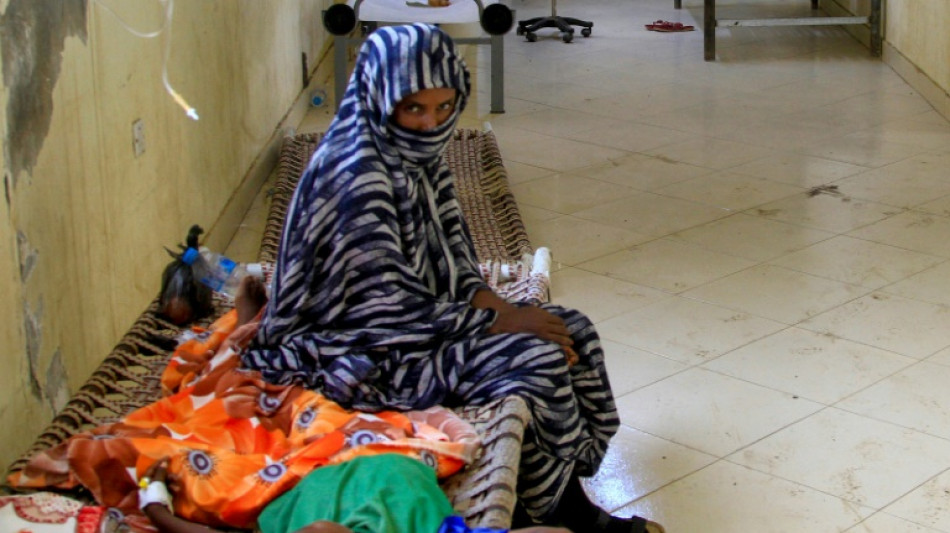
Lying on a hospital bed, Aisha Mohammed said she is "suffering" from cholera symptoms, an increasingly common ailment in Sudan where a prolonged war has ravaged the healthcare system.
Cholera, caused by contaminated water or food, had been common in Sudan particularly during the rainy season even before war broke out in April 2023 between rival generals.
But more than 16 months of fighting have forced most hospitals out of service, leaving the country of 48 million people struggling to control the sometimes deadly but treatable disease.
In the southeastern Sudanese town of Wad al-Hulaywah, 40-year-old Mohammed receives intravenous medicine to ease her crippling symptoms.
"I'm suffering from acute diarrhoea," she whispered.
Sudanese authorities and the United Nations have reported a surge in cholera cases amid several weeks of torrential rains that have battered parts of Sudan and displaced thousands.
Rains and floods have contributed to a resurgence of the largely waterborne disease, which can cause severe dehydration and lead to death within hours if not treated.
The health ministry on Monday declared an epidemic, later reporting 556 cholera cases including 27 deaths, most in Kassala state where Wad al-Hulaywah is located.
Nearby Gedaref state has also been hit particularly hard, the ministry said.
The World Health Organization said Sudan has had at least 11,327 cholera cases, 316 of them deadly, since June 2023.
Sudan's Health Minister Haitham Ibrahim said "climatic conditions and water contamination" were behind the epidemic.
In Wad al-Hulaywah alone, "we've counted 150 cases so far, among them seven dead" since late July, local health official Adam Ali told AFP.
- 'Polluted water' -
Before the start of the war between Sudan's army and paramilitary forces, the UN had said that about 40 percent of Sudanese did not have access to clean water. Conditions have since worsened.
"Our problem is drinking water," said Ali.
Most residents of Wad al-Hulaywah "drink water directly from the river -- polluted water", he said.
During the rainy season, large amounts of silt are washed into the Setit river, which begins in neighbouring Ethiopia, increasing pollution levels, the health official added.
Near the local hospital, workers spray insecticide to fight the proliferation of flies, which Ali said was a symptom of poor sanitation.
Dam construction in 2015 on the Setit river had displaced "entire villages", he said, and their inhabitants "dug makeshift latrines, which attract flies because they are not maintained".
Access to clean water has been hampered across the country, in areas under either the army or the paramilitary Rapid Support Forces, both vying for control of Sudan.
- 'I will have no one' -
The paramilitaries have laid siege to entire areas, preventing the entry of fuel needed to pump clean water, while bureaucratic hurdles and fighting have blocked aid operations, putting key water stations out of service.
The war has killed tens of thousands of people, displaced more than 10 million and shuttered more than 70 percent of Sudan's healthcare facilities, according to the UN.
The rival forces have both been accused of war crimes, including targeting civilians and looting or obstructing humanitarian aid.
With Sudan facing what the UN has called "one of the worst humanitarian crises in recent memory" and aid groups unable to help, many feel they have to fend for themselves.
Sitting outside a hospital in Kassala, 49-year-old Hassan al-Junaid said he has been displaced by the war, and now "we are living in very bad conditions, which caused my sister to get cholera."
"I am the only one with her, but I can't go with her inside because she has been placed in quarantine," he said.
"So I'm staying here, worried for her and afraid that I might be infected myself," added Junaid.
"If that happens, I will have no one to buy me the medicine I would need."
X.Brito--PC