Mpox epicentre DRC set to receive first vaccines to contain outbreak / Photo: Tchandrou NITANGA - AFP/File

 US warns of rapid escalation in Mideast war

 Iran 'put hearts on the court' to win Asian Games basketball bronze

 School girl Yu helps China dominate in Asian Games swimming openers
 Myanmar win first Asian Games teqball gold as Spain great Puyol watches

 China's 13-year-old Yu scorches to first major gold at Asian Games

 Russians vote on last day of parliamentary elections

 Hong Kong pays final respects to former city leader Tung

 Typhoon put people off Asian Games opening ceremony, official says

 China's 13-year-old Yu cruises as Asian Games swimming begins

 AI 'warning shots' focus Beijing on national security risks

 Philippine tribe in limbo over US-led tech hub

 Leo XIV, first US pope transcends his restrained style

 Singer Ed Sheeran says Gaza situation 'unjustifiable' following controversy

 In 'Tenzing', a Sherpa mountaineer gets his due

 Ed Sheeran set to return to stage after Palestinian controversy

 Toulouse edge Vannes, Lyon beat Pau to take Top 14 summit

 Germans arrested for Louvre stunt in Mona Lisa hall

 Saudi-led coalition says Houthis fired ballistic missile at Riyadh

 France's debt climbs to highest since 1978: ministry

 McIlroy two shots off the lead at Wentworth after eagle on 18

 Martinez brace saves Inter in Serie A top-two clash with Roma

 Rosenior abused but guides Paris FC past old club Strasbourg

 Seven-try Lyon beat Pau, climb to Top 14 summit

 Brighton defeat a 'big lesson' against complacency for Arsenal, says Arteta

 Thousands protest inaction over climate crisis in Switzerland

The Democratic Republic of Congo was Thursday awaiting almost 100,000 mpox vaccine doses from the European Union, with 200,000 due to arrive by the end of the week.
The doses left the Danish capital Copenhagen on Wednesday evening.
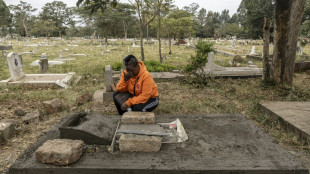
DRC is at the epicentre of an mpox outbreak with more than 19,000 cases and over 650 deaths, according to the latest figures from the health minister.
Mpox is caused by a virus transmitted to humans by infected animals but can also be passed from human to human through close physical contact.
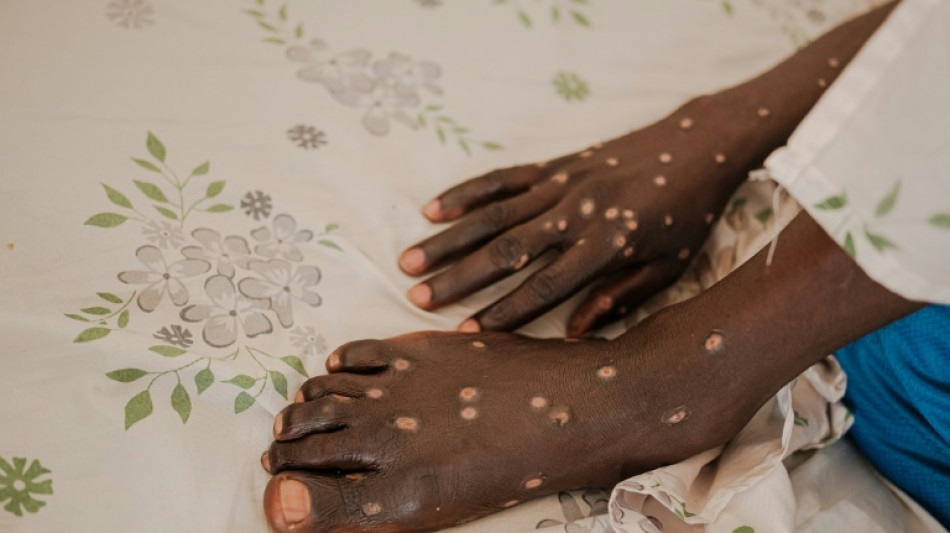
Sometimes deadly it causes fever, muscular aches and large boil-like skin lesions.
"It shows the solidarity between the European Union with Africa and also our capacity to react quickly," Laurent Muschel head of the EU's Health Emergency Preparedness and Response Authority (HERA) told AFP.
The remainder of the 200,000 doses donated by the EU are set to arrive in Kinshasa on Saturday.
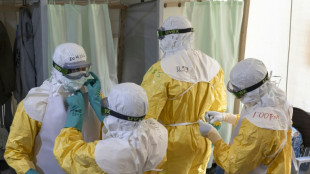
The World Health Organization declared an international emergency on August 14, concerned by the surge in cases of the new Clade 1b strain in the DRC that spread to nearby countries.
Muschel said 560,000 doses will be given by the EU and some of its member states to the DRC and other affected countries.
Mpox is now present in 13 African countries, including Burundi, Congo-Brazzaville and the Central African Republic, according to the Africa CDC.
The vaccines arriving in the DRC this week come from the Danish pharmaceutical laboratory Bavarian Nordic.
It is the only vaccine approved in Europe and the United States and is only intended for adults.
- Logistical challenge -
Trials are currently being conducted for potential use on children over the age of 12.
Another mpox vaccine is authorised in Japan, which has promised a significant number of doses to DRC.
Some 3.6 million mpox vaccine doses have been secured for African countries, according to the Africa CDC, with the DRC, by far the most affected country in the world, being a priority for international health authorities.
Sixty two percent of the mpox cases in DRC have been registered in children, according to the Africa CDC, who also account for four out of five deaths.
According to international health authorities, Kinshasa plans to start its vaccination campaign as early as October.
But DRC will face a major logistical challenge in a territory four times the size of France with poor roads, shambolic infrastructure and erratic power supplies.
The Danish vaccine must also be stored in special conditions, "at minus 20°C, the temperature of a freezer," Muschel said.
Several mpox epidemics are present in central Africa.
The 2022 epidemic was caused by Clade 2 which is still circulating in many countries, including in the West.
But the epidemic in the DRC is caused by the Clade 1 strain, and the situation is becoming more complicated with the appearance of a new version of this subgroup, variant 1b.
The danger and level of contagion of the variant are difficult to assess, according to several specialists.
According to the WHO, cases due to Clade 1b have increased rapidly over the past several weeks but "relatively few deaths have been reported".
Formerly called monkeypox, the virus was discovered in 1958 in Denmark in monkeys kept for research.
It was first discovered in humans in 1970 in Zaire, the former name of DRC.
A.Magalhes--PC