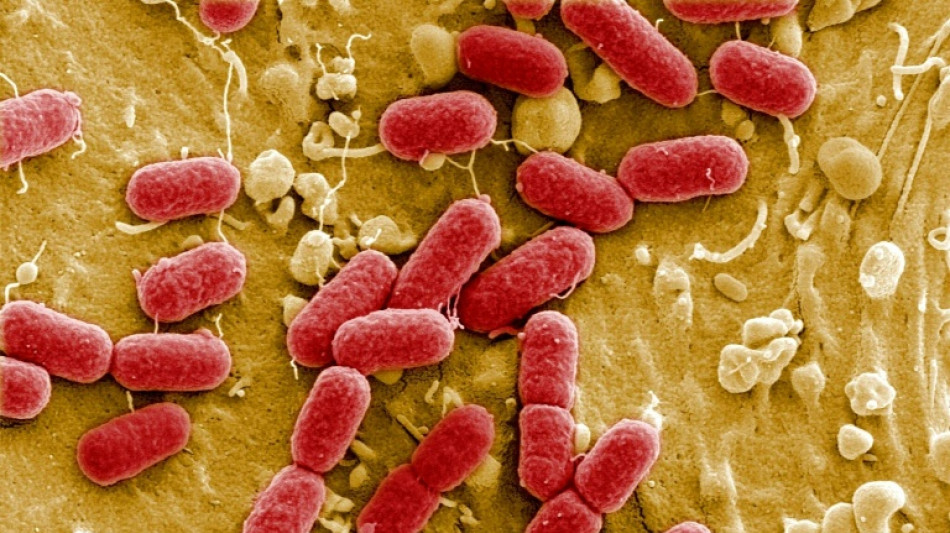
Drug-resistant superbugs projected to kill 39 million by 2050 / Photo: Manfred Rohde - Helmholtz-Zentrum für Infektions/AFP

 US warns of rapid escalation in Mideast war

 Iran 'put hearts on the court' to win Asian Games basketball bronze

 School girl Yu helps China dominate in Asian Games swimming openers

 Myanmar win first Asian Games teqball gold as Spain great Puyol watches

 China's 13-year-old Yu scorches to first major gold at Asian Games

 Russians vote on last day of parliamentary elections

 Hong Kong pays final respects to former city leader Tung

 Typhoon put people off Asian Games opening ceremony, official says

 China's 13-year-old Yu cruises as Asian Games swimming begins

 AI 'warning shots' focus Beijing on national security risks

 Philippine tribe in limbo over US-led tech hub

 Leo XIV, first US pope transcends his restrained style

 Singer Ed Sheeran says Gaza situation 'unjustifiable' following controversy

 In 'Tenzing', a Sherpa mountaineer gets his due

 Ed Sheeran set to return to stage after Palestinian controversy

 Toulouse edge Vannes, Lyon beat Pau to take Top 14 summit

 Germans arrested for Louvre stunt in Mona Lisa hall

 Saudi-led coalition says Houthis fired ballistic missile at Riyadh

 France's debt climbs to highest since 1978: ministry

 McIlroy two shots off the lead at Wentworth after eagle on 18

 Martinez brace saves Inter in Serie A top-two clash with Roma

 Rosenior abused but guides Paris FC past old club Strasbourg

 Seven-try Lyon beat Pau, climb to Top 14 summit

 Brighton defeat a 'big lesson' against complacency for Arsenal, says Arteta

 Thousands protest inaction over climate crisis in Switzerland

Infections of drug-resistant superbugs are projected to kill nearly 40 million people over the next 25 years, a global analysis predicted on Monday, as the researchers called for action to avoid this grim scenario.
Superbugs -- strains of bacteria or pathogens that have become resistant to antibiotics, making them much harder to treat -- have been recognised as a rising threat to global health.
The analysis has been billed as the first research to track the global impact of superbugs over time, and estimate what could happen next.
More than a million people died from the superbugs -- also called antimicrobial resistance (AMR) -- a year across the world between 1990 and 2021, according to the study in The Lancet journal.
Deaths among children under five from superbugs actually fell by more than 50 percent over the last three decades, the study said, due to improving measures to prevent and control infections for infants.
However when children now catch superbugs, the infections are much harder to treat.
And deaths of over-70s have surged by more than 80 percent over the same period, as an ageing population became more vulnerable to infection.
Deaths from infections of MRSA, a type of staph bacteria that has become resistant to many antibiotics, doubled to 130,000 in 2021 from three decades earlier, the study said.
- 'This threat is growing' -
The researchers used modelling to estimate that -- based on current trends -- the number of direct deaths from AMR would rise by 67 percent to reach nearly two million a year by 2050.
It will also play a role in a further 8.2 million annual deaths, a jump of nearly 75 percent, according to the modelling.
Under this scenario, AMR will have directly killed 39 million people over the next quarter century, and contributed to a total of 169 million deaths, it added.
But less dire scenarios are also possible.
If the world works to improve care for severe infections and access to antimicrobial drugs, it could save the lives of 92 million people by 2050, the modelling suggested.
"These findings highlight that AMR has been a significant global health threat for decades and that this threat is growing," study co-author Mohsen Naghavi of the US-based Institute of Health Metrics said in a statement.
The researchers looked at 22 pathogens, 84 combinations of drugs and pathogens, and 11 infectious syndromes such as meningitis. The study involved data from 520 million individual records across 204 countries and territories.
It was released ahead of a high-level AMR meeting at the United Nations scheduled for September 26.
Antimicrobial resistance is a natural phenomenon, but the overuse and misuse of antibiotics in humans, animals and plants has made the problem worse.
J.Pereira--PC