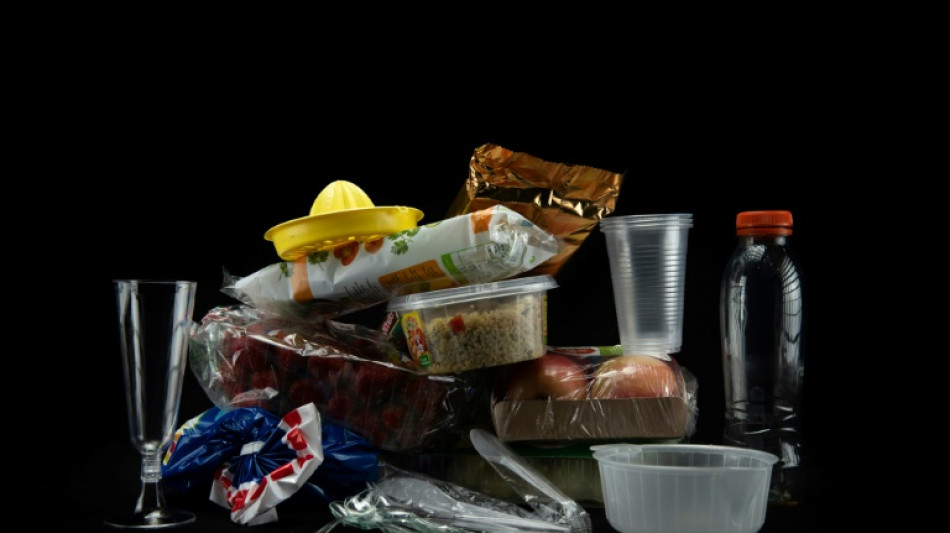
Over 3,600 food packaging chemicals found in human bodies / Photo: Olivier MORIN - AFP/File

 US warns of rapid escalation in Mideast war

 Iran 'put hearts on the court' to win Asian Games basketball bronze

 School girl Yu helps China dominate in Asian Games swimming openers

 Myanmar win first Asian Games teqball gold as Spain great Puyol watches

 China's 13-year-old Yu scorches to first major gold at Asian Games

 Russians vote on last day of parliamentary elections

 Hong Kong pays final respects to former city leader Tung

 Typhoon put people off Asian Games opening ceremony, official says

 China's 13-year-old Yu cruises as Asian Games swimming begins

 AI 'warning shots' focus Beijing on national security risks

 Philippine tribe in limbo over US-led tech hub

 Leo XIV, first US pope transcends his restrained style

 Singer Ed Sheeran says Gaza situation 'unjustifiable' following controversy

 In 'Tenzing', a Sherpa mountaineer gets his due

 Ed Sheeran set to return to stage after Palestinian controversy

 Toulouse edge Vannes, Lyon beat Pau to take Top 14 summit

 Germans arrested for Louvre stunt in Mona Lisa hall

 Saudi-led coalition says Houthis fired ballistic missile at Riyadh

 France's debt climbs to highest since 1978: ministry

 McIlroy two shots off the lead at Wentworth after eagle on 18

 Martinez brace saves Inter in Serie A top-two clash with Roma

 Rosenior abused but guides Paris FC past old club Strasbourg

 Seven-try Lyon beat Pau, climb to Top 14 summit

 Brighton defeat a 'big lesson' against complacency for Arsenal, says Arteta

 Thousands protest inaction over climate crisis in Switzerland

More than 3,600 chemicals used in food packaging or preparation have been detected in human bodies, some of which are hazardous to health, while little is known about others, a study said Tuesday.
Around 100 of these chemicals are considered to be of "high concern" to human health, said lead study author Birgit Geueke from the Food Packaging Forum Foundation, a Zurich-based NGO.
Some of these chemicals are relatively well-studied and have already been found in human bodies, such as PFAS "forever chemicals" and bisphenol A -- both of which are the target of bans.
But little is known about the health effects of others, Geueke told AFP, calling for more research into how chemicals used in packaging end up being swallowed along with food.
The researchers had previously catalogued around 14,000 food contact chemicals (FCCs), which are capable of "migrating" into food from packaging made of plastic, paper, glass, metal or other materials.
They can also come from other parts of the food-making process, such as from conveyer belts or kitchen utensils.
The researchers then searched for these chemicals in existing biomonitoring databases, which track chemicals in human samples.
The team was expecting to find a few hundred FCCs, Geueke said. Instead, they were surprised to find 3,601 -- a quarter of all the known FCCs.
Geueke emphasised that this study could not show that all these chemicals necessarily ended up in bodies from food packaging, as "other exposure sources are possible".
Among the "high concern" chemicals were numerous PFAS, also known as forever chemicals, which have been detected in many parts of the human body in recent years and linked to a range of health problems.
Also detected was bisphenol A, a hormone-disrupting chemical used to make plastics that has already been banned from baby bottles in many countries.
Another hormone-disrupting chemical was phthalates, which has been linked to infertility.
Less is known about oligomers, which are also byproducts of plastic production.
"There is almost no evidence on the health effects of these chemicals," Geueke said.
- Reduce contact with packaging -
When it comes to toxicology, an old saying is that "the dose makes the poison".
A limitation of the study was that it could not say whether there were particularly high concentrations of any of the chemicals, Geueke acknowledged.
But she warned that these chemicals can interact with each other, pointing to a single sample that had up to 30 different PFAS.
Geueke recommended that people reduce their contact time with packaging -- and to avoid heating up food in the packaging it came in.
"We don't want to cause any alarm or panic, but to raise awareness that the way we package our food is... going in a direction which is not good for the environment and human health," she said.
And on the bright side, Geueke pointed out, some of the chemicals are already facing bans.
The European Union is in the final stages of banning the use of PFAS in food packaging. The EU has also proposed a similar ban for bisphenol A from the end of this year.
The study was published in the Journal of Exposure Science and Environmental Epidemiology.
C.Amaral--PC