US breast cancer rate rising sharply even as deaths fall: study / Photo: ANNE-CHRISTINE POUJOULAT - AFP/File

 US warns of rapid escalation in Mideast war

 Iran 'put hearts on the court' to win Asian Games basketball bronze

 School girl Yu helps China dominate in Asian Games swimming openers

 Myanmar win first Asian Games teqball gold as Spain great Puyol watches

 China's 13-year-old Yu scorches to first major gold at Asian Games

 Russians vote on last day of parliamentary elections

 Hong Kong pays final respects to former city leader Tung

 Typhoon put people off Asian Games opening ceremony, official says

 China's 13-year-old Yu cruises as Asian Games swimming begins

 AI 'warning shots' focus Beijing on national security risks

 Philippine tribe in limbo over US-led tech hub

 Leo XIV, first US pope transcends his restrained style

 Singer Ed Sheeran says Gaza situation 'unjustifiable' following controversy

 In 'Tenzing', a Sherpa mountaineer gets his due

 Ed Sheeran set to return to stage after Palestinian controversy

 Toulouse edge Vannes, Lyon beat Pau to take Top 14 summit

 Germans arrested for Louvre stunt in Mona Lisa hall

 Saudi-led coalition says Houthis fired ballistic missile at Riyadh

 France's debt climbs to highest since 1978: ministry

 McIlroy two shots off the lead at Wentworth after eagle on 18

 Martinez brace saves Inter in Serie A top-two clash with Roma

 Rosenior abused but guides Paris FC past old club Strasbourg

 Seven-try Lyon beat Pau, climb to Top 14 summit

 Brighton defeat a 'big lesson' against complacency for Arsenal, says Arteta

 Thousands protest inaction over climate crisis in Switzerland

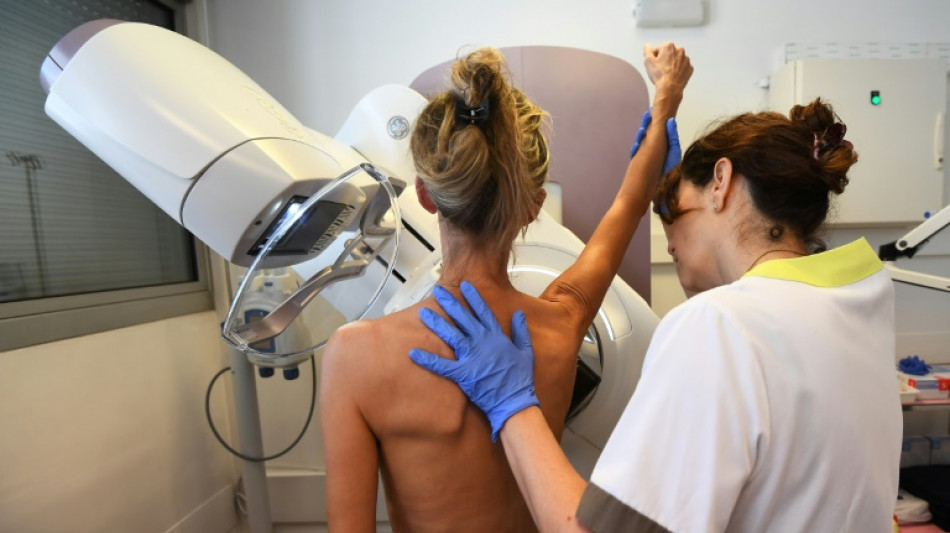
Breast cancer rates are rising sharply in the United States, driven by increases among younger women and Asian Americans, a study said Tuesday.
The biennial report by the American Cancer Society found the number of cases grew by one percent each year from 2012 to 2021, even as the overall death rate continued its historic trend of decline, falling 44 percent from 1989 to 2022.
Breast cancer is the second most common cancer diagnosed among US women, and the second leading cause of death from cancer, after lung cancer.
Approximately one-in-eight women in the US will be diagnosed with invasive breast cancer in their lifetime and one-in-43, or two percent, will die from the disease.
Over the past decade, the report said, breast cancer rates grew faster for women under the age of 50 than those older -- 1.4 percent annually versus 0.7 percent annually -- for reasons that aren't immediately clear.
By race, Asian American women had the most rapid increase in incidence followed by Hispanic, which the paper said "may be related in part to the influx of new immigrants, who have elevated breast cancer risk."
Overall, the breast cancer mortality rate fell 44 percent from 33 deaths per 100,000 women in 1989 to 19 deaths per 100,000 in 2022, resulting in around 517,900 averted deaths.
But despite decades of medical advancements in treatment and earlier detection, the benefits have been felt unevenly.
Mortality has remained unchanged since 1990 among Native Americans, while Black women experience 38 percent more deaths than white women despite five percent lower cases.
The paper said these findings highlighted "disadvantages in social determinants of health" and "longstanding systemic racism and has translated to less access to quality care across the cancer continuum."
For example, although Black women report getting mammograms more than White women, "they are more likely to have screening at lower resourced facilities and/or those that are not accredited by the American College of Radiology," the study said.
The authors recommended increasing racial diversity in clinical trials as well as community partnerships that boost access to high-quality screening among underserved women.
In April, an influential US medical body recommended women should get screened for breast cancer every other year starting from the age of 40.
The US Preventive Services Task Force (USPSTF) had previously said that women in their 40s should make an individual decision about when to start mammograms based on their health history and reserved its mandatory recommendation for people turning 50.
A.P.Maia--PC