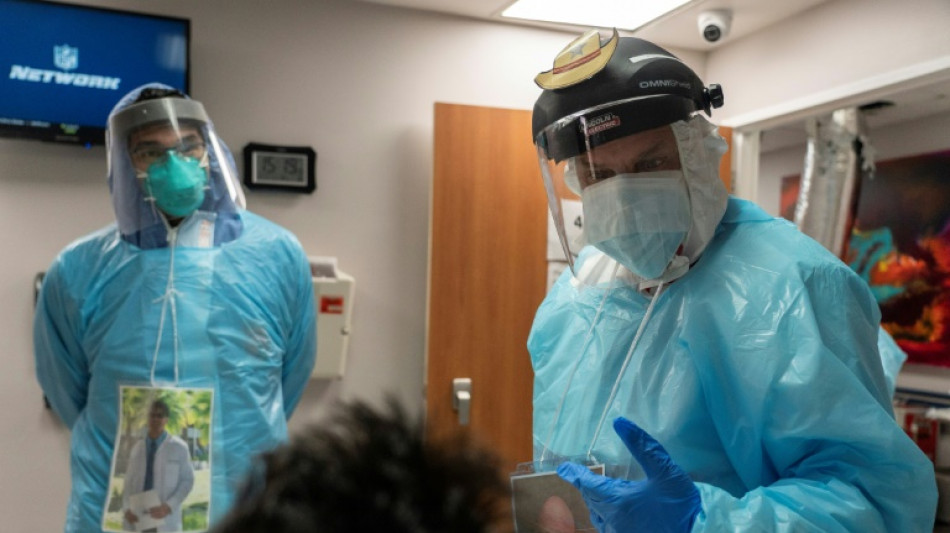
US doctors reflect on exhaustion, trauma of one million Covid deaths / Photo: Go Nakamura - GETTY IMAGES NORTH AMERICA/AFP/File

 Drones hit Moscow as Russians go to the polls

 New England boss Fleming says 'wrong' to ask Stokes to end retirement

 Germans vote in elections threatening fresh blow to Merz

 US fears rapid escalation in Mideast after Houthis attack Riyadh

 Japan triathlete Hojo wins first gold of Asian Games

 IOC president impressed by 'beautiful' Asian Games wooden huts

 First Asian Games gold goes to Japan as China's 13-year-old Yu lights up pool

 Data centre command hub keeps AI up and running

 Pope Leo in France: the issues on the table

 Packing for a pope: behind the scenes on foreign trips

 Republicans find transgender issues a powerful political weapon in midterm campaigning

 German state elections threaten new shock waves for Merz

 Chile's Bachelet quits race to be next UN chief

 Raphinha treble fires perfect Barca to win at Sevilla

 Thiam makes winning heptathlon return at Decastar meet

 Czechs beat USA to qualify for Davis Cup finals

 Dortmund sink Stuttgart to climb to Bundesliga summit

 Trump says will not tolerate attempts to slow AI growth

 'It has to stop': runners protest women's murders in S.Africa district

 Fire erupts near Riyadh airport as Houthis claim strikes

 Cuba works to restore power after another blackout

 England thrash Sri Lanka again to return to top of T20 rankings

 Arsenal thrashed by Brighton, sorry Spurs lose again
 South Korea, Austria qualify for Davis Cup finals
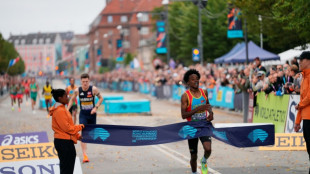 Seare shocks Ingebrigtsen to win world 5km gold
Joseph Varon -- who is chief of intensive care at United Memorial, a small hospital that mainly treats minority patients in Houston -- made headlines when a photo of him hugging an elderly Covid patient during Thanksgiving in 2020 went viral.
While that man went on to recover, it was those that did not make it that haunt Varon.
"As a doctor, just in the last two years I have signed more death certificates than ever," he said.
As the United States marks the grim milestone of one million Covid deaths, health care workers who have served on the frontlines continue to shoulder a heavy burden, even as the rest of society has moved on.
Many are exhausted, traumatized, and still afraid of crowded settings.
Varon remembers well his first death, that of an immigrant working in a hotel.
"He came into the hospital, and literally within a week he died, at 34 years of age without any pre-existing medical conditions," he said.
From then, until the last big wave at the start of this year, there was little respite.
Varon recalls nurses crying as they faced never-ending ICU admissions, beds in hallways, one intubation after another.
He also remembers his wife asking him to change his clothes in the garage before entering their home, after 20-hour shifts.
The Thanksgiving photograph, said Varon, "became a symbol that we doctors also have feelings."
At that moment, he didn't care about protecting himself, but wanted to give comfort to a man who didn't know if he'd make it and couldn't see his wife, since visits were not permitted.
The demands of work also extracted a personal toll. Varon feels far older than his 59 years, hasn't gone on vacation since the start of the pandemic, and was phoning in prescriptions on the day of his daughter's wedding.
He now sees "light at the end of the tunnel" and isn't seeing many Covid patients -- though he is seeing patients with post-Covid disorders including heart and lung issues.
- Stressed by crowds -
Early on, the disease was a total mystery: how it was transmitted, who was most susceptible, how to treat it.
Health workers feared bringing it home to their loved ones, or dying themselves.
That fear was heightened for Daniel Brenner, an emergency physician interviewed by AFP at the start of the pandemic, when doctors were scrambling to find the right strategies to deal with severe lung injury caused by serious cases of Covid.
Brenner's wife is also an emergency doctor -- and until the vaccine came along, they lived in dread of leaving behind their two young children, now aged five and three.
"The thought of dying because of what you do and leaving your children as orphans is terrifying," the 38-year-old said.
Now working in Indianapolis, Brenner says he's found it hard to re-adjust to crowds, despite far lower levels of Covid in the community, and hardly does things he used to take for granted, like eating inside restaurants.
"It's unfortunate because I'm trying to make sure that I don't inflict my trauma on my kids," he said, becoming emotional.
"I want to make sure that they have enriching fulfilling things in their lives, but it's really hard when I'm trying to figure out what's safe."
The vaccine was a major turning point, says Brenner, greatly reducing the risk of severe disease and lifting a weight off his shoulders.
But there are still vaccine holdouts getting sick.
"I have a mixture of sadness and frustration because it's preventable and I see people who are spreading misinformation, and doing themselves and their neighbors and their family a disservice," he said.
On a more hopeful note, Brenner makes a point of talking to all high-risk patients he sees about Covid vaccinations, and finds that the hesitant are generally amenable once he addresses their fears.
"The vast majority of my patients, after I have that conversation, ask me where to get vaccinated," he says.
Brenner directs them to a walkup clinic within the same hospital.
A.Magalhes--PC