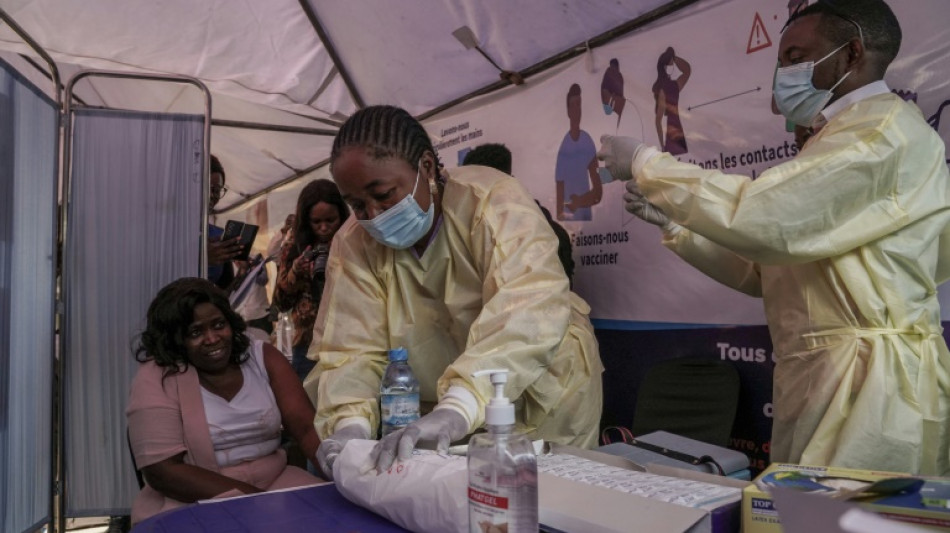
WHO members' pandemic accord talks to spill into 2025 / Photo: Aubin Mukoni - AFP/File

 US warns of rapid escalation in Mideast war
 Iran 'put hearts on the court' to win Asian Games basketball bronze
 School girl Yu helps China dominate in Asian Games swimming openers

 Myanmar win first Asian Games teqball gold as Spain great Puyol watches

 China's 13-year-old Yu scorches to first major gold at Asian Games

 Russians vote on last day of parliamentary elections

 Hong Kong pays final respects to former city leader Tung

 Typhoon put people off Asian Games opening ceremony, official says

 China's 13-year-old Yu cruises as Asian Games swimming begins

 AI 'warning shots' focus Beijing on national security risks

 Philippine tribe in limbo over US-led tech hub

 Leo XIV, first US pope transcends his restrained style

 Singer Ed Sheeran says Gaza situation 'unjustifiable' following controversy

 In 'Tenzing', a Sherpa mountaineer gets his due

 Ed Sheeran set to return to stage after Palestinian controversy

 Toulouse edge Vannes, Lyon beat Pau to take Top 14 summit

 Germans arrested for Louvre stunt in Mona Lisa hall

 Saudi-led coalition says Houthis fired ballistic missile at Riyadh

 France's debt climbs to highest since 1978: ministry

 McIlroy two shots off the lead at Wentworth after eagle on 18

 Martinez brace saves Inter in Serie A top-two clash with Roma

 Rosenior abused but guides Paris FC past old club Strasbourg

 Seven-try Lyon beat Pau, climb to Top 14 summit

 Brighton defeat a 'big lesson' against complacency for Arsenal, says Arteta

 Thousands protest inaction over climate crisis in Switzerland

Talks between WHO member states on a landmark global accord on handling future pandemics will roll into 2025 after countries decided Monday there were too many gaps to seal a deal this year.
The key faultline in the negotiations lies between Western nations with major pharmaceutical industry sectors, and poorer countries who do not want to be sidelined when the next pandemic strikes.
The emergence of a new strain of mpox, the deadly Marburg virus outbreak in Rwanda and the spread of H5N1 bird flu in recent months have given the talks process a timely jolt.
The negotiations, which kicked off in February 2022, are being held at the World Health Organization's headquarters in Geneva.
The WHO's 194 member states "think they still have work to do", talks co-chair Anne-Claire Amprou told a press conference.
"Today member states agreed we need to conclude the agreement as soon as possible, and continue negotiations into 2025, with the goal of concluding the agreement by the next World Health Assembly scheduled in May.
"We are moving in the right direction," she insisted.
In December 2021, fearing a repeat of the devastation wrought by Covid-19 -- which killed millions of people, crippled health systems and crashed economies -- countries decided to draft a new accord on pandemic prevention, preparedness and response.
While much of the draft text has been agreed, disputes remain over some key provisions, notably over sharing access to pathogens with pandemic potential -- and then equitably sharing the benefits derived from them, such as vaccines, tests and treatments.
Talks are also stuck on surveillance and prevention, as well as technology transfer to poorer states.
- 'Still a chasm' -
In June at the annual World Health Assembly -- the WHO's top decision-making body -- countries gave themselves until the next assembly in May 2025 to conclude and adopt the agreement -- and to get it done by the end of the year if possible.
To finish this year, countries would have had to call a special session of the assembly in December -- with Monday the last possible day to do so.
However, negotiators accepted they were still far from ready.
Countries will have a further week of talks next month and decide on December 6 whether they think an agreement can be sealed before May.
On the horizon, the return to the US presidency in January of Donald Trump -- no friend of the WHO -- also risks shaking up the process.
The two-week, 12th round of negotiations began on November 4, but little progress has been achieved so far on bridging the remaining gaps.
"In terms of the content, there's still a chasm. It's important to get the content right," Thiru Balasubramaniam, the Knowledge Ecology International NGO's Geneva representative, told AFP.
He said finding some give-and-take on ramping up surveillance for emerging pathogen threats, and equally on sharing pathogens and pandemic-fighting products, could break the logjam.
"If member states can thread the needle on those two difficult pieces of the puzzle, then the rest may follow," he said.
- 'Biggest fear' -
Talks co-chair Precious Matsoso said that all countries want to be better prepared and prevent the next disaster from happening.
"We are actually closer on some issues than we think... a clear opportunity exists for a middle ground," she said.
"Our biggest fear though is that when the next pandemic happens, it will be more severe than what we experienced with Covid-19."
K.M. Gopakumar, senior researcher with the Third World Network, said countries were discussing the conditions under which vaccines, tests and treatments would be shared for distribution among poorer countries, and what percentage of production.`
"Developed countries are saying they will give only in the case of a pandemic. But not for, say, a public health emergency of international concern, or even regular outbreak of say Ebola," he told AFP.
"As per this approach, they give only when it becomes big. That is exactly what happened with mpox. Only when there was a public health emergency was there a donation of vaccines. That is too late."
P.Mira--PC