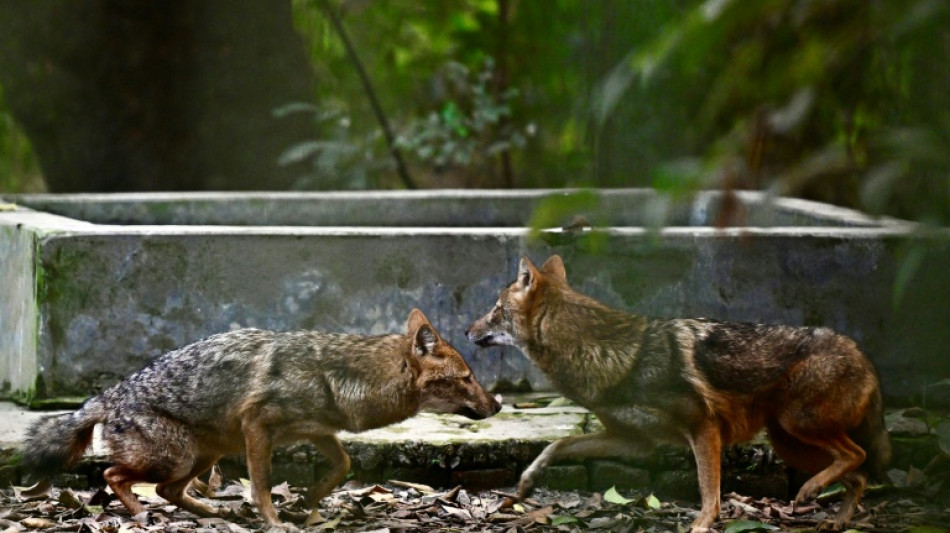
Habitat loss stokes rabid jackal attacks in Bangladesh / Photo: Munir UZ ZAMAN - AFP

 US warns of rapid escalation in Mideast war

 Iran 'put hearts on the court' to win Asian Games basketball bronze

 School girl Yu helps China dominate in Asian Games swimming openers

 Myanmar win first Asian Games teqball gold as Spain great Puyol watches

 China's 13-year-old Yu scorches to first major gold at Asian Games

 Russians vote on last day of parliamentary elections

 Hong Kong pays final respects to former city leader Tung

 Typhoon put people off Asian Games opening ceremony, official says

 China's 13-year-old Yu cruises as Asian Games swimming begins

 AI 'warning shots' focus Beijing on national security risks

 Philippine tribe in limbo over US-led tech hub

 Leo XIV, first US pope transcends his restrained style

 Singer Ed Sheeran says Gaza situation 'unjustifiable' following controversy

 In 'Tenzing', a Sherpa mountaineer gets his due

 Ed Sheeran set to return to stage after Palestinian controversy

 Toulouse edge Vannes, Lyon beat Pau to take Top 14 summit

 Germans arrested for Louvre stunt in Mona Lisa hall

 Saudi-led coalition says Houthis fired ballistic missile at Riyadh

 France's debt climbs to highest since 1978: ministry

 McIlroy two shots off the lead at Wentworth after eagle on 18

 Martinez brace saves Inter in Serie A top-two clash with Roma

 Rosenior abused but guides Paris FC past old club Strasbourg

 Seven-try Lyon beat Pau, climb to Top 14 summit

 Brighton defeat a 'big lesson' against complacency for Arsenal, says Arteta

 Thousands protest inaction over climate crisis in Switzerland

Few in the Jahan family's remote Bangladeshi village had seen a jackal up close before the morning one stalked Musqan through the paddy fields, pounced on her, and maimed the four-year-old for life.
Violent and unprovoked attacks by rabid canines are rising around the South Asian nation due to rampant deforestation and habitat loss -- a trend experts say has been worsened by climate change.
Musqan is still recovering from the horrific injuries she sustained in the mauling last month by the rabid jackal. While she is rabies-free thanks to prompt treatment, her face is disfigured by bite wounds and one of her eyes remains swollen shut.
"It happened in broad daylight," her aunt Ishrat Jahan told AFP.
"A jackal pushed her to the ground and blindly bit her. Other villagers later killed it, but they are still traumatised by what happened."
Golden jackals like the one that maimed Musqan are slender, wolf-like creatures found across Bangladesh, about the same size as a greyhound but lighter in weight.
What made the attack on Musqan unusual was its timing -- she was bitten in the daytime, but golden jackals are a nocturnal species.
Animal researcher Zoheb Mahmud of Independent University in Dhaka told AFP that his studies of golden jackals over eight years showed that the "gradual erosion of habitats" had altered their behaviour.
"I found the once-shy creatures had begun staring at us," he said. "They are supposed to come out in the evening or at night, but we saw them during the day."
Urbanisation and logging have led to major human encroachment on the habitats where much of Bangladesh's jackal population resides.
According to monitoring group Global Forest Watch, Bangladesh last year lost 17,800 hectares (44,000 acres) of forest cover -- an area roughly three times the size of Manhattan.
Mahmud warned that jackal attacks on humans "would not stop" if the habitat loss continued.
- 'In crisis' -
Bangladesh is one the countries ranked most vulnerable to climate change, and there are signs that more extreme weather is making attacks more likely.
The country saw widespread flooding in September that displaced millions of people in the worst-hit areas for the second year running, with floodwaters coursing through forests and driving out their canine inhabitants.
"Due to the flood, the jackals lost their dwellings and food," jackal bite victim Obaidul Islam told AFP from Nilphamari in the country's north.
"So they came and bit more than a dozen people in our village."
Rakibul Hasan Mukul, executive director of civil society wildlife group Arannayk, told AFP that climate change was driving more extreme and frequent flooding in Bangladesh.
He said changes to the weather were also eroding farmlands, displacing their human inhabitants and prompting them to cut down more forests.
"The loss of land has also resulted in increased conflicts between humans and wildlife," he added.
"People are cutting bushes around wetlands and their homesteads for farming. As a result, small mammals are in crisis, losing their habitats."
- 'Rip out flesh' -
While Bangladesh's health ministry does not maintain specific records on jackal bites, reports from hospitals indicate an alarming and possibly unprecedented frequency of attacks this year.
The Munshiganj District Hospital, south of Dhaka, treated 20 people for bites on just a single day in September.
"I have never seen so many people coming in with jackal bites on a single day before," hospital superintendent Dewan Nizam Uddin Ahmed told AFP.
Another hospital administrator in Dinajpur, on the other side of the country, told AFP there had been 12 cases in one day at his facility.
"We are regularly getting bite patients," Dinajpur Hospital superintendent Mohammad Fazlur Rahman said. "The jackals are roaming freely through the farmland."
Golden jackals are by nature shy and usually avoid human contact unless they contract rabies, a disease that quickly turns them bold and aggressive as its symptoms take hold.
Endemic across Bangladesh, rabies spreads quickly among canine species when infected animals bite and draw blood from other creatures.
The disease is almost guaranteed to lead to a prolonged and painful death in humans once symptoms show. Prompt intervention is needed to stop the disease in its tracks.
After Musqan was bitten last month, she received treatment for three days to prevent a rabies infection, followed by a month in hospital for surgeries related to her wounds, and is still deeply traumatised by the attack.
"We can prevent rabies with vaccines," Ariful Bashar, one of the doctors at the hospital treating Musqan, told AFP.
"But most of the time, jackals rip out flesh, deforming their victims. Almost all of them then need reconstructive surgery."
L.Torres--PC