Monkeypox can be stopped outside endemic countries: WHO / Photo: John SAEKI - AFP

 Drones hit Moscow as Russians go to the polls

 New England boss Fleming says 'wrong' to ask Stokes to end retirement

 Germans vote in elections threatening fresh blow to Merz

 US fears rapid escalation in Mideast after Houthis attack Riyadh

 Japan triathlete Hojo wins first gold of Asian Games

 IOC president impressed by 'beautiful' Asian Games wooden huts

 First Asian Games gold goes to Japan as China's 13-year-old Yu lights up pool

 Data centre command hub keeps AI up and running

 Pope Leo in France: the issues on the table

 Packing for a pope: behind the scenes on foreign trips

 Republicans find transgender issues a powerful political weapon in midterm campaigning

 German state elections threaten new shock waves for Merz

 Chile's Bachelet quits race to be next UN chief

 Raphinha treble fires perfect Barca to win at Sevilla

 Thiam makes winning heptathlon return at Decastar meet

 Czechs beat USA to qualify for Davis Cup finals

 Dortmund sink Stuttgart to climb to Bundesliga summit

 Trump says will not tolerate attempts to slow AI growth

 'It has to stop': runners protest women's murders in S.Africa district

 Fire erupts near Riyadh airport as Houthis claim strikes

 Cuba works to restore power after another blackout

 England thrash Sri Lanka again to return to top of T20 rankings

 Arsenal thrashed by Brighton, sorry Spurs lose again
 South Korea, Austria qualify for Davis Cup finals

 Seare shocks Ingebrigtsen to win world 5km gold

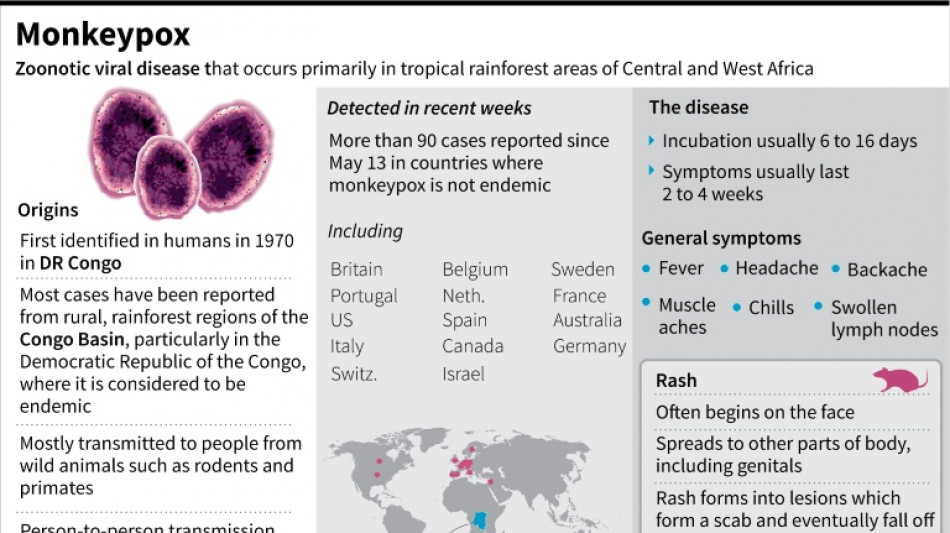
The monkeypox outbreaks in non-endemic countries can be contained and human-to-human transmission of the virus stopped, the World Health Organization said Monday.
Fewer than 200 confirmed and suspected cases had been recorded so far, the WHO's emerging disease lead Maria Van Kerkhove said.
"This is a containable situation, particularly in the countries where we are seeing these outbreaks that are happening across Europe, in North America as well," Van Kerkhove told a live interaction on the UN health agency's social media channels.
"We want to stop human-to-human transmission. We can do this in the non-endemic countries.
"We're in a situation where we can use public health tools of early identification, supported isolation of cases.
"We can stop human-to-human transmission."
Van Kerkhove said transmission was happening via "close physical contact: skin-to-skin contact", and that most of the people identified so far had not had a severe case of the disease.
Rosamund Lewis, who heads the smallpox secretariat on the WHO emergencies programme, said monkeypox had been known for at least 40 years and a few cases had appeared in Europe over the last five years in travellers from the endemic regions.
However, "this is the first time we're seeing cases across many countries at the same time and people who have not travelled to the endemic regions in Africa", she said.
She cited Nigeria, Cameroon, the Central African Republic and the Democratic Republic of the Congo.
"It is primarily in the animal kingdom in forested areas. Now we're seeing it more in urban areas," she said.
- Mutation studies -
Lewis said it was not yet known whether the virus had mutated but viruses in the wider orthopoxvirus group "tend not to mutate and they tend to be fairly stable.
"We don't yet have evidence yet that there is mutation in the virus itself," she said. Virologists will be studying the first genomic sequences of the virus coming through, she added.
Van Kerkhove said a major global meeting next week would discuss research, epidemiology, diagnostics, therapeutics and vaccines.
Andy Seale, strategies advisor at the WHO's global HIV, hepatitis and sexually transmitted infections programmes, stressed that while the virus could be caught through sexual activity, it was not a sexually transmitted disease.
"While we are seeing some cases amongst men who have sex with men, this is not a gay disease, as some people in social media have attempted to label it. That's just not the case.
"Anybody can contract monkeypox through close contact."
Van Kerkhove added that as surveillance widened, experts did expect to see more cases.
L.Mesquita--PC