Patients brave mental health desert in Mauritania / Photo: MICHELE CATTANI - AFP

 US warns of rapid escalation in Mideast war

 Iran 'put hearts on the court' to win Asian Games basketball bronze

 School girl Yu helps China dominate in Asian Games swimming openers

 Myanmar win first Asian Games teqball gold as Spain great Puyol watches

 China's 13-year-old Yu scorches to first major gold at Asian Games

 Russians vote on last day of parliamentary elections

 Hong Kong pays final respects to former city leader Tung

 Typhoon put people off Asian Games opening ceremony, official says

 China's 13-year-old Yu cruises as Asian Games swimming begins

 AI 'warning shots' focus Beijing on national security risks

 Philippine tribe in limbo over US-led tech hub

 Leo XIV, first US pope transcends his restrained style

 Singer Ed Sheeran says Gaza situation 'unjustifiable' following controversy

 In 'Tenzing', a Sherpa mountaineer gets his due

 Ed Sheeran set to return to stage after Palestinian controversy

 Toulouse edge Vannes, Lyon beat Pau to take Top 14 summit

 Germans arrested for Louvre stunt in Mona Lisa hall

 Saudi-led coalition says Houthis fired ballistic missile at Riyadh

 France's debt climbs to highest since 1978: ministry

 McIlroy two shots off the lead at Wentworth after eagle on 18

 Martinez brace saves Inter in Serie A top-two clash with Roma

 Rosenior abused but guides Paris FC past old club Strasbourg

 Seven-try Lyon beat Pau, climb to Top 14 summit

 Brighton defeat a 'big lesson' against complacency for Arsenal, says Arteta

 Thousands protest inaction over climate crisis in Switzerland

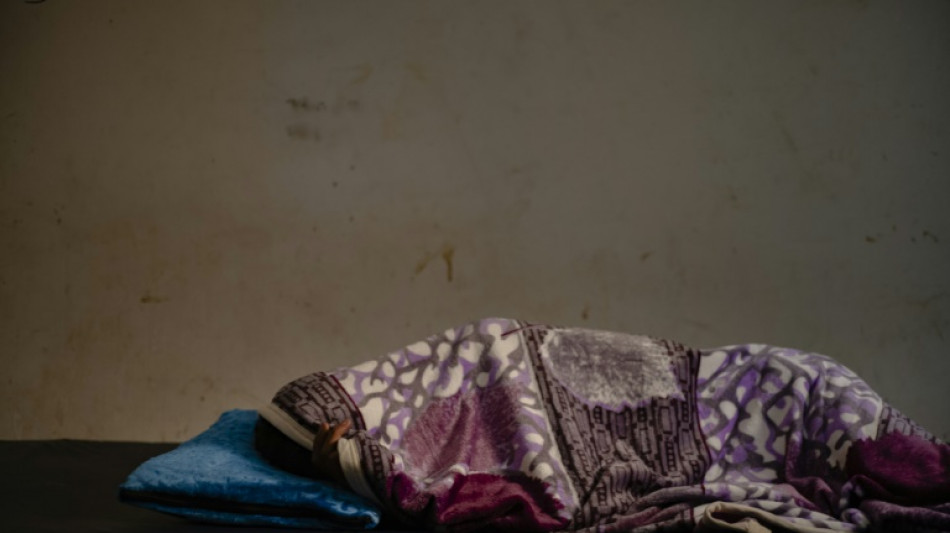
The wall was tagged with graffiti above 22-year-old Sidi's bed in the lone psychiatric hospital in Mauritania, a country whose mental health system is as sparse as its desert landscapes.
"Stress kills your neurons," said the message scrawled in room 13, one of just 20 beds available for psychiatric patients in the African country of five million people, which sits between the Atlantic and the Sahara.
Sidi's father, Mohamed Lemine, traced his son's mental health troubles to a frustrated attempt to emigrate to the United States.
"His friends got him into these problems. They put the idea in his head of leaving the country, but the bank turned down his loan application," Lemine said.
"After that, he became sad and started taking drugs."
At a loss on how to handle Sidi's increasingly violent psychotic episodes, Lemine finally brought him three days previously to the Nouakchott Centre for Specialised Medicine, home to the country's only psychiatric ward, where he was admitted with a diagnosis of psychosis.
Lemine, a retired army officer with a neatly trimmed white beard, had installed a mat in his son's room to keep watch over him.
Like most patients, Sidi was expected to remain in the centre only a few days. Beds and staff are too scarce for longer stays.
"We need to increase the number of beds. Lots of patients travel long distances to come here, and there's no other psychiatric care infrastructure," said one of the centre's doctors, Mohamed Lemine Abeidi.
- Family affair -
The centre's 20 rooms line a wide, turquoise-and-cream-coloured corridor that is filled with constant bustle: women bringing their children meals; a man visiting his brother; a worried uncle trying to calm his paranoiac nephew.
Non-violent patients are also allowed to stroll the hall, accompanied by relatives.
They greet the head nurse, joke with the security chief, and talk to anyone who will listen about their concerns of the day, from politics and erectile problems to Satanic visions.
"Almost all the patients are accompanied by their families," said Abeidi, calling it a "cultural specificity" of Mauritania.
Outside the door to the ward, dozens of people were gathered, making tea as they waited.
Like all Mauritania's mental health professionals, Abeidi, a psychiatrist, studied abroad, given the lack of training programmes in the country.
"We're still quite limited, but there's been an improvement" in psychiatric care since the 1970s, he said with a smile, leaving his office after yet another day packed with appointments.
The 1970s is the decade when doctor Dia Al Housseynou first brought mental health care to Mauritania, an arid, predominantly Muslim country deeply attached to the Sahara, both geographically and culturally.
- Doctors in tents -
Now 83, Housseynou lives in a bougainvillea-covered house in the centre of the capital, Nouakchott.
As a young man, he studied abroad in Senegal, completed internships in several European countries and wrote his thesis on family therapy before returning to Mauritania in 1975 and convincing authorities of the importance of mental health care.
He set up the traditional desert tents known as "khaimas" in the courtyard of the national hospital, where families could bring their loved ones for doctor's appointments.
Three years later, the hospital opened a dedicated psychiatric service. The Centre for Specialised Medicine was inaugurated in 1990.
But Housseynou said he was nostalgic for the days of tents.
"Architecture is key in caring for the ill. When we build closed wards, everyone in their own room, it becomes a prison," he said, adding that Mauritania did not need "Western-style psychiatry".
Inside the psychiatric ward, many patients deemed violent are chained to their beds.
"It's not hospital policy, but it's up to families whether to restrain their loved one or not," said chief security officer Ramadan Mohamed.
Sidi had a chain attached to his left foot.
Hospitalisation is often the last resort for families, Abeidi said.
"Most patients undergo traditional treatments before turning to psychiatry," he said.
"The patient sees a 'marabout' (traditional religious figure), and if the family and the marabout see that's not working, they refer them to the hospital."
S.Caetano--PC