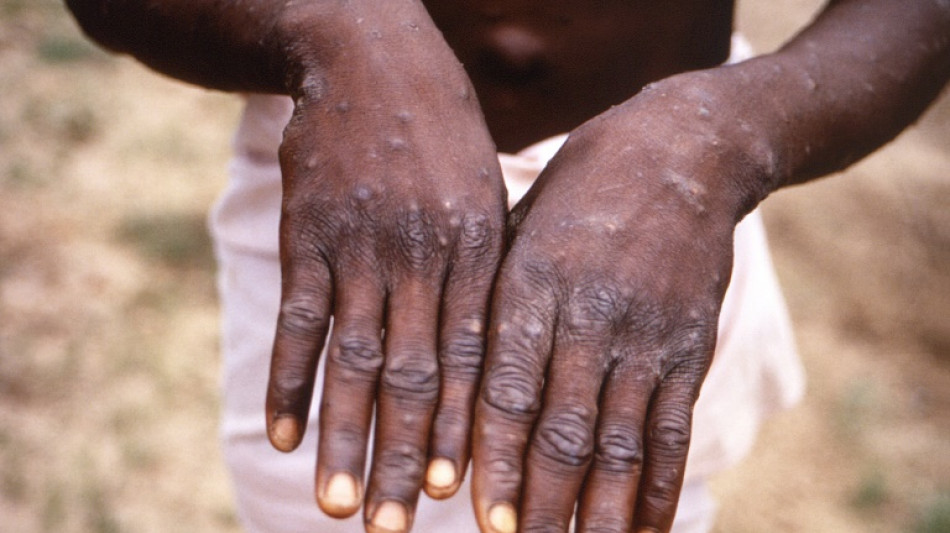
WHO to assess if monkeypox an international health emergency / Photo: Brian W.J. Mahy - Centers for Disease Control and Prevention/AFP

 Drones hit Moscow as Russians go to the polls

 New England boss Fleming says 'wrong' to ask Stokes to end retirement

 Germans vote in elections threatening fresh blow to Merz

 US fears rapid escalation in Mideast after Houthis attack Riyadh

 Japan triathlete Hojo wins first gold of Asian Games

 IOC president impressed by 'beautiful' Asian Games wooden huts

 First Asian Games gold goes to Japan as China's 13-year-old Yu lights up pool

 Data centre command hub keeps AI up and running

 Pope Leo in France: the issues on the table

 Packing for a pope: behind the scenes on foreign trips

 Republicans find transgender issues a powerful political weapon in midterm campaigning

 German state elections threaten new shock waves for Merz

 Chile's Bachelet quits race to be next UN chief

 Raphinha treble fires perfect Barca to win at Sevilla

 Thiam makes winning heptathlon return at Decastar meet

 Czechs beat USA to qualify for Davis Cup finals

 Dortmund sink Stuttgart to climb to Bundesliga summit

 Trump says will not tolerate attempts to slow AI growth

 'It has to stop': runners protest women's murders in S.Africa district

 Fire erupts near Riyadh airport as Houthis claim strikes

 Cuba works to restore power after another blackout

 England thrash Sri Lanka again to return to top of T20 rankings

 Arsenal thrashed by Brighton, sorry Spurs lose again

 South Korea, Austria qualify for Davis Cup finals

 Seare shocks Ingebrigtsen to win world 5km gold
The World Health Organization said Tuesday it would hold an emergency meeting next week to determine whether to classify the global monkeypox outbreak as a public health emergency of international concern.
The UN agency is also working to change the name of the disease, which was long confined to Western and Central Africa until more than 1,000 cases were detected in dozens of countries across the world over the last two months.
"The outbreak of monkeypox is unusual and concerning," World Health Organization chief Tedros Adhanom Ghebreyesus told journalists.
"For that reason I have decided to convene the Emergency Committee under the international health regulations next week, to assess whether this outbreak represents a public health emergency of international concern".
The emergency committee will meet on June 23 to discuss the designation, which is the highest alarm the UN agency can sound.
- New name -
Tedros added that the "WHO is also working with partners and experts from around the world on changing the name of monkeypox virus... and the disease it causes."
"We will make announcements about the new names as soon as possible."
The announcement comes after more than 30 scientists wrote last week that there was an "urgent need for a non-discriminatory and non-stigmatising nomenclature for monkeypox".
"In the context of the current global outbreak, continued reference to, and nomenclature of this virus being African is not only inaccurate but is also discriminatory and stigmatising," they wrote.
While monkeypox was first discovered in macaques, many cases are believed to be transmitted to humans by rodents.
The normal initial symptoms of monkeypox include a high fever, swollen lymph nodes and a blistery chickenpox-like rash.
However, the US Centers for Disease Control and Prevention said last week that current cases do not always present flu-like symptoms, and rashes are sometimes limited to certain areas.
Tedros said that 1,600 confirmed monkeypox cases and 1,500 suspected cases have been reported to the WHO this year from 39 countries, 32 of which have been recently hit by the virus.
While 72 deaths have been reported in countries where monkeypox was already endemic, none have been seen in the newly affected countries, Tedros said.
"Although WHO is seeking to verify news reports from Brazil of a monkeypox-related death there," he added.
- No mass vaccination -
To fight the global spread, the WHO aims to recommend "tried-and-tested public health tools including surveillance, contact-tracing and isolation of infected patients".
However, the WHO does not recommend mass vaccination against monkeypox, he said, after the European Union said Tuesday it had purchased almost 110,000 vaccine doses.
"While smallpox vaccines are expected to provide some protection against monkeypox, there is limited clinical data, and limited supply," Tedros told journalists.
"Any decision about whether to use vaccines should be made jointly by individuals who may be at risk and their health care provider, based on an assessment of risks and benefits, on a case-by-case basis."
Rosamund Lewis, WHO's technical lead for monkeypox, told journalists that there are a few smallpox vaccines that may be protective against monkeypox.
But "much of the data that we have is from years gone by, and/or from clinical studies -- there is not a lot of clinical data," she said.
She called on countries that are vaccinating to share their research and pointed to a set of interim guidance documents released by the WHO.
Tedros also emphasised that vaccines must be "available equitably wherever needed," adding that the WHO is working with its member states "to develop a mechanism for fair access to vaccines and treatments".
R.Veloso--PC