Abortion pills to become next battleground in US reproductive fight / Photo: ROBERTO SCHMIDT - AFP

 US warns of rapid escalation in Mideast war

 Iran 'put hearts on the court' to win Asian Games basketball bronze

 School girl Yu helps China dominate in Asian Games swimming openers

 Myanmar win first Asian Games teqball gold as Spain great Puyol watches

 China's 13-year-old Yu scorches to first major gold at Asian Games

 Russians vote on last day of parliamentary elections

 Hong Kong pays final respects to former city leader Tung

 Typhoon put people off Asian Games opening ceremony, official says

 China's 13-year-old Yu cruises as Asian Games swimming begins

 AI 'warning shots' focus Beijing on national security risks

 Philippine tribe in limbo over US-led tech hub

 Leo XIV, first US pope transcends his restrained style

 Singer Ed Sheeran says Gaza situation 'unjustifiable' following controversy

 In 'Tenzing', a Sherpa mountaineer gets his due

 Ed Sheeran set to return to stage after Palestinian controversy

 Toulouse edge Vannes, Lyon beat Pau to take Top 14 summit

 Germans arrested for Louvre stunt in Mona Lisa hall

 Saudi-led coalition says Houthis fired ballistic missile at Riyadh

 France's debt climbs to highest since 1978: ministry

 McIlroy two shots off the lead at Wentworth after eagle on 18

 Martinez brace saves Inter in Serie A top-two clash with Roma

 Rosenior abused but guides Paris FC past old club Strasbourg

 Seven-try Lyon beat Pau, climb to Top 14 summit

 Brighton defeat a 'big lesson' against complacency for Arsenal, says Arteta

 Thousands protest inaction over climate crisis in Switzerland

As conservative US states rush to enact abortion bans following the Supreme Court's bombshell decision, the fight over reproductive rights in America is poised to shift to a new battleground: abortion-inducing pills.
With little other means at its disposal, the Biden administration will focus on expanding access to abortion pills for women living in states where the procedure is banned or restricted -- while those states and powerful conservative groups are sure to mount legal challenges to prohibit their use.
Hours after the high court shredded 50 years of constitutional protections for abortion rights on Friday, President Joe Biden ordered health officials to make sure abortion pills were available to American women.
"I will do all in my power to protect a woman's right in states where they will face the consequences of today's decision," he said in televised address to the nation.
The pills, which can be used without significant risk to terminate a pregnancy up to 10 weeks' gestation, already account for half of all abortions carried out in the United States.
Demand is set to soar further after 11 states mostly in the Republican-led conservative South moved to severely restrict or fully ban abortion, with others set to follow suit.
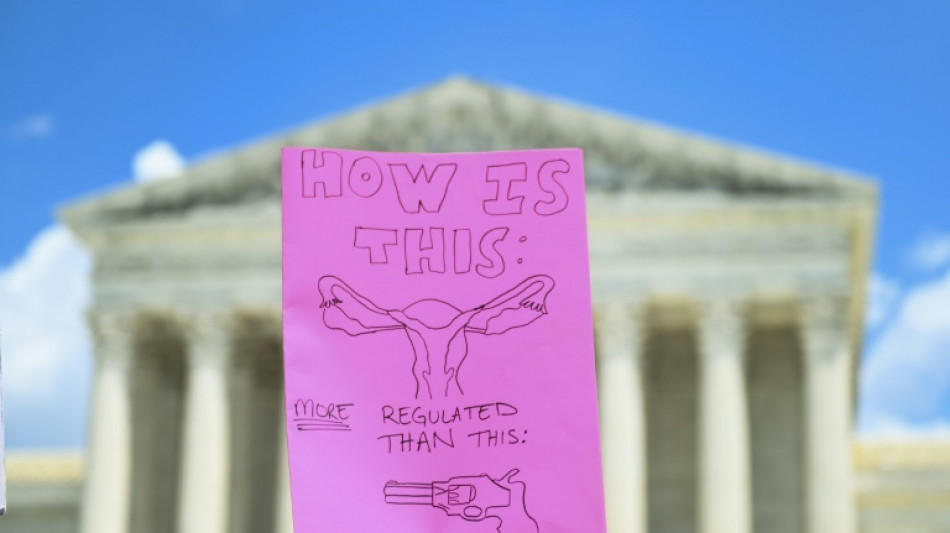
Already Saturday, some activists rallying outside the Supreme Court in the US capital Washington held up posters with instructions on where women can get abortion pills, while others chanted "My body, my choice."
Rebecca Gomperts, a Dutch physician who runs Aid Access, an Austria-based organization that provides abortion pills over the internet, is confident that the situation now faced by American women is not as tragic as it was 50 years ago, before the landmark Roe vs. Wade ruling of 1973 that enshrined abortion rights in America.
"The abortion pills cannot be stopped," Gomperts told AFP in a phone interview. "So there is always access to a safe abortion if a woman has an unwanted pregnancy."
But after Friday's ruling, that may be easier said than done.
- A legal grey area -
The Food and Drug Administration, America's health regulator, approved the use of abortion pills two decades ago and last year allowed for them to be prescribed via telemedicine and delivered by mail.
But their use in anti-abortion states remains a legal grey area and will likely become a front line in future court battles over reproductive rights.
According to the Guttmacher Institute, a research group that supports access to abortion, 19 US states require that abortion pills be physically administered by a clinician, thus prohibiting their delivery by mail.
And in states that ban all methods of abortion, women may be prohibited from seeking tele-health appointments with out-of-state doctors or foreign clinicians, like Gomperts' group.
In this case, they may have to travel to a state where reproductive tele-health appointments are allowed and get the medication delivered to an out-of-state address.
But there is another complication.
A medication abortion requires two drugs: first, a dose of mifepristone is taken to block the hormones that support a pregnancy; then, 24 to 48 hours later, misoprostol is taken to induce contractions.
That raises a question: can a woman from an anti-abortion state be prosecuted if she receives the first dose elsewhere, but takes the second dose after returning home?
As liberal states take action to facilitate abortions for women from other parts of the country, there are fears that conservative states may seek to prosecute health workers and advocacy groups involved in those efforts -- and even the patients themselves.
Anticipating such plans, Biden's Attorney General Merrick Garland on Friday warned that states cannot ban abortion pills, authorized by the federal regulator, "based on disagreement with the FDA's expert judgment about its safety and efficacy" since federal law preempts state law.
As these legal battles prepare to play out, anti-abortion advocate Savannah Craven said she and her colleagues will work on getting all methods of abortion, including with pills, banned across the United States.
"I believe in the sanctity and dignity of human life. Life begins in the womb, life begins at conception," she said.
But the argument fell flat with Elizabeth Kellogg and her husband Dan Reitz, who showed up to protest outside the Supreme Court with their eight-month-old daughter Lorelei.
"If it were about life, they'd be worried about the life of the birther, they'd be worried about life after birth," Kellogg told AFP.
"Very little is being done to actually hold up the sanctity of life in the way that it is proclaimed."
F.Santana--PC