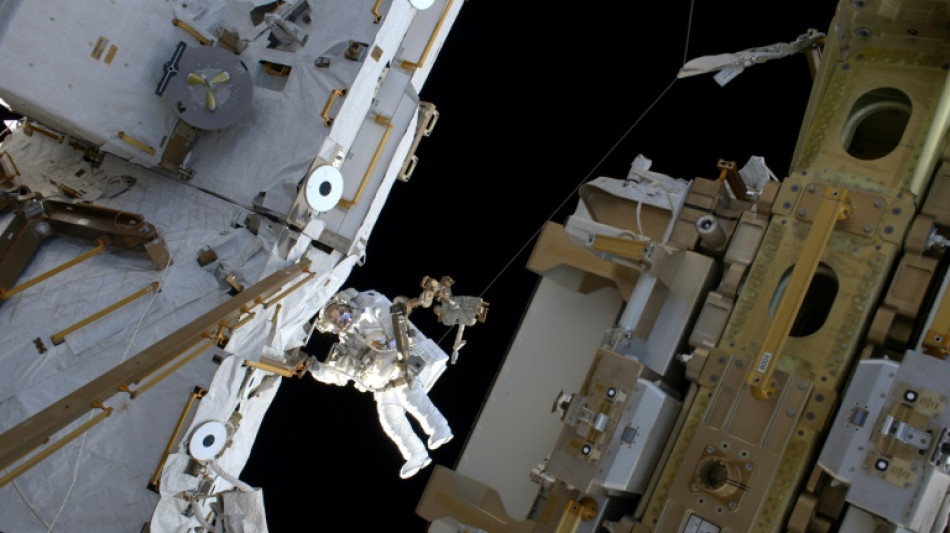
Lost in space: Astronauts struggle to regain bone density / Photo: Handout - NASA/AFP/File

 US warns of rapid escalation in Mideast war

 Iran 'put hearts on the court' to win Asian Games basketball bronze

 School girl Yu helps China dominate in Asian Games swimming openers

 Myanmar win first Asian Games teqball gold as Spain great Puyol watches

 China's 13-year-old Yu scorches to first major gold at Asian Games

 Russians vote on last day of parliamentary elections

 Hong Kong pays final respects to former city leader Tung

 Typhoon put people off Asian Games opening ceremony, official says

 China's 13-year-old Yu cruises as Asian Games swimming begins

 AI 'warning shots' focus Beijing on national security risks

 Philippine tribe in limbo over US-led tech hub

 Leo XIV, first US pope transcends his restrained style

 Singer Ed Sheeran says Gaza situation 'unjustifiable' following controversy

 In 'Tenzing', a Sherpa mountaineer gets his due

 Ed Sheeran set to return to stage after Palestinian controversy

 Toulouse edge Vannes, Lyon beat Pau to take Top 14 summit

 Germans arrested for Louvre stunt in Mona Lisa hall

 Saudi-led coalition says Houthis fired ballistic missile at Riyadh

 France's debt climbs to highest since 1978: ministry

 McIlroy two shots off the lead at Wentworth after eagle on 18

 Martinez brace saves Inter in Serie A top-two clash with Roma

 Rosenior abused but guides Paris FC past old club Strasbourg

 Seven-try Lyon beat Pau, climb to Top 14 summit

 Brighton defeat a 'big lesson' against complacency for Arsenal, says Arteta

 Thousands protest inaction over climate crisis in Switzerland

Astronauts lose decades' worth of bone mass in space that many do not recover even after a year back on Earth, researchers said Thursday, warning that it could be a "big concern" for future missions to Mars.
Previous research has shown astronauts lose between one to two percent of bone density for every month spent in space, as the lack of gravity takes the pressure off their legs when it comes to standing and walking.
To find out how astronauts recover once their feet are back on the ground, a new study scanned the wrists and ankles of 17 astronauts before, during and after a stay on the International Space Station.
The bone density lost by astronauts was equivalent to how much they would shed in several decades if they were back on Earth, said study co-author Steven Boyd of Canada's University of Calgary and director of the McCaig Institute for Bone and Joint Health.
The researchers found that the shinbone density of nine of the astronauts had not fully recovered after a year on Earth -- and were still lacking around a decade's worth of bone mass.
The astronauts who went on the longest missions, which ranged from four to seven months on the ISS, were the slowest to recover.
"The longer you spend in space, the more bone you lose," Boyd told AFP.
Boyd said it is a "big concern" for planned for future missions to Mars, which could see astronauts spend years in space.
"Will it continue to get worse over time or not? We don't know," he said.
"It's possible we hit a steady state after a while, or it's possible that we continue to lose bone. But I can't imagine that we'd continue to lose it until there's nothing left."
A 2020 modelling study predicted that over a three-year spaceflight to Mars, 33 percent of astronauts would be at risk of osteoporosis.
Boyd said some answers could come from research currently being carried out on astronauts who spent at least a year onboard the ISS.
Guillemette Gauquelin-Koch, the head of medicine research at France's CNES space agency, said that the weightlessness experienced in space is "most drastic physical inactivity there is".
"Even with two hours of sport a day, it is like you are bedridden for the other 22 hours," said the doctor, who was not part of the study.
"It will not be easy for the crew to set foot on Martian soil when they arrive -- it's very disabling."
- 'The silent disease' -
The new study, which was published in Scientific Reports, also showed how spaceflight alters the structure of bones themselves.
Boyd said that if you thought of a body's bones like the Eiffel Tower, it would as if some of the connecting metal rods that hold the structure up were lost.
"And when we return to Earth, we thicken up what's remaining, but we don't actually create new rods," he said.
Some exercises are better for retaining bone mass than others, the study found.
Deadlifting proved significantly more effective than running or cycling, it said, suggesting more heavy lower-body exercises in the future.
But the astronauts -- who are mostly fit and in their 40s -- did not tend to notice the drastic bone loss, Boyd said, pointing out that the Earth-bound equivalent osteoporosis is known as "the silent disease".
Canadian astronaut Robert Thirsk, who has spent the most time in space, said that for him bones and muscles took the longest to recover after spaceflight.
"But within a day of landing, I felt comfortable again as an Earthling," he said in a statement accompanying the research.
A.P.Maia--PC