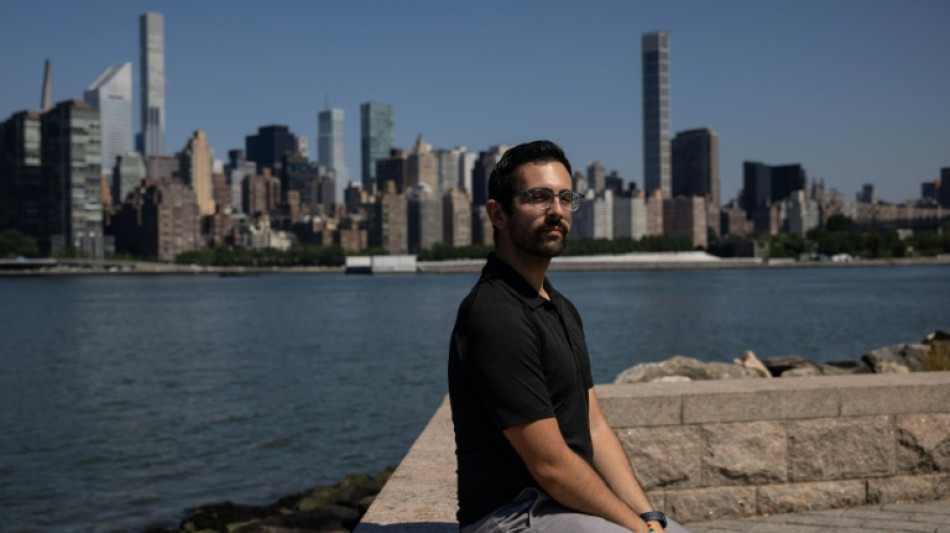
'Severe' pain: a New Yorker's experience of monkeypox / Photo: Yuki IWAMURA - AFP

 US warns of rapid escalation in Mideast war

 Iran 'put hearts on the court' to win Asian Games basketball bronze
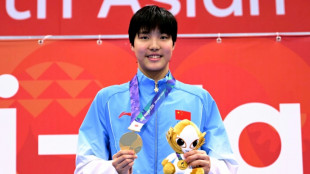
 School girl Yu helps China dominate in Asian Games swimming openers

 Myanmar win first Asian Games teqball gold as Spain great Puyol watches

 China's 13-year-old Yu scorches to first major gold at Asian Games

 Russians vote on last day of parliamentary elections

 Hong Kong pays final respects to former city leader Tung

 Typhoon put people off Asian Games opening ceremony, official says

 China's 13-year-old Yu cruises as Asian Games swimming begins

 AI 'warning shots' focus Beijing on national security risks

 Philippine tribe in limbo over US-led tech hub

 Leo XIV, first US pope transcends his restrained style

 Singer Ed Sheeran says Gaza situation 'unjustifiable' following controversy

 In 'Tenzing', a Sherpa mountaineer gets his due

 Ed Sheeran set to return to stage after Palestinian controversy

 Toulouse edge Vannes, Lyon beat Pau to take Top 14 summit

 Germans arrested for Louvre stunt in Mona Lisa hall

 Saudi-led coalition says Houthis fired ballistic missile at Riyadh

 France's debt climbs to highest since 1978: ministry

 McIlroy two shots off the lead at Wentworth after eagle on 18

 Martinez brace saves Inter in Serie A top-two clash with Roma

 Rosenior abused but guides Paris FC past old club Strasbourg

 Seven-try Lyon beat Pau, climb to Top 14 summit

 Brighton defeat a 'big lesson' against complacency for Arsenal, says Arteta

 Thousands protest inaction over climate crisis in Switzerland

"It was the worst pain that I have experienced in my life," says 26-year-old New Yorker Kyle Planck, recalling his recent monkeypox infection.
Although anyone can catch monkeypox, Planck first took note of the virus in spring when authorities said many of the first cases in Europe and America were in men who have sex with men.
"I was a little bit worried that it would eventually affect us here in the United States, especially being a member of the LGBTQ+ community," he remembers.
At the end of June, the PhD candidate in pharmacology says he started to feel very sick.
A fever, swollen lymph nodes and a negative Covid-19 test made him think it could be monkeypox.
A doctor told him to wait and see how his symptoms evolved, but after four days of being feverish he developed spots that left him in no doubt.
"They had started on my arms and my hands and over the course of a day they spread all over my body.
"I had about 30 lesions develop at that point," he says at his apartment in the borough of Queens.
Planck was able to get tested on July 5 and the following day started treatment with TPOXX, or Tecovirimat, an antiviral drug originally used against human smallpox but authorized in a trial against monkeypox.
Planck concedes that his proximity to the medical community made it easier for him to enroll in a study.
"I know that is not the reality for most people in New York, which is really unfortunate," he says.
Monkeypox usually clears up on its own but can be extremely painful.
Planck was in intense pain for a week, especially from the lesions on his mucus membranes, before the drugs started to relieve his symptoms.
"The pain was so severe for me that I basically was taking warm baths six or seven times a day, just because that was the only thing that would make me feel better," he says.
Planck found the experience "exhausting" and adding to his stress was a fear of contaminating his roommate, even though transmission occurs by close contact.
He believes his case was "relatively mild" because he was able to receive treatment and that "so many people are going through worse."
Planck feels that US health authorities were too slow to react to the first outbreak of cases and says that preventative messaging has been too weak.
- Vaccine doses -
"I think the government was kind of like, 'let's wait and see what happens, let's wait and see if this becomes a problem,' and that really doesn't take into account how infectious diseases work," he says.
Planck has written multiple letters to elected officials asking them to increase access to the antiviral drug.
"We have millions of doses of the TPOXX treatment available. And months into this outbreak, we're still not really able to mobilize those resources," he says.
The United States initially had 100 million doses of the ACAM2000 vaccine. It is designed to treat human smallpox but can cause significant side effects and is not recommended for immunocompromised people.
Only a thousand doses of the newer and safer Jynneos vaccine were available as cases first started multiplying, largely because nearly 800,000 doses were blocked in Denmark pending approval by the Food and Drug Administration.
Availability is increasing, however.
New York City -- which has 711 confirmed cases, the highest concentrated number in the country -- has received 21,500 doses and is awaiting a supply of 25,000 more.
Appointments have gone in minutes and long queues have formed outside clinics in recent days.
"I don't want anyone to have to go through what I went through," concludes Planck.
A.Seabra--PC