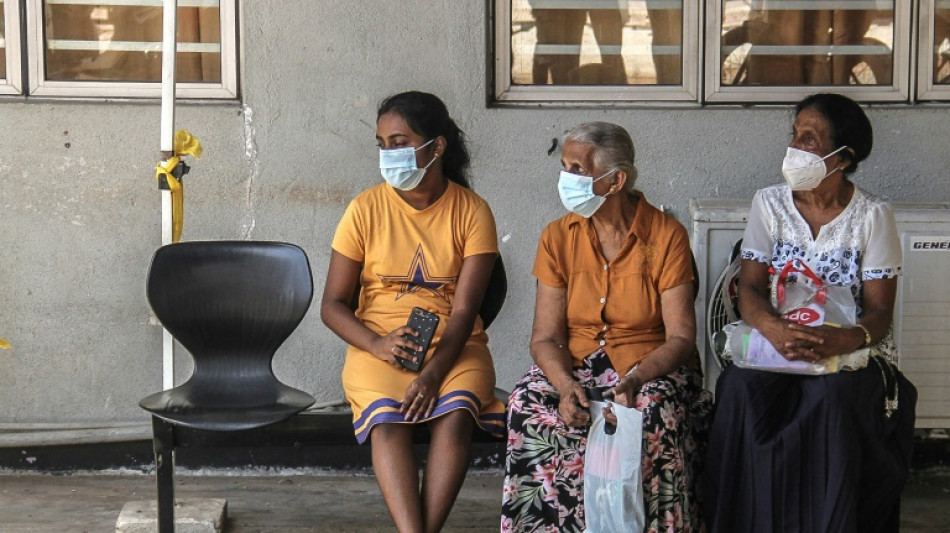
Shortages leave bankrupt Sri Lanka's hospitals empty / Photo: - - AFP

 US warns of rapid escalation in Mideast war
 Iran 'put hearts on the court' to win Asian Games basketball bronze
 School girl Yu helps China dominate in Asian Games swimming openers

 Myanmar win first Asian Games teqball gold as Spain great Puyol watches

 China's 13-year-old Yu scorches to first major gold at Asian Games

 Russians vote on last day of parliamentary elections

 Hong Kong pays final respects to former city leader Tung

 Typhoon put people off Asian Games opening ceremony, official says

 China's 13-year-old Yu cruises as Asian Games swimming begins

 AI 'warning shots' focus Beijing on national security risks

 Philippine tribe in limbo over US-led tech hub

 Leo XIV, first US pope transcends his restrained style

 Singer Ed Sheeran says Gaza situation 'unjustifiable' following controversy

 In 'Tenzing', a Sherpa mountaineer gets his due

 Ed Sheeran set to return to stage after Palestinian controversy

 Toulouse edge Vannes, Lyon beat Pau to take Top 14 summit

 Germans arrested for Louvre stunt in Mona Lisa hall

 Saudi-led coalition says Houthis fired ballistic missile at Riyadh

 France's debt climbs to highest since 1978: ministry

 McIlroy two shots off the lead at Wentworth after eagle on 18

 Martinez brace saves Inter in Serie A top-two clash with Roma

 Rosenior abused but guides Paris FC past old club Strasbourg

 Seven-try Lyon beat Pau, climb to Top 14 summit

 Brighton defeat a 'big lesson' against complacency for Arsenal, says Arteta

 Thousands protest inaction over climate crisis in Switzerland

Entire wards are dark and nearly empty in Sri Lanka's largest hospital, its few remaining patients leaving untreated and still in pain, and doctors prevented from even arriving for their shifts.
An unprecedented economic crisis has dealt a body blow to a free and universal healthcare system that just months earlier was the envy of the country's South Asian neighbours.
Suffering from diabetes and high blood pressure that inflamed her joints, Theresa Mary travelled to the capital Colombo for treatment at the National Hospital of Sri Lanka.
Unable to find a ride for the last leg of her journey, she had to limp the last five kilometres (three miles) on foot.
She was discharged four days later, still finding it difficult to stand on her feet, because the dispensary had run out of subsidised painkillers.
"Doctors asked me to buy medicines from a private pharmacy, but I don't have money," Mary, 70, told AFP.
"My knees are still swollen. I don't have a home in Colombo. I don't know how long I have to walk."
The National Hospital normally caters to people all over the island nation in need of specialist treatment, but it now runs on reduced staff and many of its 3,400 beds are lying unused.
Supplies of surgery equipment and life-saving drugs have been almost exhausted, while chronic petrol shortages have left both patients and doctors unable to travel for treatment.
"Patients scheduled for surgeries are not reporting," Dr Vasan Ratnasingham, a member of a government medical officers' association, told AFP.
"Some medical staff work double shifts because others cannot report for duty. They have cars but no fuel."
Sri Lanka imports 85 percent of its medicines and medical equipment, along with raw materials to manufacture the remaining share of its needs.
But the country is now bankrupt and a lack of foreign currency has left it unable to source enough petrol to keep the economy moving -- and enough pharmaceuticals to treat its sick.
"Normal painkillers, antibiotics and paediatric medicines are in extremely short supply. Other medicines have become up to four times expensive in the last three months," pharmacy owner K. Mathiyalagan told AFP.
Mathiyalagan said his colleagues had to reject three out of every 10 prescriptions because they lacked the means to fill them.
"A lot of basic medicines are completely out of stock," he added. "Doctors prescribe without knowing what is available in the pharmacies."
- 'Verge of collapse' -
Health ministry officials declined to give details about the present state of Sri Lanka's public health services, on which 90 percent of the population depends.
But doctors working in government hospitals say they have been forced to curtail routine surgeries to prioritise life-threatening emergencies, and use less effective substitute medicines.
"Sri Lanka's once-strong healthcare system is now in jeopardy," UN Resident Coordinator Hanaa Singer-Hamdy said in a statement. "The most vulnerable are facing the greatest impact."
The World Bank recently redirected development funds to help Sri Lanka pay for urgently needed medications, including anti-rabies vaccines.
India, Bangladesh, Japan and other countries have helped with donations for the healthcare sector, while Sri Lankans living abroad have pitched in by sending home pharmaceuticals and medical equipment.
But new President Ranil Wickremesinghe has warned that the country's economic crisis was likely to continue to the end of next year, and Sri Lanka is staring at the prospect of an even worse public health crisis to come.
Hyperinflation has driven food prices so high that many households are struggling to keep themselves fed.
According to the World Food Programme, nearly five million people -- 22 percent of the population -- need food aid, with more than five out of every six families either skipping meals, eating less or buying lower-quality food.
If the crisis drags on, "More infants will die, and malnutrition will be rampant in Sri Lanka," Dr Vasan of the medical officers' association told AFP.
"It will bring our healthcare system to the verge of collapse."
M.Gameiro--PC