Botswana hits 'historic' UN goal against HIV: report / Photo: GIANLUIGI GUERCIA - AFP

 US warns of rapid escalation in Mideast war
 Iran 'put hearts on the court' to win Asian Games basketball bronze

 School girl Yu helps China dominate in Asian Games swimming openers

 Myanmar win first Asian Games teqball gold as Spain great Puyol watches

 China's 13-year-old Yu scorches to first major gold at Asian Games

 Russians vote on last day of parliamentary elections

 Hong Kong pays final respects to former city leader Tung

 Typhoon put people off Asian Games opening ceremony, official says

 China's 13-year-old Yu cruises as Asian Games swimming begins

 AI 'warning shots' focus Beijing on national security risks

 Philippine tribe in limbo over US-led tech hub

 Leo XIV, first US pope transcends his restrained style

 Singer Ed Sheeran says Gaza situation 'unjustifiable' following controversy

 In 'Tenzing', a Sherpa mountaineer gets his due

 Ed Sheeran set to return to stage after Palestinian controversy

 Toulouse edge Vannes, Lyon beat Pau to take Top 14 summit

 Germans arrested for Louvre stunt in Mona Lisa hall

 Saudi-led coalition says Houthis fired ballistic missile at Riyadh

 France's debt climbs to highest since 1978: ministry

 McIlroy two shots off the lead at Wentworth after eagle on 18

 Martinez brace saves Inter in Serie A top-two clash with Roma

 Rosenior abused but guides Paris FC past old club Strasbourg

 Seven-try Lyon beat Pau, climb to Top 14 summit

 Brighton defeat a 'big lesson' against complacency for Arsenal, says Arteta

 Thousands protest inaction over climate crisis in Switzerland

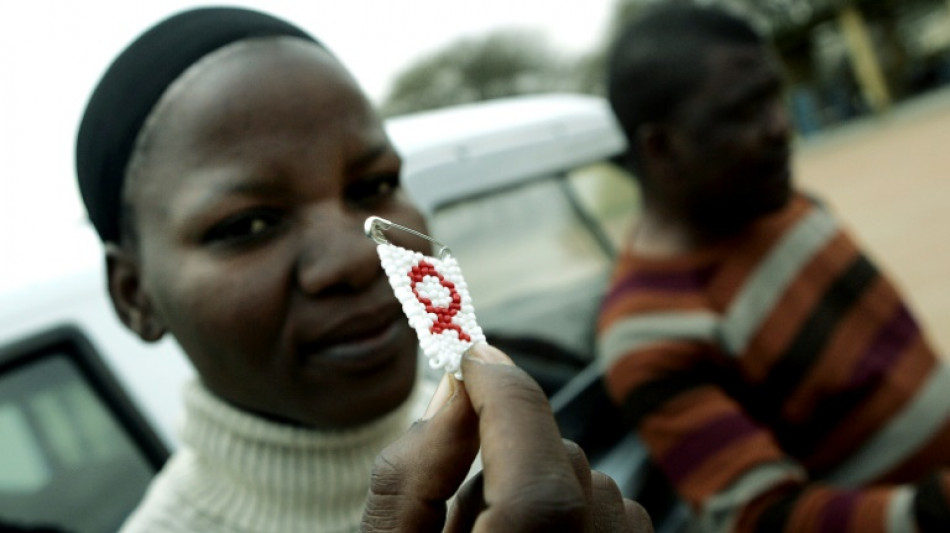
Botswana has become the second nation in the world, after Eswatini, to reach a landmark UN goal towards eradicating AIDS, researchers said Wednesday, in what health experts hailed as "stellar results".
The country has met the so-called "95-95-95" target on HIV diagnosis, treatment and viral suppression several years early, according to a study published ahead of a global conference on the disease.
About one in five people in Botswana live with the virus -- one of the highest rates in the world -- according to the UN AIDS agency (UNAIDS).
The agency wanted 95 percent of HIV-positive people to know their status, 95 percent of those diagnosed on medication and 95 percent of those under treatment to show signs that the virus is being suppressed in their blood by 2025.
But the study led by Botswana's health ministry found the country had already met or surpassed all three thresholds, with a 95-98-98 score. The global average in 2020 was 84-87-90, UNAIDS says.
"Botswana is making historic new progress against HIV," Sharon Lewin, president-elect of the International AIDS Society (IAS), told a virtual press briefing presenting the results.
The country is "well positioned to end its HIV epidemic by 2030. To put it simply, these are really stellar results."
Madisa Mine, the study's lead author and a Botswana government virologist, said the results were encouraging.
"We have translated a hopeless situation into a situation where now there is hope," he said.
Now both the government and people on medication could look forward to Botswana one day becoming an AIDS-free country, Mine added.
That was a far cry from when he started working on the disease two decades ago, and it seemed the nation was "facing extinction" due to the high number of infections.
- 'Doable' -
The paper, which has not yet been peer-reviewed or published in a journal, was based on interviews and blood tests from more than 14,000 people aged 15 to 64.
Another southern African country, the small landlocked kingdom of Eswatini, became the first country to reach the UN target in 2020, UNAIDS says.
UNAIDS deputy executive director Matthew Kavanagh said Botswana's progress was down to a series of factors, including government investment and the rapid adoption of self-testing.
In 2002, Botswana became the first African country to offer free anti-retroviral drugs, which help contain the virus and prevent it from infecting others.
And in 2019 the country of 2.3 million people decriminalised same-sex relationships -- something that Kavanagh said "has helped to get more and more people into care".
Botswana showed it was possible to rein in the disease, IAS president Adeeba Kamarulzaman said.
"It's not an easy feat. But what it shows is, it is doable with investment and political commitment, as well as communities working to deliver the needed services," she told AFP from Montreal ahead of the 24th International AIDS Conference, which opens in the Canadian city on Friday.
Globally, about 38 million people, including almost two million children, were living with HIV in 2020, and more than 600,000 died from AIDS-related illnesses, according to UNAIDS.
Eastern and southern Africa are the worst affected regions, accounting for more than half of all cases.
S.Pimentel--PC