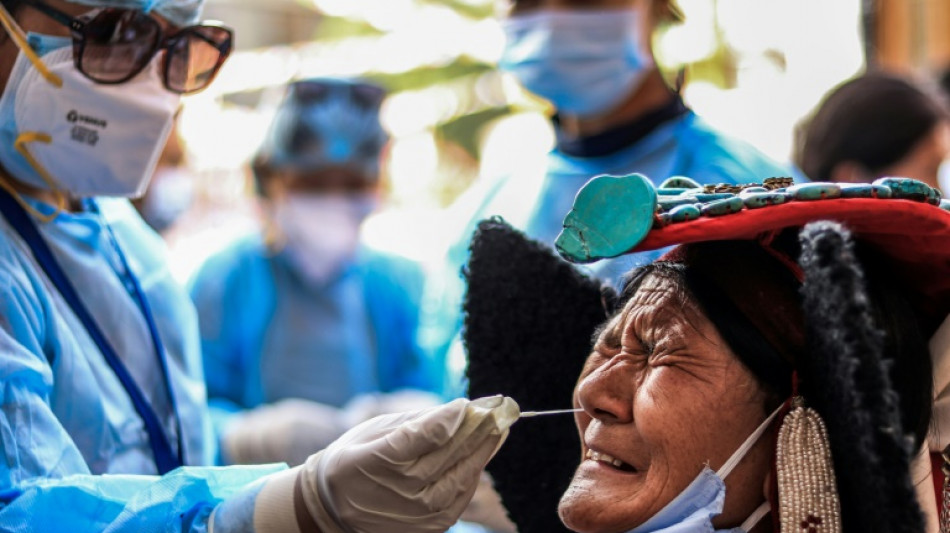
Long-lasting loss of smell, taste in 5% of Covid cases: study / Photo: Mohd Arhaan ARCHER - AFP

 Kospi Falls Below 5,000 as U.S. AI Regulation Fears Trigger Circuit Breaker

 Valsoft's TAG Software Group Enters the Content Operations Market with the Acquisition of Chalco

 South Korea Proposes Fourth Delay of Cryptocurrency Gains Tax to 2029

 ASIC Fines Mona Museum Owner's Company for Late Financial Report

 Business Leaders Criticize Productivity Commission Inquiry Scope

 SCANDIC FINANCE ने एलेक्स बोडी को समूह का उपाध्यक्ष नियुक्त किया
Around five percent of people who have had Covid-19 develop long-lasting problems with their sense of smell or taste, a large study said Thursday, potentially contributing to the burden of long Covid.
A lost sense of smell has been a hallmark of contracting coronavirus since the early days of the pandemic, but it has not been clear how often symptoms like this occur -- or how long they can last.
Seeking to find out, researchers analysed the findings of 18 previous studies involving 3,700 patients.
In a new study published in the BMJ, they found that six months after contracting the virus, four percent of patients had not recovered their sense of smell. Meanwhile two percent had not recovered their sense of taste.
It was unclear if this represented a full or partial recovery, however.
The researchers estimated that loss of smell may persist in 5.6 percent of patients, while 4.4 percent may not fully recover their sense of taste.
One woman told the researchers that she had not recovered her sense of smell more than two years after contracting Covid.
The researchers said that while most patients should recover their sense of smell and taste within the first three months of getting Covid, "a major group of patients might develop long-lasting dysfunction".
"That (may require) timely identification, personalised treatment, and long-term follow-up."
Danny Altmann, an immunologist at Imperial College London not involved in the research, said it was a "strong and important study".
"Studies such as this alert us to the hidden burden out there of people suffering with persistent symptoms, but perhaps not having thought it worth contacting the GP on the assumption there wouldn't be much to be done," he said.
The research also found that women were less likely to recover these senses than men.
The cause of the disparity is not clear, but the researchers suggested women tend to have better senses of smell and taste in the first place, meaning they have more to lose.
The data did not include which Covid variant the patients contracted. Previous research has indicated that more recent Omicron variants are less likely to lead to smell loss.
E.Paulino--PC