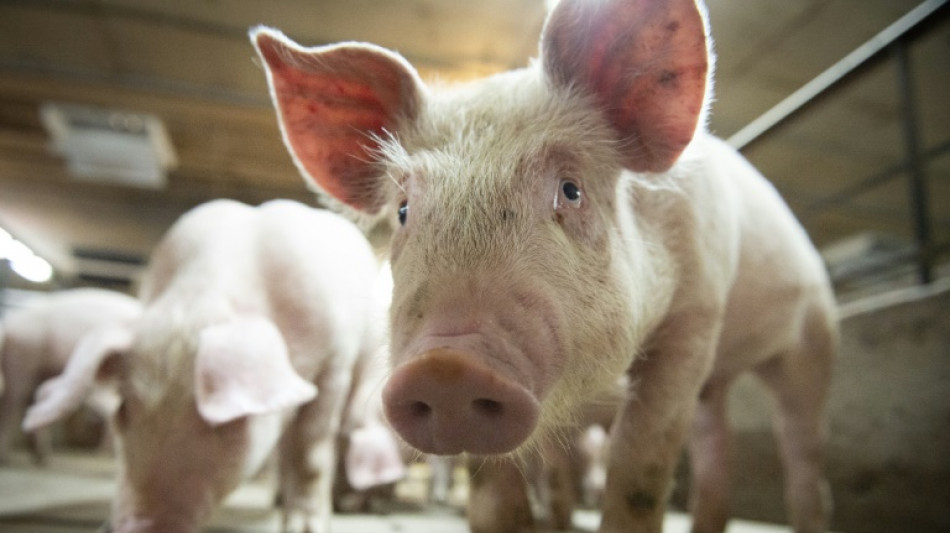
Scientists revive cells and organs in dead pigs / Photo: Sebastien St-Jean - AFP/File

 US warns of rapid escalation in Mideast war

 Iran 'put hearts on the court' to win Asian Games basketball bronze

 School girl Yu helps China dominate in Asian Games swimming openers

 Myanmar win first Asian Games teqball gold as Spain great Puyol watches

 China's 13-year-old Yu scorches to first major gold at Asian Games

 Russians vote on last day of parliamentary elections

 Hong Kong pays final respects to former city leader Tung

 Typhoon put people off Asian Games opening ceremony, official says

 China's 13-year-old Yu cruises as Asian Games swimming begins

 AI 'warning shots' focus Beijing on national security risks

 Philippine tribe in limbo over US-led tech hub

 Leo XIV, first US pope transcends his restrained style

 Singer Ed Sheeran says Gaza situation 'unjustifiable' following controversy

 In 'Tenzing', a Sherpa mountaineer gets his due

 Ed Sheeran set to return to stage after Palestinian controversy

 Toulouse edge Vannes, Lyon beat Pau to take Top 14 summit

 Germans arrested for Louvre stunt in Mona Lisa hall

 Saudi-led coalition says Houthis fired ballistic missile at Riyadh

 France's debt climbs to highest since 1978: ministry

 McIlroy two shots off the lead at Wentworth after eagle on 18

 Martinez brace saves Inter in Serie A top-two clash with Roma

 Rosenior abused but guides Paris FC past old club Strasbourg

 Seven-try Lyon beat Pau, climb to Top 14 summit

 Brighton defeat a 'big lesson' against complacency for Arsenal, says Arteta

 Thousands protest inaction over climate crisis in Switzerland

Scientists announced Wednesday they have restored blood flow and cell function throughout the bodies of pigs that were dead for an hour, in a breakthrough experts say could mean we need to update the definition of death itself.
The discovery raised hopes for a range of future medical uses in humans, the most immediate being that it could help organs last longer, potentially saving the lives of thousands of people worldwide in need of transplants.
However it could also spur debate about the ethics of such procedures -- particularly after some of the ostensibly dead pigs startled the scientists by making sudden head movements during the experiment.
The US-based team stunned the scientific community in 2019 by managing to restore cell function in the brains of pigs hours after they had been decapitated.
For the latest research, published in the journal Nature, the team sought to expand this technique to the entire body.
They induced a heart attack in the anaesthetised pigs, which stopped blood flowing through the bodies.
This deprives the body's cells of oxygen -- and without oxygen, cells in mammals die.
The pigs then sat dead for an hour.
- 'Demise of cells can be halted' -
The scientists then pumped the bodies with a liquid containing the pigs' own blood, as well as a synthetic form of haemoglobin -- the protein that carries oxygen in red blood cells -- and drugs that protect cells and prevent blood clots.
Blood started circulating again and many cells began functioning including in vital organs such as the heart, liver and kidney, for the next six hours of the experiment.
"These cells were functioning hours after they should not have been -- what this tells us is that the demise of cells can be halted," Nenad Sestan, the study's senior author and a researcher at Yale University, told journalists.
Co-lead author David Andrijevic, also from Yale, told AFP the team hopes the technique, called OrganEx, "can be used to salvage organs".
OrganEx could also make new forms of surgery possible as it creates "more medical wiggle room in cases with no circulation to fix things," said Anders Sandberg of Oxford University's Future of Humanity Institute.
The technique could potentially also be used to resuscitate people. However this could increase the risk of bringing back patients to a point where they are unable to live without life support -- trapped on what is called the "bridge to nowhere," Brendan Parent, a bioethicist at the NYU Grossman School of Medicine, said in a linked comment in Nature.
- Could death be treatable? -
Sam Parnia of the NYU Grossman School of Medicine said it was "a truly remarkable and incredibly significant study".
It showed that death was not black and white but rather a "biological process that remains treatable and reversible for hours after it has occurred", he said.
Benjamin Curtis, a philosopher focused on ethics at the UK's Nottingham Trent University, said the definition of death may need updating because it hinges on the concept of irreversibility.
"This research shows that many processes that we thought were irreversible are not in fact irreversible, and so on the current medical definition of death a person may not be truly dead until hours after their bodily functions have stopped," he told AFP.
"Indeed, there may be bodies lying in morgues right now that haven't yet 'died', if we take the current definition as valid."
During the experiment, pretty much all of the OrganEx pigs made powerful movements with their head and neck, said Stephen Latham, a Yale ethicist and study co-author.
"It was quite startling for the people in the room," he told journalists.
He emphasised that while it was not known what caused the movement, at no point was any electrical activity recorded in the pigs' brains, showing that they never regained consciousness after death.
While there was a "little burst" on the EEG machine measuring brain activity at the time of the movement, Latham said that was probably caused by the shifting of the head affecting the recording.
However Curtis said the movement was a "major concern" because recent neuroscience research has suggested that "conscious experience can continue even when electrical activity in the brain cannot be measured".
"So it is possible that this technique did in fact cause the subject pigs to suffer, and would cause human beings to suffer were it to be used on them," he added, calling for more research.
F.Cardoso--PC