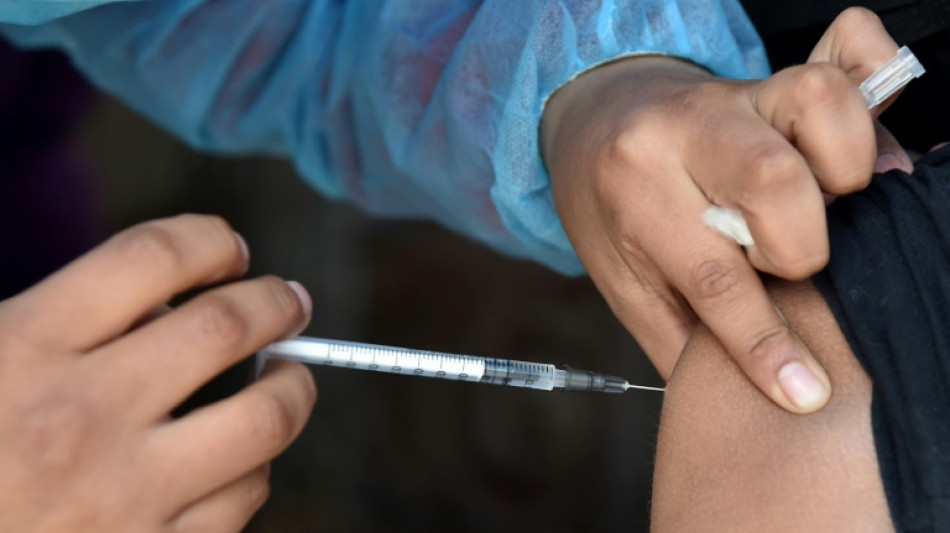
WHO experts back second Covid booster for most at risk / Photo: Aizar RALDES - AFP/File

 US warns of rapid escalation in Mideast war

 Iran 'put hearts on the court' to win Asian Games basketball bronze

 School girl Yu helps China dominate in Asian Games swimming openers

 Myanmar win first Asian Games teqball gold as Spain great Puyol watches

 China's 13-year-old Yu scorches to first major gold at Asian Games

 Russians vote on last day of parliamentary elections

 Hong Kong pays final respects to former city leader Tung

 Typhoon put people off Asian Games opening ceremony, official says

 China's 13-year-old Yu cruises as Asian Games swimming begins

 AI 'warning shots' focus Beijing on national security risks

 Philippine tribe in limbo over US-led tech hub

 Leo XIV, first US pope transcends his restrained style

 Singer Ed Sheeran says Gaza situation 'unjustifiable' following controversy

 In 'Tenzing', a Sherpa mountaineer gets his due

 Ed Sheeran set to return to stage after Palestinian controversy

 Toulouse edge Vannes, Lyon beat Pau to take Top 14 summit

 Germans arrested for Louvre stunt in Mona Lisa hall

 Saudi-led coalition says Houthis fired ballistic missile at Riyadh

 France's debt climbs to highest since 1978: ministry

 McIlroy two shots off the lead at Wentworth after eagle on 18

 Martinez brace saves Inter in Serie A top-two clash with Roma

 Rosenior abused but guides Paris FC past old club Strasbourg

 Seven-try Lyon beat Pau, climb to Top 14 summit

 Brighton defeat a 'big lesson' against complacency for Arsenal, says Arteta

 Thousands protest inaction over climate crisis in Switzerland

The World Health Organization's vaccine advisers on Thursday recommended that people most at risk from Covid-19 should be offered a second booster dose to increase their immunity.
The Strategic Advisory Group of Experts on Immunisation (SAGE) said following initial vaccination, typically consisting of two doses, and an already recommended first booster dose, specific groups of people should be offered an additional jab.
"We are doing this on the basis obviously of observations in relation to waning immunity and particularly in the context of Omicron," WHO senior health advisor Joachim Hornbach told reporters via video link.
The UN health agency has already recommended that all adults receive a booster shot four to six months after an initial round of vaccination, typically consisting of two jabs.
But SAGE chairman Alejandro Cravioto stressed that Thursday's recommendation for a second booster after another four to six months had passed was only meant for the "populations at the highest risk".
It "does not constitute a general recommendation of vaccinating all adults after the first booster", he told the virtual press briefing.
SAGE said second boosters should be offered to the elderly and all immunocompromised people, pregnant women, as well as those with conditions like diabetes, hypertension and cardiac, lung and kidney disease that put them at higher risk.
Health workers of all ages should also get the additional jab, Cravioto said, insisting on the need to "protect our health systems from the devastation of having its personnel sick and not at work".
Looking forward, the SAGE experts pointed to "significant uncertainties related to the evolution of the virus, the characteristics of future variants, and the trajectory of the epidemic given increasing vaccine- and infection-induced immunity globally".
"It is likely that additional doses may be needed within 4–12 months after the second booster, especially in persons most vulnerable to severe disease and death," they said.
For now, the booster recommendations are for the available vaccines developed to tackle the initial Covid-19 strain.
WHO has said it will evaluate new jabs being developed by vaccine makers like Moderna and Pfizer that are adapted to target new, fast-spreading Omicron variants.
But SAGE stressed that current vaccines appeared to continue providing high protection "against severe disease in the context of the Omicron variant and its sub-lineages".
Second boosters for at-risk populations "should not be delayed in anticipation of future variant-containing vaccines", they said.
A.Motta--PC