Australia's 'irreplaceable' platypus threatened by dams: study / Photo: Handout - Thomas Rayner/AFP

 US warns of rapid escalation in Mideast war

 Iran 'put hearts on the court' to win Asian Games basketball bronze

 School girl Yu helps China dominate in Asian Games swimming openers

 Myanmar win first Asian Games teqball gold as Spain great Puyol watches

 China's 13-year-old Yu scorches to first major gold at Asian Games

 Russians vote on last day of parliamentary elections

 Hong Kong pays final respects to former city leader Tung

 Typhoon put people off Asian Games opening ceremony, official says

 China's 13-year-old Yu cruises as Asian Games swimming begins

 AI 'warning shots' focus Beijing on national security risks

 Philippine tribe in limbo over US-led tech hub

 Leo XIV, first US pope transcends his restrained style

 Singer Ed Sheeran says Gaza situation 'unjustifiable' following controversy

 In 'Tenzing', a Sherpa mountaineer gets his due

 Ed Sheeran set to return to stage after Palestinian controversy

 Toulouse edge Vannes, Lyon beat Pau to take Top 14 summit

 Germans arrested for Louvre stunt in Mona Lisa hall

 Saudi-led coalition says Houthis fired ballistic missile at Riyadh

 France's debt climbs to highest since 1978: ministry

 McIlroy two shots off the lead at Wentworth after eagle on 18

 Martinez brace saves Inter in Serie A top-two clash with Roma

 Rosenior abused but guides Paris FC past old club Strasbourg

 Seven-try Lyon beat Pau, climb to Top 14 summit

 Brighton defeat a 'big lesson' against complacency for Arsenal, says Arteta

 Thousands protest inaction over climate crisis in Switzerland

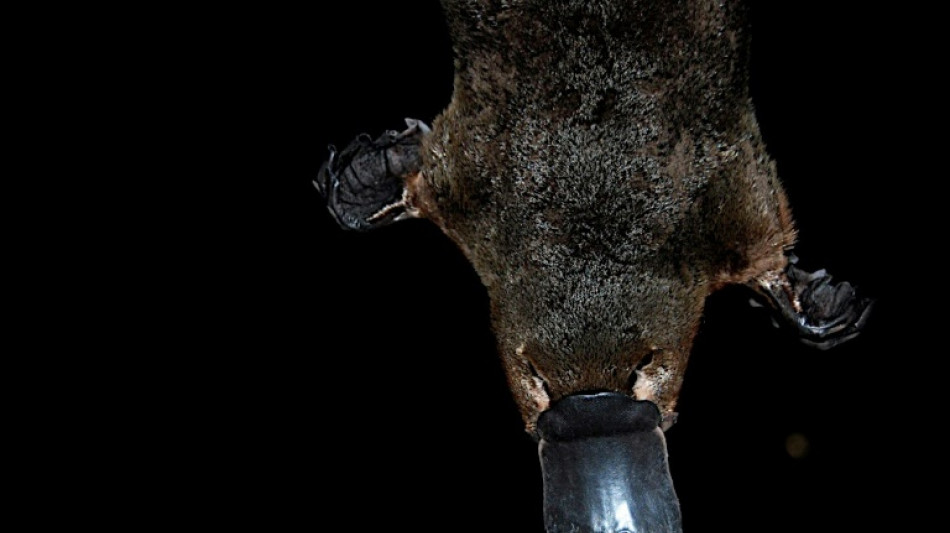
The future of the platypus, a unique duck-billed, egg-laying mammal only found in Australia, is under threat because they cannot climb over tall river dams, according to a new study.
The platypus is an oddity in many ways. As well as its duck-like bill and egg-laying, it is a rare venomous mammal, brandishing centimetre-long poisonous spurs on its hind legs.
They are also one of the only mammals who can locate prey by detecting electric fields and whose fur glows blue-green under an ultraviolet light. Platypuses even have 10 sex chromosomes -- most mammals have two.
But the number of platypuses has fallen by 50 percent since Europeans settled Australia more than two centuries ago, according to previous research.
Its habitat has increasingly come under threat from climate change-fuelled extreme weather events including drought and fire. They are also preyed upon by invasive species such as foxes, cats and dogs.
A new study published in the journal Communications Biology this week identified a new threat: platypuses are not able to climb over large, human-madedams in rivers.
The study's lead author, Jose Luis Mijangos of the University of New South Wales, told AFP that "there might be as few as 30,000 mature platypuses" left in Australia.
More than three quarters of Australia's dams measuring over 10 metres (33 feet) are in regions where platypuses live, the study said.
Some platypuses, which mostly live in rivers and streams but can use their webbed feet to walk on land, have been reported to be able to cross smaller dams.
But they cannot get over taller dams, isolating the animals from each other, the study found.
- Increased inbreeding -
The researchers took the DNA samples of 274 platypuses from nine rivers in the states of Victoria and New South Wales. Five of the rivers have dams between 85 to 180 metres tall, while the others flow unimpeded.
Comparing the samples, they found that genetic differences were four to 20 times higher in platypus populations around the dammed rivers compared to those not living near dams, indicating the first group rarely mixed with others.
They also estimated that the genetic differences had increased in every platypus generation since the nearby dams had been completed.
"These results suggest that almost no or no platypuses have passed around the dams since they were built," Mijangos said.
As a result, "populations are fragmented, which means that the ability to recolonise available habitat or migrate to areas with more suitable conditions is restricted," he added.
"Fragmentation also simultaneously reduces both local population size and gene flow, each of which is expected to lead to increased inbreeding and reduction of the genetic variation."
To address the problem, the researchers propose structures be built to help the platypuses scale the dams. They also suggested that humans could relocate some platypuses to promote diversity.
After all, the platypus is too weird to be lost.
"Platypuses are arguably the most irreplaceable mammal because they have a unique combination of features," Mijangos said.
B.Godinho--PC