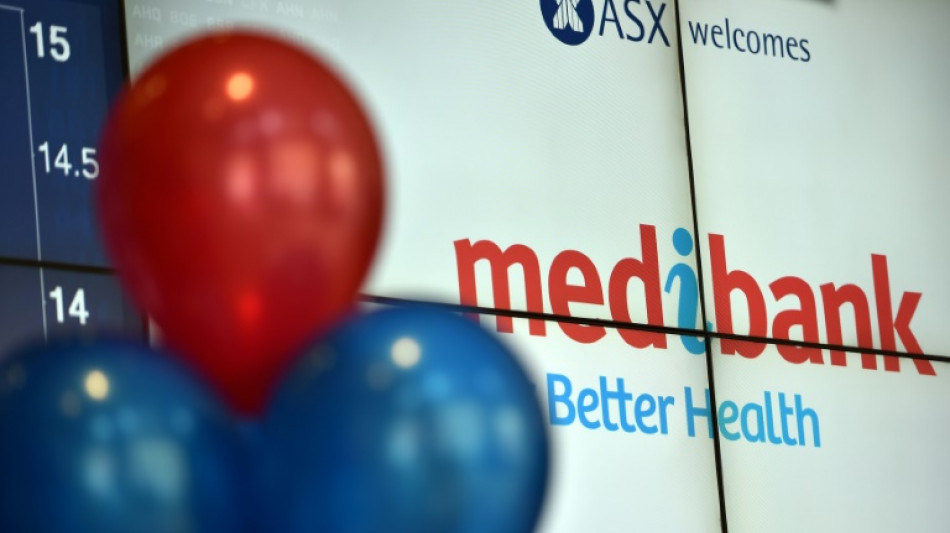
Hackers demand $10 mn for stolen Australian health records / Photo: SAEED KHAN - AFP/File

 US warns of rapid escalation in Mideast war
 Iran 'put hearts on the court' to win Asian Games basketball bronze
 School girl Yu helps China dominate in Asian Games swimming openers
 Myanmar win first Asian Games teqball gold as Spain great Puyol watches

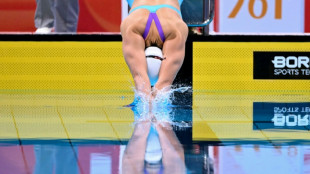 China's 13-year-old Yu scorches to first major gold at Asian Games

 Russians vote on last day of parliamentary elections

 Hong Kong pays final respects to former city leader Tung

 Typhoon put people off Asian Games opening ceremony, official says

 China's 13-year-old Yu cruises as Asian Games swimming begins

 AI 'warning shots' focus Beijing on national security risks

 Philippine tribe in limbo over US-led tech hub

 Leo XIV, first US pope transcends his restrained style

 Singer Ed Sheeran says Gaza situation 'unjustifiable' following controversy

 In 'Tenzing', a Sherpa mountaineer gets his due

 Ed Sheeran set to return to stage after Palestinian controversy

 Toulouse edge Vannes, Lyon beat Pau to take Top 14 summit

 Germans arrested for Louvre stunt in Mona Lisa hall

 Saudi-led coalition says Houthis fired ballistic missile at Riyadh

 France's debt climbs to highest since 1978: ministry

 McIlroy two shots off the lead at Wentworth after eagle on 18

 Martinez brace saves Inter in Serie A top-two clash with Roma

 Rosenior abused but guides Paris FC past old club Strasbourg

 Seven-try Lyon beat Pau, climb to Top 14 summit

 Brighton defeat a 'big lesson' against complacency for Arsenal, says Arteta

 Thousands protest inaction over climate crisis in Switzerland

Hackers on Thursday demanded US$10 million to stop leaking highly sensitive records stolen from a major Australian healthcare company, as they uploaded yet more intimate details about customers.
Medibank, Australia's largest private health insurer, confirmed this week that hackers had accessed the information of 9.7 million current and former clients, including Prime Minister Anthony Albanese.
The hackers on Thursday uploaded a second batch of files to a dark web forum, with more sensitive details about hundreds of Medibank customers.
The first leaks appear to have been selected to cause maximum harm: targeting those who received treatment related to drug abuse, sexually transmitted infections or pregnancy terminations.
"Added one more file abortions.csv," the anonymous hackers wrote on the forum, before detailing their ransom threat.
"Society ask us about ransom, it's 10 million USD. We can make discount... $1 = 1 customer."
Medibank has repeatedly refused to pay the ransom.
- 'Profit and greed' -
The Medibank hack -- and an earlier data breach impacting nine million customers at telecom company Optus -- has raised questions about Australia's ability to repel cyber criminals.
Dennis Desmond, a former FBI agent and US Defense Intelligence Agency officer, said Australia was no worse "than any other high-value target or Western country".
"It's very unfortunate, but I don't think Australia is any more vulnerable than any other Western developed nation," he told AFP.
Desmond said profit-driven hackers were unlikely to single out a specific country -- and were typically more interested in targeting companies holding valuable data.
"It's the data types that are of the most interest to these hackers," he said.
"The healthcare data is a huge target and personally identifiable data is high-value.
"Generally, profit and greed are the number one drivers."
- 'Scummy criminals' -
The Medibank hack is likely to include data on some of the country's most influential and wealthy individuals.
Medibank chief executive David Koczkar condemned the "disgraceful" extortion tactics.
"The weaponisation of people's private information in an effort to extort payment is malicious and it is an attack on the most vulnerable members of our community."
The group behind the attack appears to be pressuring Medibank by hunting for the most potentially damaging personal information within the records.
The first records posted to the dark web forum were separated into "naughty" and "nice" lists.
Some on the "naughty" list had numeric codes that appeared to link them to drug addiction, alcohol abuse and HIV infection.
For example, one record carried an entry that read: "p_diag: F122".
F122 corresponds with "cannabis dependence" under the International Classification of Diseases, published by the World Health Organization.
Names, addresses, passport numbers and birth dates were also included in the data.
Home Affairs Minister Clare O'Neil has described the hackers as "scummy criminals".
H.Silva--PC