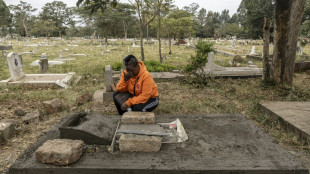
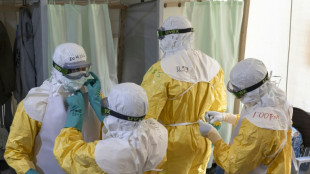
Repeat Covid infections increase risk of health problems: study / Photo: Mohammed ABED - AFP/File

 US warns of rapid escalation in Mideast war

 Iran 'put hearts on the court' to win Asian Games basketball bronze

 School girl Yu helps China dominate in Asian Games swimming openers

 Myanmar win first Asian Games teqball gold as Spain great Puyol watches

 China's 13-year-old Yu scorches to first major gold at Asian Games

 Russians vote on last day of parliamentary elections

 Hong Kong pays final respects to former city leader Tung

 Typhoon put people off Asian Games opening ceremony, official says

 China's 13-year-old Yu cruises as Asian Games swimming begins

 AI 'warning shots' focus Beijing on national security risks

 Philippine tribe in limbo over US-led tech hub

 Leo XIV, first US pope transcends his restrained style

 Singer Ed Sheeran says Gaza situation 'unjustifiable' following controversy

 In 'Tenzing', a Sherpa mountaineer gets his due

 Ed Sheeran set to return to stage after Palestinian controversy

 Toulouse edge Vannes, Lyon beat Pau to take Top 14 summit

 Germans arrested for Louvre stunt in Mona Lisa hall

 Saudi-led coalition says Houthis fired ballistic missile at Riyadh

 France's debt climbs to highest since 1978: ministry

 McIlroy two shots off the lead at Wentworth after eagle on 18

 Martinez brace saves Inter in Serie A top-two clash with Roma

 Rosenior abused but guides Paris FC past old club Strasbourg

 Seven-try Lyon beat Pau, climb to Top 14 summit

 Brighton defeat a 'big lesson' against complacency for Arsenal, says Arteta

 Thousands protest inaction over climate crisis in Switzerland

People who have had Covid more than once are two or three times more likely to have a range of serious health problems than those who have only had it once, the first major study on the subject said Thursday.
Multiple infections have surged as the pandemic rumbles on and the virus mutates into new strains, but the long-term health effects of reinfection have not been clear.
The US researchers said their new study published in the Nature Medicine journal was the first to look at how reinfection increases the risk of health problems from acute cases as well as long Covid.
The researchers analysed the anonymous medical records of 5.8 million people in the US Department of Veterans Affairs' national healthcare database.
More than 443,000 had tested positive for Covid at least once between March 1, 2020 and April this year.
Nearly 41,000 of that group had Covid more than once. Over 93 percent had a total of two infections, while six percent had three and nearly one percent had four.
The other 5.3 million never contracted Covid.
When the researchers compared the health outcomes of the different groups, they found that "people who got reinfected have an increased risk of all sorts of adverse health problems," Ziyad Al-Aly, an epidemiologist at Washington University in St Louis and the study's senior author, told AFP.
People with repeat infections were twice as likely to die prematurely and three times more likely to be hospitalised with illness than those who had not been reinfected, the study found.
Heart and lung problems were more than three times more common for people who had been reinfected.
Reinfection also contributes to brain conditions, kidney disease and diabetes, the study said.
And the risk of such problems could increase with each infection, it suggested.
- 'Worrisome' -
Al-Aly warned that this means that continuous reinfections "would likely elevate the burden of disease in the population".
Ahead of a feared Covid spike during the holiday season, he called on people to wear masks to protect themselves.
He also urged authorities to do more to stop Covid circulating.
"The reason reinfection is happening is that our current vaccine strategy does not block transmission," he said.
"I think reinfections will continue to happen until we have vaccines that block transmission, offer more durable protection, and are variant proof."
The authors said the limitations of the study included that most of the veteran participants were older white males.
When the study was released as a preprint in June, US expert Eric Topol described the findings as "worrisome".
In a Substack post, Topol pointed out that reinfections became "much more common" after April, when the study's time frame ended, due to new, more transmissible Omicron variants.
In more positive news, earlier this week Al-Aly published a pre-print study, which has not been peer-reviewed, which found that people who took Pfizer's drug Paxlovid within five days of testing positive had a reduced risk of getting long Covid.
P.Queiroz--PC