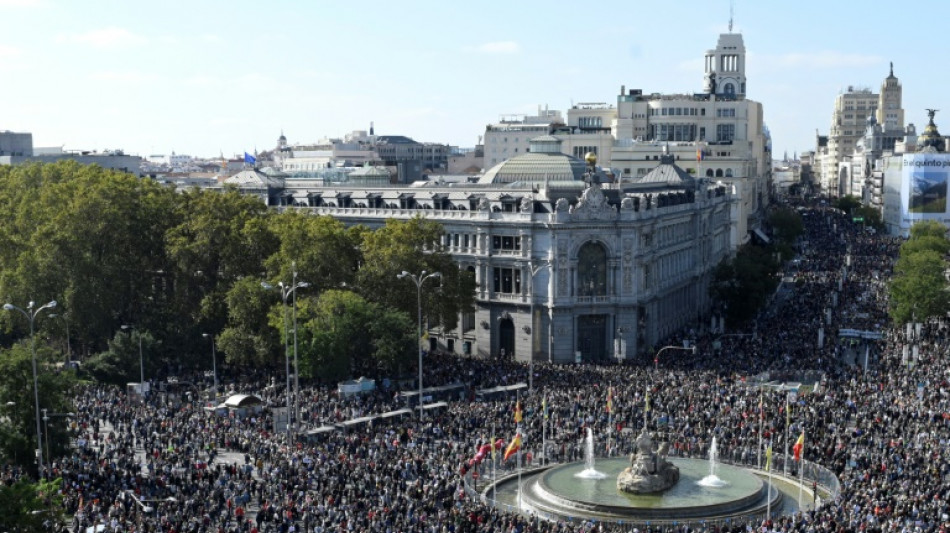
Madrid region's public health system on the brink / Photo: OSCAR DEL POZO - AFP/File

 US warns of rapid escalation in Mideast war
 Iran 'put hearts on the court' to win Asian Games basketball bronze
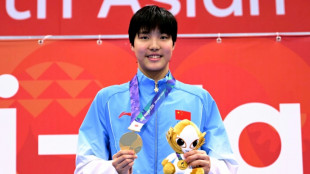
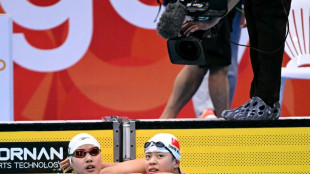 School girl Yu helps China dominate in Asian Games swimming openers

 Myanmar win first Asian Games teqball gold as Spain great Puyol watches

 China's 13-year-old Yu scorches to first major gold at Asian Games

 Russians vote on last day of parliamentary elections

 Hong Kong pays final respects to former city leader Tung

 Typhoon put people off Asian Games opening ceremony, official says

 China's 13-year-old Yu cruises as Asian Games swimming begins

 AI 'warning shots' focus Beijing on national security risks

 Philippine tribe in limbo over US-led tech hub

 Leo XIV, first US pope transcends his restrained style

 Singer Ed Sheeran says Gaza situation 'unjustifiable' following controversy

 In 'Tenzing', a Sherpa mountaineer gets his due

 Ed Sheeran set to return to stage after Palestinian controversy

 Toulouse edge Vannes, Lyon beat Pau to take Top 14 summit

 Germans arrested for Louvre stunt in Mona Lisa hall

 Saudi-led coalition says Houthis fired ballistic missile at Riyadh

 France's debt climbs to highest since 1978: ministry

 McIlroy two shots off the lead at Wentworth after eagle on 18

 Martinez brace saves Inter in Serie A top-two clash with Roma

 Rosenior abused but guides Paris FC past old club Strasbourg

 Seven-try Lyon beat Pau, climb to Top 14 summit

 Brighton defeat a 'big lesson' against complacency for Arsenal, says Arteta

 Thousands protest inaction over climate crisis in Switzerland

Madrid's regional system of primary public healthcare is struggling to cope with high numbers of patients, many of whom are unable to access treatment elsewhere, with some observers warning it could collapse.
Enrique Villalobos' father is just one example of how the system is deteriorating.
"It took nine months for my 85-year-old father to have his prostate operation and he ended up in the emergency department several times because he was at death's door," says Villalobos.
Hundreds of thousands of protesters took the streets of the Spanish capital on Sunday to demand action to save its healthcare system.
Among the demonstrators, who included healthcare workers, unions and politicians, were several famous faces, including Oscar-winning director Pedro Almodovar who wore a white T-shirt with a green heart saying "public healthcare".
"This is not a political demonstration, it affects all of us and mostly the most vulnerable," he said.
"Public healthcare is a fundamental right we have which is written into the constitution."
Public healthcare in Spain, which is highly decentralised, is managed by regional governments.
In Madrid, the richest and most densely-populated region with nearly seven million people, annual spending per resident is just 1,491 euros ($1,545) -- the second lowest of Spain's 17 regions, according to a 2020 health ministry report.
"People have become more and more aware of the progressive deterioration of public healthcare," says Villalobos, head of FRAVM, a group that was one of the driving forces behind Sunday's protest.
The authorities said 200,000 people joined the rally but organisers gave a figure three-times higher, saying it had drawn 670,000 protesters who could be seen thronging the wide boulevards running past city hall.
- 'There's nowhere else' -
Local healthcare centres are understaffed, their doctors overwhelmed with scores of patients and never-ending waiting lists, as key screening appointments such as mammograms are cancelled or rescheduled for months in the future, Villalobos says.
To address the problems, the regional government is trying to promote video consultations.
"How can you diagnose something like peritonitis by video conference?" asked the 53-year-old, accusing the regional authorities of trying to push for "an American-style healthcare model in Madrid".
But such allegations are rejected by the region's right-wing leader Isabel Diaz Ayuso, who dismissed Sunday's protest as politically motivated.
Her recent decision to reopen 80 walk-in centres for non-hospital emergencies -- closed at the start of the pandemic -- but with staffing levels at half what they were previously sparked criticism.
Exhausted by the Covid crisis, emergency centre doctors began an open-ended strike on November 7.
Although they reached a deal to end their strike late on Thursday, some 4,240 primary care doctors and 720 paediatricians are due to go on strike on Monday.
Ivan Saez, a 48-year-old teacher, says he can no longer rely on seeing his family doctor at the local health centre -- and has no idea who will treat him.
"It could be someone who is seeing 50 other patients and who calls you when they have a free moment. But it won't be the doctor you've had for years who knows your medical history," says Saez who was at Sunday's protest.
"If something happens one day, I'll have to do what everyone does and go to hospital even if it's a small thing, not because it's urgent but because there's nowhere else."
- 'Burnout' -
As a primary care doctor, a normal day can "start with 40 appointments on the books" but "you can end up seeing 60 or 70 patients," says 62-year-old Isabel Vaquez Burgos, who worked in a busy clinic until becoming a representative for the Amyts doctors' union.
Jose Manuel Zapatero, 65, worked as a family doctor for 40 years but has just retired, exhausted by the extra five or six hours he put in every day just so he could see an average of 60 patients.
If it was not for the exhausting conditions, Zapatero says he "would have carried on working".
And the situation was putting an impossible strain on them, with doctors "becoming depressed, having anxiety attacks and getting sick", he says.
"It's called burnout."
Others have simply quit, moving abroad or to other regions of Spain where there is more spending on healthcare, further worsening the outlook.
P.Cavaco--PC