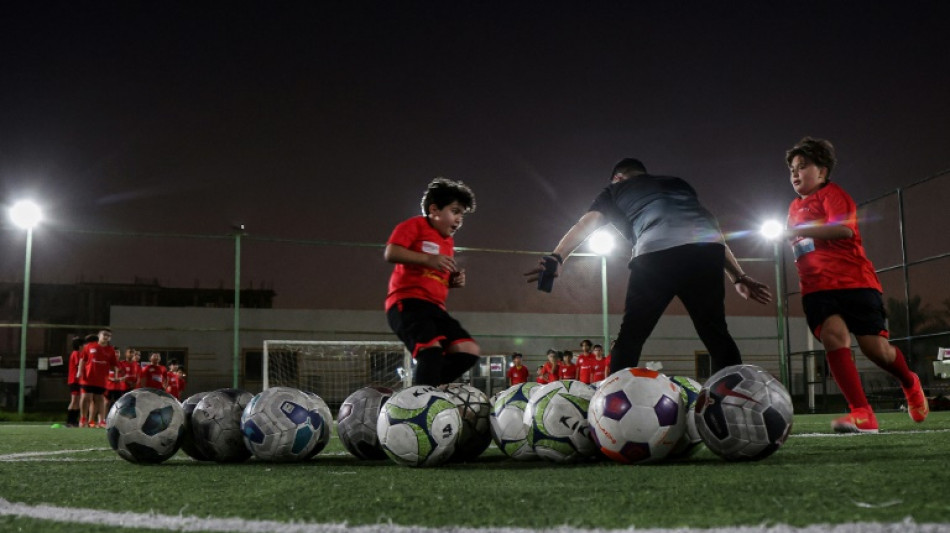
Qatar looks to football, World Cup to kick obesity problem / Photo: KARIM JAAFAR - AFP/File

 US warns of rapid escalation in Mideast war
 Iran 'put hearts on the court' to win Asian Games basketball bronze
 School girl Yu helps China dominate in Asian Games swimming openers

 Myanmar win first Asian Games teqball gold as Spain great Puyol watches

 China's 13-year-old Yu scorches to first major gold at Asian Games

 Russians vote on last day of parliamentary elections

 Hong Kong pays final respects to former city leader Tung

 Typhoon put people off Asian Games opening ceremony, official says

 China's 13-year-old Yu cruises as Asian Games swimming begins

 AI 'warning shots' focus Beijing on national security risks

 Philippine tribe in limbo over US-led tech hub

 Leo XIV, first US pope transcends his restrained style

 Singer Ed Sheeran says Gaza situation 'unjustifiable' following controversy

 In 'Tenzing', a Sherpa mountaineer gets his due

 Ed Sheeran set to return to stage after Palestinian controversy

 Toulouse edge Vannes, Lyon beat Pau to take Top 14 summit

 Germans arrested for Louvre stunt in Mona Lisa hall

 Saudi-led coalition says Houthis fired ballistic missile at Riyadh

 France's debt climbs to highest since 1978: ministry

 McIlroy two shots off the lead at Wentworth after eagle on 18

 Martinez brace saves Inter in Serie A top-two clash with Roma

 Rosenior abused but guides Paris FC past old club Strasbourg

 Seven-try Lyon beat Pau, climb to Top 14 summit

 Brighton defeat a 'big lesson' against complacency for Arsenal, says Arteta

 Thousands protest inaction over climate crisis in Switzerland

Seven-year-old Alain trains with two dozen other children in Doha, the World Cup's host city, striving to lose weight in pursuit of his dream: becoming a professional footballer.
Dribbling around cones on a hot and sticky evening, he is taking part in a broad campaign to encourage health and fitness in the Gulf, home to alarming levels of obesity.
"I'm here to lose weight and become a footballer... because this sport makes me happy," Alain says with a smile, wiping the sweat from his forehead.
The boy is not the only one who wants to improve his fitness in the resource-rich Gulf, whose wealth and exercise-deterring heat have combined to produce some of the world's most overweight populations.
The hundreds of super-fit international footballers now in Qatar for the World Cup, which starts on Sunday, are an anomaly for the desert peninsula where 70 percent of adults are overweight.
It's a similar story around the region, with 66 percent of Omanis overweight or obese, according to official figures, and a 2020 study putting Kuwait's childhood obesity at 35-40 percent.
In the United Arab Emirates, childhood obesity leapt from 12 percent to 17.4 percent in just two years to 2020, the health ministry said.
Unhealthy diets and sedentary lifestyles are to blame in a region which imports most of its food and has some of the world's hottest summers, making it hazardous to exercise outside.
Ali Koteich, director of the Cedars Sport Academy where Alain trains, said physical activity was vital for kids in Doha, where options are largely limited to "going to shopping centres or parks".
"In a place like Doha, sport is very important for children," the 39-year-old told AFP.
- 'Sport and health connected' -
Twenty-four percent of deaths among adults in the emirate are the result of heart conditions, and seven percent are due to diabetes, according to the health ministry.
In a report on physical inactivity issued last month, the World Health Organization said nearly half-a-billion people will develop associated medical conditions by 2030 and called for governments to "take urgent action".
"Obesity is linked to multiple chronic illnesses including diabetes and stress," explained Yousef al-Maslamani, a doctor and health spokesperson for the 2022 World Cup.
"That's why it is so important to show how sport and health are connected."
Gulf countries have begun promoting healthy lifestyles, including a fun run organised by the WHO in Doha on Saturday.
Dubai, the UAE's commercial capital an hour's flight away, is in the midst of a 30x30 campaign, encouraging residents to exercise 30 minutes daily for a month.
And at the World Cup, children are being encouraged to send videos of dance moves that players can use as goal celebrations, in a FIFA-backed bid to make them more active.
"We know the negative impact on children's health that a lack of exercise can have," said FIFA chief Gianni Infantino.
Whether hosting big sports events can improve a nation's health is debatable.
In 2019, Britain's National Institute for Health and Care Research said the London 2012 Olympics had only "small and transient" effects on physical activity for nearby residents.
But healthy messaging is at least being heard. Back at the football academy, nine-year-old Oubay el-Sayyed is giving his team-mates a pep talk, under the approving gaze of his mother, Nada.
"You shouldn't play with your phone all the time, because you have to do some exercise," he tells them. "Football will make your life easier and help you."
G.Machado--PC