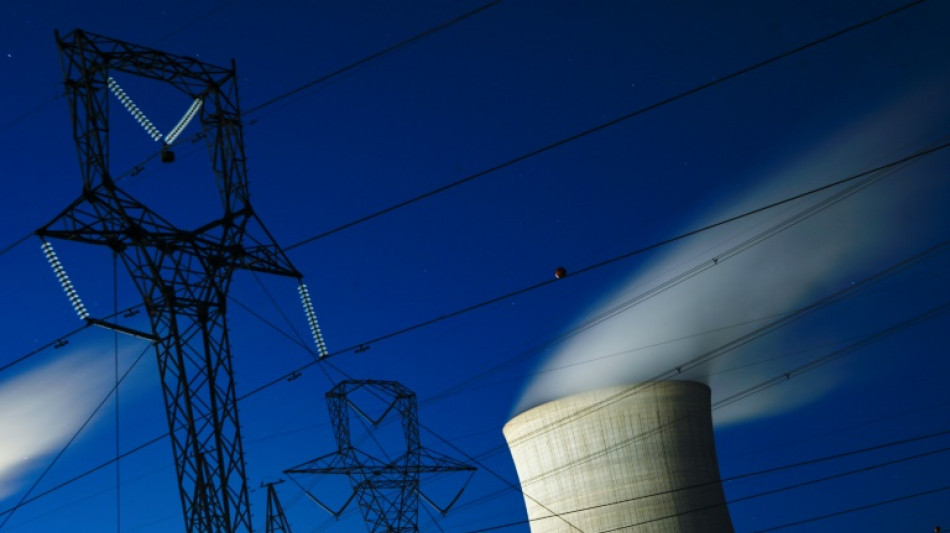
US Supreme Court hears climate case as UN issues stark warning

 Trump's beef policies irk Texas ranchers, testing their loyalty

 Nvidia, OpenAI CEOs to attend Xi dinner at White House

 Anthropic picks Accenture for in-house AI safety evaluation

 Balogun returns as Monaco beat Lens to continue strong Ligue 1 start

 'Pause' on overt repression in Venezuela, but reforms still needed: HRW

 Global stocks mixed as yen falls despite Bank of Japan rate hike

 Cuba hit with seventh major blackout of the year

 Murray out with concussion so Wentz will start for Vikings

 UN chief 'deeply regrets' US visa refusal to Abbas for annual meeting

 England quick Carse to face no charges over alleged nightclub assault

 Mancini brings nine newcomers into the first squad of his Italy comeback

 Czechs level Davis Cup tie against USA as South Korea eye Finals

 New France boss Zidane confirms Mbappe as captain after naming first squad

 California governor signs order to explore AI 'kill switch'

 Head leads run spree as Australia win Zimbabwe ODI series

 In-form Raphinha wants to finish career at Barcelona

 Warren Buffett steps down as Berkshire Hathaway chairman

 Carrick confident Man Utd can 'work through' tough time

 Mbappe ends Nike partnership to join Swiss brand On

 Liverpool boss Iraola puts Bournemouth love affair on hold

 'A disaster' if Man City do not win says Maresca after flawless start

 Kerry James Marshall: American 'blackness' painter celebrated in Europe

 Spain coach De la Fuente offers 'full support' to people of Ceuta

 Russia seizes assets of Nestle, French firms over West's Ukraine support

 England can build on World Cup 'spirit', says Tuchel

A divided US Supreme Court heard arguments on Monday in an environmental regulation case with potentially far-reaching implications for the Biden administration's fight against climate change.
The case concerns the authority of the Environmental Protection Agency (EPA) to regulate greenhouse gas emissions from coal-fired power plants, which produce nearly 20 percent of the electricity in the United States.
As the Supreme Court was hearing arguments, the United Nations issued a landmark report containing dire warnings over climate change.
While the three liberal justices on the nine-member Supreme Court appeared largely to support arguments that the EPA was operating within its brief, several of the conservative justices appeared skeptical.
"This agency is doing greenhouse gas regulation," said Justice Sonia Sotomayor, one of the liberal members of the court. "This is in, you know, exactly in its wheelhouse."
Jacob Roth, arguing for The North America Coal Corp., said the EPA is going beyond its remit.
"The agency is asking questions like: Should we phase out the coal industry? Should we build more solar farms in this country? Should we restrict how consumers use electricity in order to bring down emissions?
"Those are not the types of questions we expect the agency to be answering," Roth said.
In 2007, the Supreme Court, by a narrow majority, ruled that the EPA has the power to regulate carbon dioxide emissions from power plants under the Clean Air Act of 1970.
In 2015, Democratic president Barack Obama unveiled his Clean Power Plan, which was intended to combat global warming by reducing carbon dioxide emissions from coal- and gas-burning plants and shifting energy production to clean sources such as solar and wind power.
The Clean Power Plan was blocked in the Supreme Court in 2016 and repealed by former Republican president Donald Trump, who replaced it with his own industry-friendly Affordable Clean Energy (ACE) rule.
Trump, a climate change skeptic hostile to government regulation of industry, also nominated three justices to the Supreme Court, giving conservatives a 6-3 majority.
- 'Constrain EPA authority' -
The US Court of Appeals for the District of Columbia threw out Trump's ACE rule on the last day of his presidency, setting the stage for the case currently before the Supreme Court: West Virginia vs EPA.
West Virginia and several other coal-producing states asked the Supreme Court to intervene and define the powers of the EPA. The case has also been embraced by opponents of strong government regulatory authority.
Solicitor General Elizabeth Prelogar, arguing before the court for the Biden administration, said the justices should just wait until the EPA publishes its new rules.
"The DC Circuit's judgment leaves no EPA rule in effect," Prelogar said. "No federal regulation will occur until EPA completes its upcoming rulemaking.
"Petitioners aren't harmed by the status quo," she said. "Instead, what they seek from this court is a decision to constrain EPA authority in the upcoming rulemaking."
In its brief to the court, West Virginia accused the EPA of acting like "the country's central energy planning authority."
Justice Samuel Alito, one of the more conservative members of the court, questioned how far the EPA could go in regulating emissions.
"Is there any reason EPA couldn't force the adoption of a system for single family homes that is similar to what it has done, what it is claiming it can do, with respect to existing power plants?" Alito asked.
Prelogar, the solicitor general, replied that the EPA "has never listed homes as a source category and couldn't do so because they are far too diverse and differentiated."
UN experts, in the report issued Monday on the global impacts of climate change, said humanity is perilously close to missing its chance to secure a "liveable" future.
"The cumulative scientific evidence is unequivocal: Climate change is a threat to human wellbeing and planetary health," the Intergovernmental Panel on Climate Change (IPCC) said.
Any further delay in global action to cut carbon pollution and prepare for impacts already in the pipeline "will miss a brief and rapidly closing window of opportunity to secure a liveable and sustainable future for all," the 195-nation IPCC warned.
The Supreme Court is expected to issue its decision in West Virginia vs EPA before June.
F.Santana--PC



