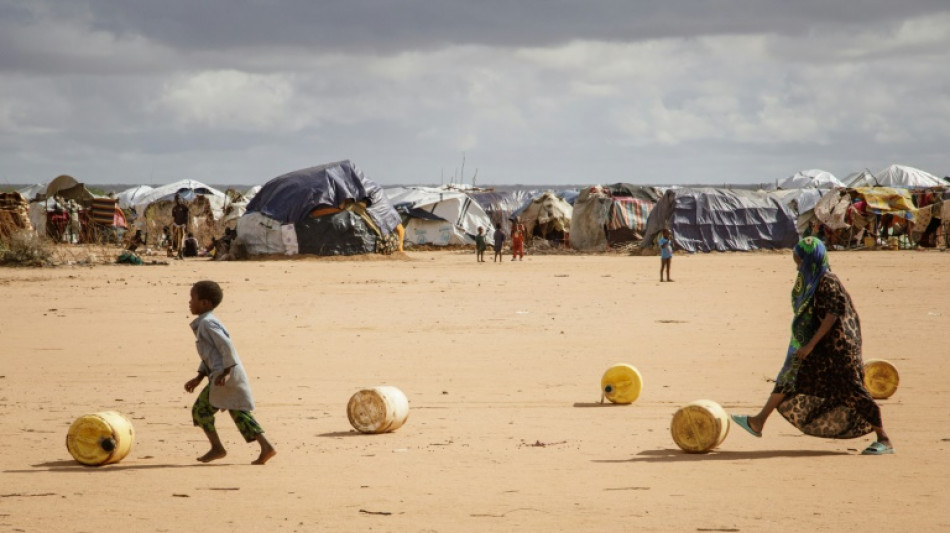
Global warming made Horn of Africa drought possible: report / Photo: Bobb Muriithi - AFP

 Ed Sheeran returns to stage after Palestinian controversy

 Asian Games to open in Japan after troubled build-up

 Drone owners rush to offload devices ahead of Beijing ban

 Trump's beef policies irk Texas ranchers, testing their loyalty

 Nvidia, OpenAI CEOs to attend Xi dinner at White House

 Anthropic picks Accenture for in-house AI safety evaluation

 Balogun returns as Monaco beat Lens to continue strong Ligue 1 start

 'Pause' on overt repression in Venezuela, but reforms still needed: HRW

 Global stocks mixed as yen falls despite Bank of Japan rate hike

 Cuba hit with seventh major blackout of the year

 Murray out with concussion so Wentz will start for Vikings

 UN chief 'deeply regrets' US visa refusal to Abbas for annual meeting

 England quick Carse to face no charges over alleged nightclub assault

 Mancini brings nine newcomers into the first squad of his Italy comeback

 Czechs level Davis Cup tie against USA as South Korea eye Finals

 New France boss Zidane confirms Mbappe as captain after naming first squad

 California governor signs order to explore AI 'kill switch'

 Head leads run spree as Australia win Zimbabwe ODI series

 In-form Raphinha wants to finish career at Barcelona

 Warren Buffett steps down as Berkshire Hathaway chairman

 Carrick confident Man Utd can 'work through' tough time

 Mbappe ends Nike partnership to join Swiss brand On

 Liverpool boss Iraola puts Bournemouth love affair on hold

 'A disaster' if Man City do not win says Maresca after flawless start

 Kerry James Marshall: American 'blackness' painter celebrated in Europe

A devastating drought that has struck the Horn of Africa could not have occurred without global warming, according to a new report released Thursday from an international team of climate scientists.
"Human-caused climate change has made agricultural drought in the Horn of Africa about 100 times more likely," said a summary of the report by the World Weather Attribution (WWA) group.
"The ongoing devastating drought would not have happened at all without the effect of greenhouse gas emissions," it added.
Since late 2020, countries on the Horn of Africa -- Djibouti, Ethiopia, Eritrea, Kenya, Somalia, South Sudan and Sudan -- have been suffering the worst drought in 40 years. The extended drought has led to the deaths of millions of heads of cattle and wiped out crops.
The WWA study concentrated on the three areas worst hit by the drought: southern Ethiopia, Somalia and eastern Kenya.
While climate change had little effect on total annual rainfall in the region, "higher temperatures have significantly increased evaporation from soil and plants, which has made dry soils much more likely", according to the 19 scientists who contributed to the WWA report.
"Without this effect, the region would not have experienced agricultural drought -- when crops and pastures are affected by dry conditions -- over the last two years," the summary added.
"Instead, widespread crop failures and livestock deaths have left more than 20 million people at risk of acute food insecurity."
The WWA said that, for its rapid analysis, "scientists looked at changes in rainfall in 2021 and 2022 in the affected region, covering southern Ethiopia, southern Somalia and eastern Kenya".
"They found that climate change is affecting the rainfall periods in opposite ways. The long rains are becoming drier, with low rainfall now about twice as likely, while the short rains are becoming wetter due to climate change," it added.
"This wettening trend in the short rains has been masked recently by the La Nina weather pattern, which reduces rainfall in the short rains."
Joyce Kimutai, a Kenyan climatologist who contributed to the report, told AFP: "It is time we act and engage differently. Central to this process is to transform and enhance resilience of our systems.
"We need to innovate across and throughout food systems, improve collaboration, involve vulnerable groups, make the best use of data and information, as well as incorporating new technologies and traditional knowledge."
The WWA network, set up by leading climate scientists, has built a reputation in recent years for its capacity to evaluate the extent to which climate change has contributed to extreme weather events.
Its results are published as a matter of urgency, without passing through the long peer-review process required by scientific journals, but employ approved methodological approaches.
X.Brito--PC



