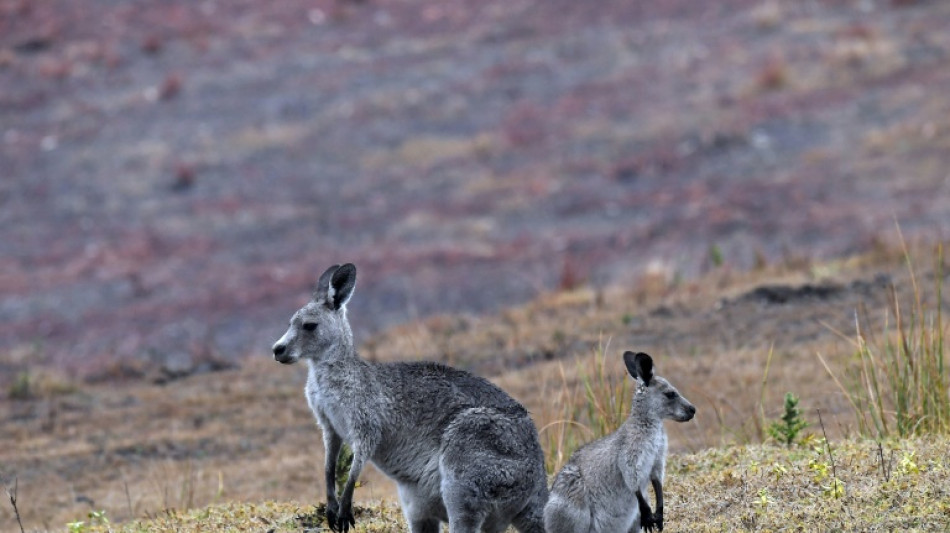
Australia told to shoot kangaroos before they starve / Photo: SAEED KHAN - AFP

 Ed Sheeran returns to stage after Palestinian controversy

 Asian Games to open in Japan after troubled build-up

 Drone owners rush to offload devices ahead of Beijing ban

 Trump's beef policies irk Texas ranchers, testing their loyalty

 Nvidia, OpenAI CEOs to attend Xi dinner at White House

 Anthropic picks Accenture for in-house AI safety evaluation

 Balogun returns as Monaco beat Lens to continue strong Ligue 1 start

 'Pause' on overt repression in Venezuela, but reforms still needed: HRW

 Global stocks mixed as yen falls despite Bank of Japan rate hike

 Cuba hit with seventh major blackout of the year

 Murray out with concussion so Wentz will start for Vikings

 UN chief 'deeply regrets' US visa refusal to Abbas for annual meeting

 England quick Carse to face no charges over alleged nightclub assault

 Mancini brings nine newcomers into the first squad of his Italy comeback

 Czechs level Davis Cup tie against USA as South Korea eye Finals

 New France boss Zidane confirms Mbappe as captain after naming first squad

 California governor signs order to explore AI 'kill switch'

 Head leads run spree as Australia win Zimbabwe ODI series

 In-form Raphinha wants to finish career at Barcelona

 Warren Buffett steps down as Berkshire Hathaway chairman

 Carrick confident Man Utd can 'work through' tough time

 Mbappe ends Nike partnership to join Swiss brand On

 Liverpool boss Iraola puts Bournemouth love affair on hold

 'A disaster' if Man City do not win says Maresca after flawless start

 Kerry James Marshall: American 'blackness' painter celebrated in Europe

Australia's kangaroos could die in "catastrophic" numbers if a population boom is left unchecked, ecologists have warned, while backing the industrial-scale culling of the marsupials.
To outsiders, the kangaroo is an instantly-recognisable symbol of the Australian wilderness, but within the country the native animal poses a major environmental headache.
Kangaroos have a "boom and bust" population cycle -- when fodder is plentiful on the back of a good wet season their numbers can balloon by tens of millions.
Hopping mobs of kangaroos can rapidly strip paddocks bare, but ecologist Katherine Moseby warned they would starve to death in droves when food ran out.
"The last drought we estimated that 80 or 90 percent of the kangaroos in some areas died," she told AFP.
"They are starving to death -- going into public toilets and eating toilet paper, or lying on the road starving while their joeys are trying to feed," she added, referring to events from the last population boom.
Moseby said the kindest way to save kangaroos from this fate was to shoot them, and harvest the meat, as a way of keeping numbers in check.
"It keeps the numbers down so that when we do get drought we don't get these welfare issues," she said.
"If we saw them as a resource and managed them like that, we wouldn't get the catastrophic deaths that we see."
Kangaroos are protected in Australia but the most common species are not endangered -- this means they can be shot and killed in most jurisdictions, but government permission is needed.
Each year, as many as five million kangaroos are shot as part of a homegrown industry, which harvests their carcasses for meat, pet food and leather.
Dennis King from the Kangaroo Industry Association of Australia believes the country is on the cusp of another kangaroo boom.
"After three years of La Nina right down the east coast, we've seen the perfect growth scenario for kangaroos over the next couple of years," he told AFP.
"The breeding cycle really speeds up."
King said the national kangaroo population fell under 30 million following a crippling drought in the early 2000s, but could soon rebound to as many as 60 million.
- 'Cruel slaughter' -
Animal rights activists have denounced the commercial cull as a "cruel slaughter", pressuring global sportswear giants such as Nike and Puma to phase out the use of kangaroo leather.
"Nike divested of its only kangaroo leather supplier in 2021 and will stop making any product with kangaroo leather in 2023," a spokeswoman for the company said in March.
Politicians in Oregon, where Nike was founded, introduced a bill earlier this year that would outlaw the use of "any part of a dead kangaroo".
"These native animals are slaughtered for the sake of commercial profit," Animals Australia said earlier this year.
George Wilson, a leading researcher on kangaroo management, said attempts to shut down the industry were well-intentioned but ultimately misguided.
"They say it's unethical, but it's unethical to let them starve to death," he told AFP.
"The cruelty is not doing anything about it."
Moseby agreed, saying ending the culling of kangaroos would actually be more cruel in the long run.
"Trying to stop the harvest of leather or meat, it's not going to have any welfare benefit," she said.
"It's going to make it worse."
G.Teles--PC



