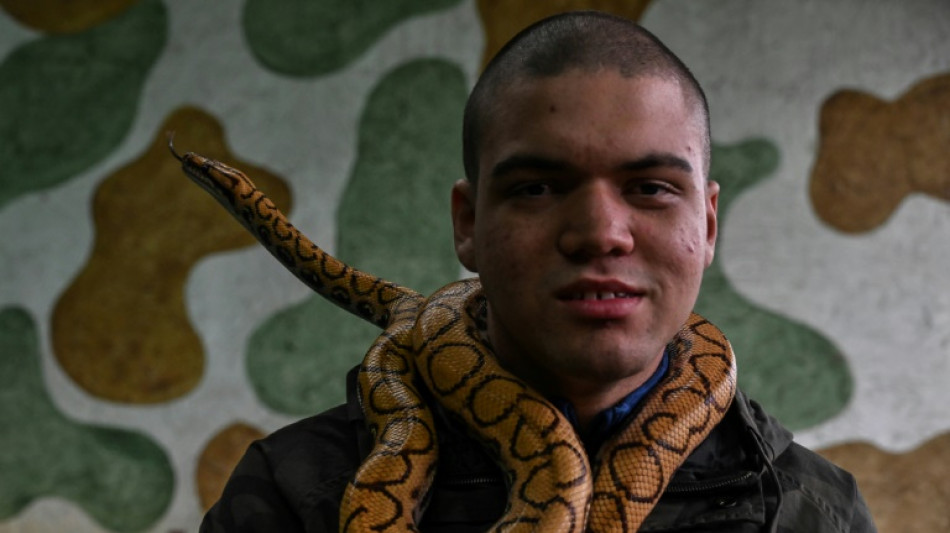
Snakes as therapy animals: reptiles help heal in Brazil / Photo: Nelson ALMEIDA - AFP

 Indians living in Japan on stand-by to house Asian Games athletes

 Trump signs bill authorizing sweeping Russia sanctions

 Protesters form human chain at Kennedy Center after Trump threat

 Death toll from attack at police HQ in Pakistan rises to 31

 Trump says Denmark to give US 'permanent control' over Greenland security

 Kennedy Center: future unclear for iconic Washington arts hub

 Trump claims 'infinite' Greenland security deal with Denmark

 Helicopters battle wildfire threatening Ecuador's capital

 Brentford batter Chelsea to undo Alonso's promising start

 Kane hits Bundesliga century as Bayern rout Union

 Trump says CNN, MS NOW, Politico banned from White House

 Hushing and hedging: US companies retreat on climate

 Springboks to face Fiji before 2027 Rugby World Cup

 Nigeria miners struggled to breathe in cell before 37 died: survivors

 McIlroy on the charge at PGA Championship as Reed withdraws

 McIlroy on the charge at PGA Championship

 Crisis-wracked Volkswagen warns of 10-bn-euro hit to profits

 Costa Rica's Grynspan tops third informal poll for UN chief: diplomat

 Stock markets retreat after central bank rate hikes

 Russia labels director of Cannes Grand Prix winner a 'foreign agent'

 Macron warns of Russian 'hybrid' threat after meeting presidential hopefuls

 UN holds third informal poll for new chief

 Kulusevski return can spark Spurs: De Zerbi

 Shakira to cap off world tour with Madrid 12-gig run

 Isolated Syrian-Druze city blames Damascus for shortages

A yellow-and-brown boa constrictor wraps itself around David de Oliveira Gomes's neck like a scarf, but the 15-year-old Brazilian with autism is fascinated, not afraid.
For him, this is therapy.
"His name is Gold. He's cold. He eats mice," Gomes tells his therapist at a treatment center in Sao Paulo, gently holding the large snake as it slithers around him.
That is exactly the kind of sentence his therapist, Andrea Ribeiro, is trying to elicit.
She specializes in treating people with disabilities, autism or anxiety, using an unusual method: reptile therapy, which she says helps patients relax and improve their communication, motor skills and other abilities.
"He's working on speech and memory formation," the 51-year-old language-speech therapist says of Gomes, sitting at a table with him and the large snake.
Ribeiro has pioneered this method over the past decade at the treatment center, which features an open-air space where patients interact with lizards, turtles and a "jacare" -- a kind of alligator native to Latin America that is common in Brazil, including in the Amazon rainforest.
The treatment is not scientifically proven.
But "it's been medically demonstrated that when people come in contact with animals, it releases neurotransmitters such as serotonin and beta-endorphins that give a sense of pleasure and well-being," says Ribeiro.
"That makes (patients) feel good and want to learn."
The reptiles "enable us to achieve better, faster results," she told AFP.
- Step aside, dogs -
Ribeiro used to use dogs in her treatment sessions.
But she found their constant attempts to play and interact made some patients uneasy, especially those with autism.
So she turned to reptiles.
It's a class of animals that makes many people squirm.
But people with autism tend to approach them "without prejudice," she says: The animals spark their curiosity without making them uncomfortable.
The reptiles, for their part, "are indifferent," she says.
"They don't seek attention the way some mammals do."
Ten-year-old Gabriel Pinheiro is petting a small alligator, trying to imitate Ribeiro's syllables by opening his mouth wide three times: "Ja-ca-re."
"It's wet," he says, his eyes fixated on the creature from behind his glasses.
The alligator's scales are "hard," its belly "soft," he says, as the therapist helps him work on opposites.
He and Ribeiro then sing a song about the jacare to practice auditory memory skills.
Pinheiro's mother, Cristina, credits four years of this therapy with helping improve his listening, communication and motor skills.
"He's always happy when we come," she says.
- Reptilian massage -
Another patient, 34-year-old Paulo Palacio Santos, suffered severe brain damage in an accident that left him paralyzed and speechless.
Ribeiro wraps his face with a thick snake, whose weight and cold temperature help reactivate Santos's swallowing reflex, she says.
She then uses a smaller boa constrictor to work the muscles around his mouth.
The handling of these species is regulated by Brazil's environmental authority, IBAMA.
Ribeiro works side-by-side with biologist Beatriz Araujo, whose job is to monitor the animals' stress levels and ensure patients remain safe.
There has never been an accident in 10 years of treatment, the center says.
The reptiles, which are raised on site, are accustomed to human contact. No poisonous snakes are used.
"I'm always here, just in case (an animal) reacts unexpectedly," says Araujo.
"The dangers are the same as for close contact with any animal."
G.M.Castelo--PC



