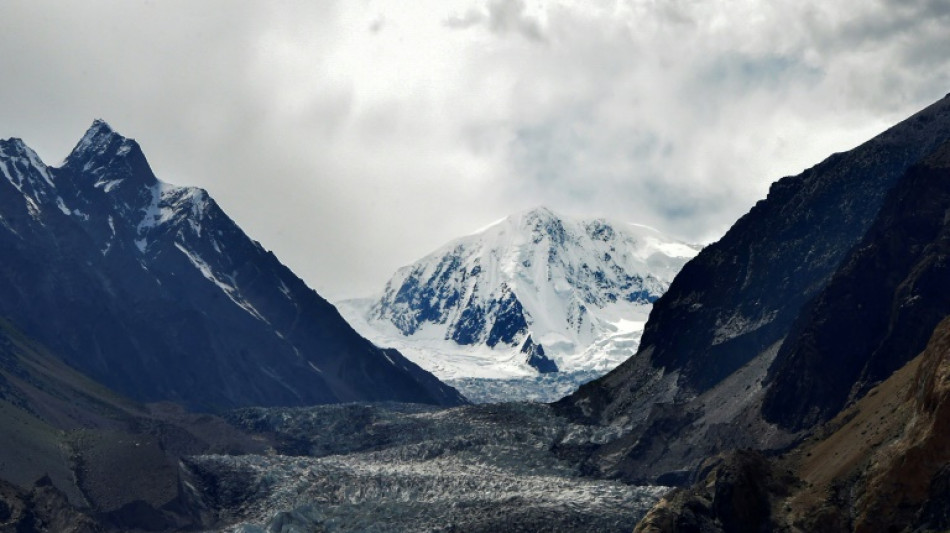
Himalayan glaciers melting 65 percent faster than previous decade: study / Photo: Abdul MAJEED - AFP/File

 Indians living in Japan on stand-by to house Asian Games athletes
 Trump signs bill authorizing sweeping Russia sanctions

 Protesters form human chain at Kennedy Center after Trump threat

 Death toll from attack at police HQ in Pakistan rises to 31

 Trump says Denmark to give US 'permanent control' over Greenland security

 Kennedy Center: future unclear for iconic Washington arts hub

 Trump claims 'infinite' Greenland security deal with Denmark

 Helicopters battle wildfire threatening Ecuador's capital

 Brentford batter Chelsea to undo Alonso's promising start

 Kane hits Bundesliga century as Bayern rout Union

 Trump says CNN, MS NOW, Politico banned from White House

 Hushing and hedging: US companies retreat on climate

 Springboks to face Fiji before 2027 Rugby World Cup

 Nigeria miners struggled to breathe in cell before 37 died: survivors

 McIlroy on the charge at PGA Championship as Reed withdraws

 McIlroy on the charge at PGA Championship

 Crisis-wracked Volkswagen warns of 10-bn-euro hit to profits

 Costa Rica's Grynspan tops third informal poll for UN chief: diplomat

 Stock markets retreat after central bank rate hikes

 Russia labels director of Cannes Grand Prix winner a 'foreign agent'

 Macron warns of Russian 'hybrid' threat after meeting presidential hopefuls

 UN holds third informal poll for new chief

 Kulusevski return can spark Spurs: De Zerbi

 Shakira to cap off world tour with Madrid 12-gig run

 Isolated Syrian-Druze city blames Damascus for shortages

Himalayan glaciers providing critical water to nearly two billion people are melting faster than ever before due to climate change, exposing communities to unpredictable and costly disasters, scientists warned Tuesday.
The glaciers disappeared 65 percent faster from 2011 to 2020 compared with the previous decade, according to a report by the International Centre for Integrated Mountain Development (ICIMOD).
"As it gets warmer, ice will melt, that was expected, but what is unexpected and very worrying is the speed," lead author Philippus Wester told AFP. "This is going much faster than we thought."
Glaciers in the Hindu Kush Himalaya (HKH) region are a crucial water source for around 240 million people in the mountainous regions, as well as for another 1.65 billion people in the river valleys below, the report said.
Based on current emissions trajectories, the glaciers could lose up to 80 percent of their current volume by the end of the century, said the Nepal-based ICIMOD, an inter-governmental organisation that also includes member countries Afghanistan, Bangladesh, Bhutan, China, India, Myanmar and Pakistan.
The glaciers feed 10 of the world's most important river systems, including the Ganges, Indus, Yellow, Mekong and Irrawaddy, and directly or indirectly supply billions of people with food, energy, clean air and income.
"With two billion people in Asia reliant on the water that glaciers and snow here hold, the consequences of losing this cryosphere (a frozen zone) are too vast to contemplate," said ICIMOD's deputy chief Izabella Koziell.
- 'Too vast to contemplate' -
Even if global warming is limited to the 1.5 to 2.0 degrees Celsius from pre-industrial levels agreed to in the Paris climate treaty, the glaciers are expected to lose a third to a half of their volume by 2100, the peer-reviewed report said.
"It underscores the need for urgent climate action," Wester said. "Every small increment will have huge impacts and we really, really need to work on climate mitigation... that is our plea."
Wester said improving technologies and previously classified high-resolution satellite imagery meant predictions could be made with a good degree of accuracy.
The world has warmed an average of nearly 1.2 C since the mid-1800s, unleashing a cascade of extreme weather, including more intense heatwaves, more severe droughts and storms made more ferocious by rising seas.
Hardest hit are the most vulnerable people and the world's poorest countries, which have done little to contribute to the fossil fuel emissions that drive up temperatures
Amina Maharjan, a livelihoods and migration specialist at ICIMOD, said communities do not have the support they need.
"Most of the adaptation is communities and households reacting (to climate events). It is inadequate to meet the challenges posed by climate change," Maharjan said.
"What is going to be very critical moving forward is anticipating change," she said.
S.Caetano--PC



