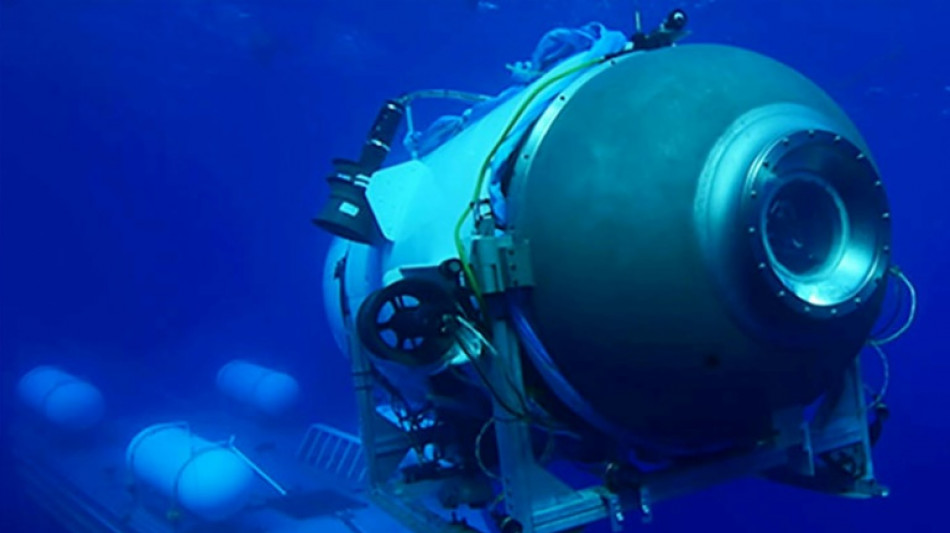
Stockton Rush, Titanic sub's deep-sea 'daredevil' / Photo: Handout - OceanGate Expeditions/AFP

 Indians living in Japan on stand-by to house Asian Games athletes

 Trump signs bill authorizing sweeping Russia sanctions

 Protesters form human chain at Kennedy Center after Trump threat

 Death toll from attack at police HQ in Pakistan rises to 31

 Trump says Denmark to give US 'permanent control' over Greenland security

 Kennedy Center: future unclear for iconic Washington arts hub

 Trump claims 'infinite' Greenland security deal with Denmark

 Helicopters battle wildfire threatening Ecuador's capital

 Brentford batter Chelsea to undo Alonso's promising start

 Kane hits Bundesliga century as Bayern rout Union

 Trump says CNN, MS NOW, Politico banned from White House

 Hushing and hedging: US companies retreat on climate

 Springboks to face Fiji before 2027 Rugby World Cup

 Nigeria miners struggled to breathe in cell before 37 died: survivors

 McIlroy on the charge at PGA Championship as Reed withdraws

 McIlroy on the charge at PGA Championship

 Crisis-wracked Volkswagen warns of 10-bn-euro hit to profits

 Costa Rica's Grynspan tops third informal poll for UN chief: diplomat

 Stock markets retreat after central bank rate hikes

 Russia labels director of Cannes Grand Prix winner a 'foreign agent'

 Macron warns of Russian 'hybrid' threat after meeting presidential hopefuls

 UN holds third informal poll for new chief

 Kulusevski return can spark Spurs: De Zerbi

 Shakira to cap off world tour with Madrid 12-gig run

 Isolated Syrian-Druze city blames Damascus for shortages

Deep-sea thrill-seeker Stockton Rush founded OceanGate in 2009 with the hopes of advancing submersible vehicle technology and taking travelers into the darkest depths of the ocean.
Described by Smithsonian Magazine as a "daredevil inventor," Rush pushed the envelope of underwater exploration and complained about strict rules he said were holding the industry back.
"It's obscenely safe because they have all these regulations. But it also hasn't innovated or grown -- because they have all these regulations," Rush told the magazine in 2019.
In an attempt to raise his company's profile, Rush began in 2021 to take paying customers to the iconic wreck of the Titanic on his specially built vessel.
During such a mission on June 18, 2023, the submersible -- with Rush onboard -- went missing, losing contact with the surface ship less than two hours after it began its descent.
An international search effort was launched to try and find Rush and the four other passengers in the remote North Atlantic, but no sign of them has been found.
The trips cost $250,000 with hardly a guarantee that the 110-year-old wreck will be reached, given all the potential obstacles, like bad weather, while customers must also sign a waiver recognizing the possible risk of death.
In a segment for CBS News, Rush extolled the excursions and pushed back against claims his equipment seemed slapped together -- though he admitted his sub was steered with a modified video game controller.
But he insisted that the fundamental design was sound and not slipshod.
"The pressure vessel is not 'MacGyver' at all, because that's where we worked with Boeing and NASA and the University of Washington," he told CBS.
"Everything else can fail. Your thrusters can go, your lights can go, you're still going to be safe," he said.
The Titanic trips followed a long period of delay during which Rush failed to get the proper permits for the project's support vessel.
- Marketing ploy -
He admitted that visiting the legendary shipwreck was part of a marketing strategy as he attempted to grow his business and develop new innovations for submersible vessels.
"If you ask people to name something underwater, it's going to be sharks, whales, Titanic," he told Smithsonian.
According to his company website, Rush began his career not underwater, but as a pilot, qualifying for the United Airlines Jet Training Institute in 1981 at the age of 19.
During college at Princeton University, he spent summers serving as a DC-8 first officer on flights to Europe and the Middle East.
He then got an MBA at UC Berkeley after which he dabbled in experimental aircraft and submarines.
But over the last two decades, Rush threw himself into several ocean-related tech ventures including serving on the board of Seattle's BlueView Technologies, which makes small, high-frequency sonar systems.
Rush has downplayed the risk of going to the depths of the ocean, saying that he was more concerned by the unexpected.
"What I worry about most are things that will stop me from being able to get to the surface. Overhangs, fish nets, entanglement hazards," he told the Unsung Science podcast.
He also said that he worried about a passenger on the journey out to the Titanic, when they could slip on the icy deck or have a door slam and crush a hand.
"That's to me the dangerous part. But, the scary part for most people is going down to 6,000 PSI (pressure)," he said.
T.Batista--PC



