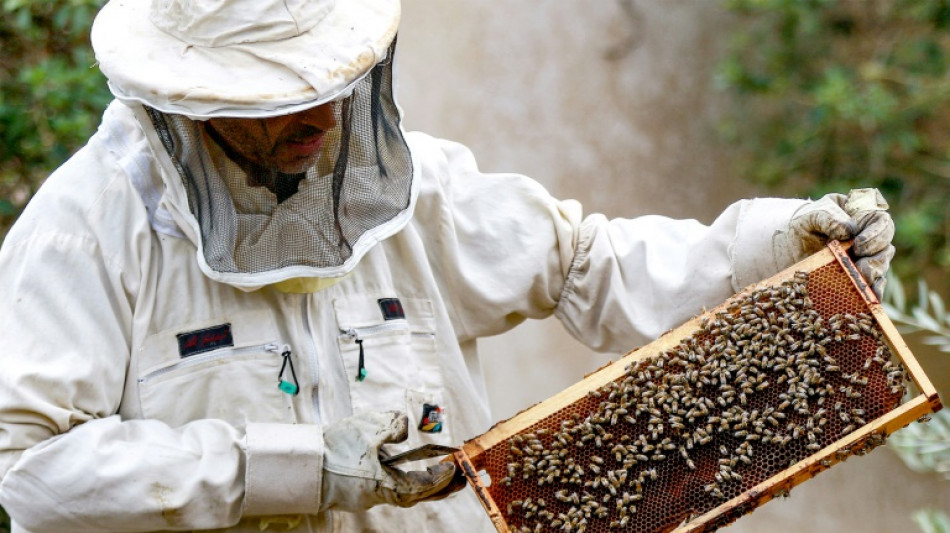
Sweet success: Jordan's beekeepers busy as honey demand soars / Photo: Khalil MAZRAAWI - afp/AFP

 Indians living in Japan on stand-by to house Asian Games athletes
 Trump signs bill authorizing sweeping Russia sanctions

 Protesters form human chain at Kennedy Center after Trump threat

 Death toll from attack at police HQ in Pakistan rises to 31

 Trump says Denmark to give US 'permanent control' over Greenland security

 Kennedy Center: future unclear for iconic Washington arts hub

 Trump claims 'infinite' Greenland security deal with Denmark

 Helicopters battle wildfire threatening Ecuador's capital

 Brentford batter Chelsea to undo Alonso's promising start

 Kane hits Bundesliga century as Bayern rout Union

 Trump says CNN, MS NOW, Politico banned from White House

 Hushing and hedging: US companies retreat on climate

 Springboks to face Fiji before 2027 Rugby World Cup

 Nigeria miners struggled to breathe in cell before 37 died: survivors

 McIlroy on the charge at PGA Championship as Reed withdraws

 McIlroy on the charge at PGA Championship

 Crisis-wracked Volkswagen warns of 10-bn-euro hit to profits

 Costa Rica's Grynspan tops third informal poll for UN chief: diplomat

 Stock markets retreat after central bank rate hikes

 Russia labels director of Cannes Grand Prix winner a 'foreign agent'

 Macron warns of Russian 'hybrid' threat after meeting presidential hopefuls

 UN holds third informal poll for new chief

 Kulusevski return can spark Spurs: De Zerbi

 Shakira to cap off world tour with Madrid 12-gig run

 Isolated Syrian-Druze city blames Damascus for shortages

Jordan's key tourism industry may have been hammered by Covid, but the pandemic gave a boost to another sector, keeping its beekeepers busy as demand for honey has soared.
The country's 4,000 apiarists have ramped up output of the sweet and sticky golden substance long praised for its anti-inflammatory and other health benefits.
Even if there is no scientific consensus that honey helps fight Covid, many of those infected have used it to soothe symptoms such as sore throats.
"The Covid period in particular had a great, positive impact on us," said beekeeper Mutasim Hammad, 48, who retired 12 years ago from the public security directorate and turned his hobby into his main job.
"There was good demand for honey, and people got to know it," added Hammad, dressed in a white protective suit while checking on his 80 bee hive boxes on a property in Irbid 90 kilometres (60 miles) north of Amman.
"People have become more aware of the value of honey and are turning to the guaranteed locally produced honey," said Hammad, who sells about 400 kilograms (880 pounds) a year.
The kingdom of Jordan prides itself on its 19 different types of honey, including citrus, eucalyptus and maple varieties, depending on which plants the bees pollinate.
"We have about 2,500 flowering plants," said Mohammad Rababaa, head of the Jordan Beekeeping Association.
"This diversity distinguishes Jordanian honey and means that the therapeutic and nutritional value of this honey is expected to be better than other types."
Rababaa said the slightly bitter maple honey variety, for example, boasts "very high phenolic compounds and antioxidants compared to other types, which indicates that it has a higher value".
- Ecosystem service -
Rababaa also said that, since the Covid pandemic, "demand for locally produced honey has clearly increased".
He said the sector has a much bigger workforce than Jordan's official count of about 1,400 beekeepers.
"The reality is that the number of beekeepers is more than 4,000," said the professor of Natural Resources and Environment at the Jordan University of Science and Technology.
They produce about 700 to 800 tonnes annually, or about 70 percent of Jordan's annual domestic needs, he said.
"We are very close to self-sufficiency," said Rababaa, adding that "imports must be stopped".
A fellow enthusiast, Mohammad Khatib, 49, also pointed to the pandemic and lockdown periods, saying it "helped me and gave me enough time to learn about bees and take good care of them".
A French language professor at Al-Bayt University, he now works about 15 bee boxes in his garden, which he said earns him a nice side income.
"People are looking for reliable honey" and some customers place their orders a year in advance, he said.
Jordanian honey sells for 15 to 30 dinars ($21 to $42) per kilogram, depending on the type.
Rababaa said the economic benefit "is not limited to honey as it also produces pollen, royal jelly, wax, propolis and bee venom, which is included in many therapeutic compounds".
Crucially, healthy populations of bees and other insects provide an almost immeasurable ecosystem service by pollinating plants.
While the beekeeping sector generates about $28 million a year, Rababaa said, "the indirect value of crop pollination exceeds $100 million".
Nogueira--PC



