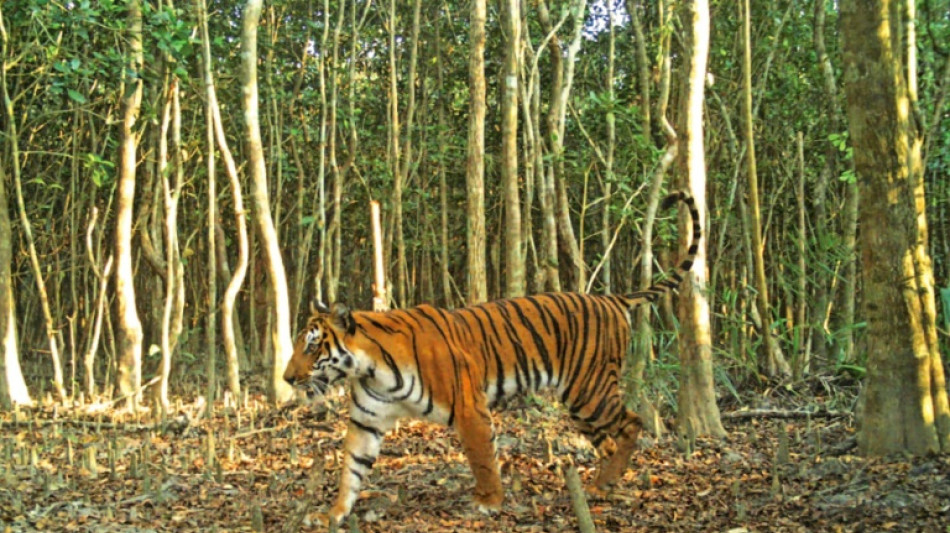
Bangladesh major hub for tiger poaching: study / Photo: Handout - BANGLADESH FOREST DEPARTMENT/AFP/File

 Indians living in Japan on stand-by to house Asian Games athletes

 Trump signs bill authorizing sweeping Russia sanctions

 Protesters form human chain at Kennedy Center after Trump threat

 Death toll from attack at police HQ in Pakistan rises to 31

 Trump says Denmark to give US 'permanent control' over Greenland security

 Kennedy Center: future unclear for iconic Washington arts hub

 Trump claims 'infinite' Greenland security deal with Denmark

 Helicopters battle wildfire threatening Ecuador's capital

 Brentford batter Chelsea to undo Alonso's promising start

 Kane hits Bundesliga century as Bayern rout Union

 Trump says CNN, MS NOW, Politico banned from White House

 Hushing and hedging: US companies retreat on climate

 Springboks to face Fiji before 2027 Rugby World Cup

 Nigeria miners struggled to breathe in cell before 37 died: survivors

 McIlroy on the charge at PGA Championship as Reed withdraws

 McIlroy on the charge at PGA Championship

 Crisis-wracked Volkswagen warns of 10-bn-euro hit to profits

 Costa Rica's Grynspan tops third informal poll for UN chief: diplomat

 Stock markets retreat after central bank rate hikes

 Russia labels director of Cannes Grand Prix winner a 'foreign agent'

 Macron warns of Russian 'hybrid' threat after meeting presidential hopefuls

 UN holds third informal poll for new chief

 Kulusevski return can spark Spurs: De Zerbi

 Shakira to cap off world tour with Madrid 12-gig run

 Isolated Syrian-Druze city blames Damascus for shortages

Bangladesh remains a major hub for the poaching of endangered tigers despite government claims of a successful crackdown on pirate groups involved in the trade, according to research published Friday.
The vast Sundarbans mangrove forest straddling India and Bangladesh hosts one of the world's largest populations of Bengal tigers.
Their pelts, bones and flesh are bought by black marketeers as part of a broader illegal wildlife trade valued at an estimated $20 billion globally each year.
Research from big cat conservation group Panthera and the Chinese Academy of Sciences said tiger parts harvested in the Sundarbans have been exported to 15 countries, with India and China being the most common destinations.
"Bangladesh plays a much more significant role in the illicit tiger trade than we previously realized," study co-author Rob Pickles said in a statement.
Pirate groups operating in the Sundarbans found a lucrative trade in tiger poaching before a government crackdown starting in 2016.
At least 117 pirates were shot dead and hundreds more were detained, according to official figures, while many others surrendered as part of a government amnesty.
But Panthera's research, published in the Conservation Science and Practice journal, said that the vacuum created by the crackdown had been filled by more than 30 specialist tiger poaching syndicates and opportunistic poachers.
Traders operated through their own logistics companies and in some cases concealed their activities through licenses for legal wildlife trade, the study added.
The research, based partly on interviews with those involved in the wildlife trade, also found that domestic consumption of tiger parts had increased since the crackdown, owing to Bangladesh's burgeoning economy.
Wealthy local buyers were purchasing medicines using tiger parts "as well as large ornamental items for display such as skulls and skins", the study said.
The findings were disputed by Bangladesh's official Sundarbans conservator Abu Naser Mohsin Hossain, who said the crackdown had brought the illicit trade to a standstill.
"We have taken measures to conserve the Bengal tiger population in the Sundarbans," he told AFP.
"No tiger has died from... tiger-human conflict in the past five years. Tiger sightings have increased."
Just 114 Bengal tigers live in Bangladesh's portion of the Sundarbans, according to an official census published in 2019 -- up slightly since a record low four years prior.
An updated population count is due to be published next year.
Poaching is the number one threat to tigers globally, and China is the biggest overall driver of demand, largely for use of their body parts in traditional medicine, according to Panthera.
H.Silva--PC



