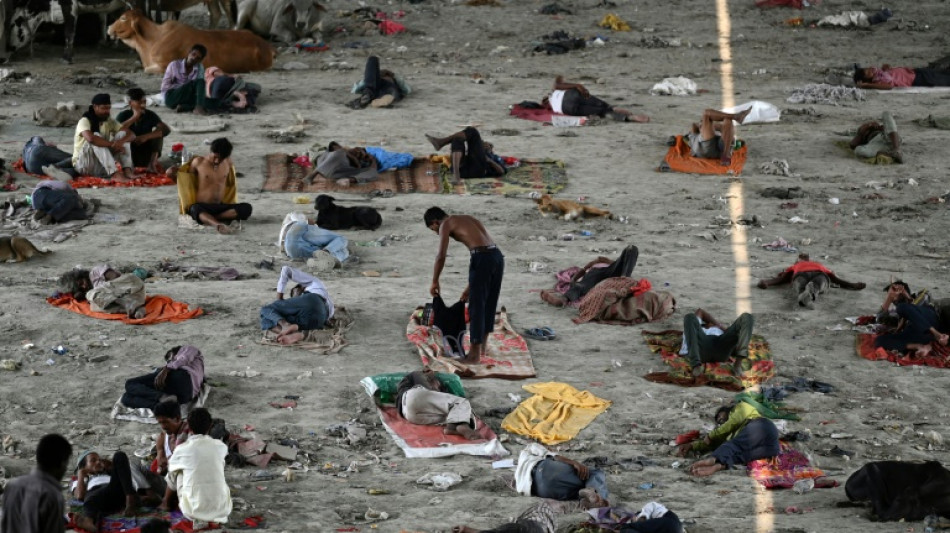
Heat records topple across sweltering Asia / Photo: Sajjad HUSSAIN - AFP/File

 Indians living in Japan on stand-by to house Asian Games athletes

 Trump signs bill authorizing sweeping Russia sanctions

 Protesters form human chain at Kennedy Center after Trump threat

 Death toll from attack at police HQ in Pakistan rises to 31

 Trump says Denmark to give US 'permanent control' over Greenland security

 Kennedy Center: future unclear for iconic Washington arts hub

 Trump claims 'infinite' Greenland security deal with Denmark

 Helicopters battle wildfire threatening Ecuador's capital

 Brentford batter Chelsea to undo Alonso's promising start

 Kane hits Bundesliga century as Bayern rout Union

 Trump says CNN, MS NOW, Politico banned from White House

 Hushing and hedging: US companies retreat on climate

 Springboks to face Fiji before 2027 Rugby World Cup

 Nigeria miners struggled to breathe in cell before 37 died: survivors

 McIlroy on the charge at PGA Championship as Reed withdraws

 McIlroy on the charge at PGA Championship

 Crisis-wracked Volkswagen warns of 10-bn-euro hit to profits

 Costa Rica's Grynspan tops third informal poll for UN chief: diplomat

 Stock markets retreat after central bank rate hikes

 Russia labels director of Cannes Grand Prix winner a 'foreign agent'

 Macron warns of Russian 'hybrid' threat after meeting presidential hopefuls

 UN holds third informal poll for new chief

 Kulusevski return can spark Spurs: De Zerbi

 Shakira to cap off world tour with Madrid 12-gig run

 Isolated Syrian-Druze city blames Damascus for shortages

Temperature records are being toppled across Asia, from India's summer to Australia's winter, authorities said Friday, in fresh evidence of the impact of climate change.
The sweltering temperatures match longstanding warnings from climate scientists and come as countries from Greece to Canada battle record heat and deadly wildfires.
In India, the world's most populous country, officials said this August was the hottest and driest since national records began more than a century ago.
The month falls in the middle of India's annual monsoon, which usually brings up to 80 percent of the country's yearly rainfall.
But despite heavy downpours that caused deadly floods in the country's north earlier this month, overall rainfall has been far below average.
August saw an average of just 161.7 millimetres (6.4 inches), 30.1 mm lower than the previous August record in 2005, the India Meteorological Department (IMD) said.
That has left the country baking in unrelenting heat.
"The large rainfall deficiency and weak monsoon condition is the main reason," the IMD said.
Authorities in Japan also said Friday that the country had experienced its hottest summer since records began in 1898.
Temperatures from June to August were "considerably higher" than average across the north, east and west of the country, the weather agency said.
In many locations "not only maximum temperatures but also minimum temperatures" reached record highs, it added.
And in Australia this winter was the warmest on record, with an average temperature of 16.75 degrees Celsius (62.15 Fahrenheit) for the season running from June to August.
That is a hair above a record set in 1996, and the highest average winter temperature since the country's records began in 1910, the Bureau of Meteorology said.
- 'More intense, more frequent' -
Climate change has fuelled searing temperatures across the globe already this year, with July the hottest month ever recorded on Earth.
Scientists have long warned that climate change produces heatwaves that are hotter, longer and more frequent.
And the warming El Nino weather pattern could turbocharge the heat further, though its effects are likely to become more apparent later in the year as it strengthens.
Heatwaves are among the deadliest natural hazards, with hundreds of thousands of people dying from preventable heat-related causes each year.
In developed countries, adaptations including air conditioning can help mitigate the impact.
But even in wealthy Japan, authorities said at least 53 people died of heatstroke in July, with almost 50,000 needing emergency medical attention.
The effects of heat are unevenly distributed, with small children and the elderly less able to regulate their body temperatures and thus more vulnerable.
Those who have to work outside are also particularly at risk.
Even a healthy young person will die after enduring six hours of 35-degree-Celsius (95 Fahrenheit) warmth coupled with 100 percent humidity.
But extreme heat does not need to be anywhere near that level to kill people, experts warn.
John Nairn, a senior extreme heat adviser at the UN's World Meteorological Organization (WMO), said last month that heatwaves are "becoming much more dangerous".
"It's the most rapidly emerging consequence of global warming that we are seeing," he told AFP in an interview.
"People are far too relaxed about the signs," he lamented.
"It will only get more intense and more frequent."
burs-sah/leg
F.Cardoso--PC



