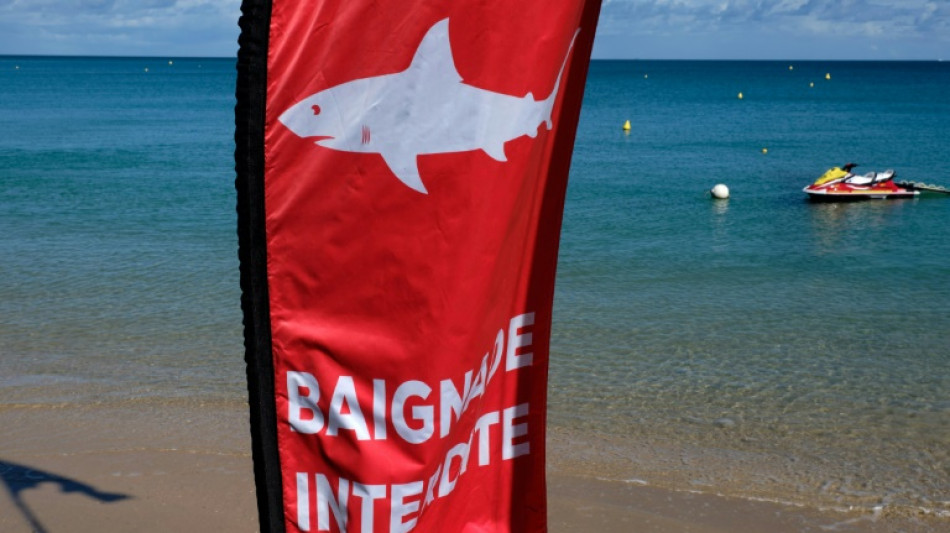
French Pacific archipelago divided over shark hunt / Photo: Theo Rouby - AFP/File

 Indian crude-sensitive shares gain after 13% oil-price decline

 Stocks and dollar fall as Democratic election gains reshape markets

 Kuwait marks key events and anniversaries from national history

 Trump congratulates Democrats and signals willingness to cooperate

 Qatar prime minister advances mediation through diplomatic calls

 Greenland parliament approves security agreement with United States

 Qatar envoy meets incoming UN General Assembly president

 Trump Signals Willingness to Work With Democrats After Midterm Defeat

 Pitches and Keynote Speakers Are Confirmed for Blue Magic Netherlands on November 17
After killing seven people in the past five years, sharks are enemy number one in France's Pacific archipelago of New Caledonia where the authorities have declared open season on the species in the hope of making beaches safe again.
But environmentalists are on the side of the sharks, saying the local government's order to cull the animals has led to indiscriminate killing and harm to marine life.
The population of New Caledonia, a French overseas territory about 1,200 kilometres (750 miles) east of Australia, is divided between those who want the problem removed by force, and those urging caution.
Nobody is sure what prompted the sharks to arrive in unusually high numbers in the bays around the capital Noumea, and to attack humans in 10 incidents registered since 2018.
The local authorities have been running fishing campaigns targeting sharks since 2019, but after closing several beaches as a precaution this year, mayor Sonia Lagarde stepped up the fight.
- 'Not anti-shark' -
The authorities say the wellbeing of their country's tourism sector is at stake, just as visitors are returning after years of Covid-19 restrictions.
"We're not anti-shark," said Romain Paireau, Noumea's secretary-general. "But we must reduce the risk."
The local authorities say they are targeting tiger sharks and bulldog sharks -- considered to be among the most dangerous shark species -- but Martine Cornaille, president of the association Ensemble pour la Planete (Together for the planet, EPLP) said that the collateral damage among even harmless shark types is unacceptable.
"Culling as a response to attacks on humans is irresponsible in environmental terms," she said in a letter to the journal Nature.
The city has promised to release any fish caught accidentally, but Cornaille told AFP she believed that collateral deaths of the campaign which has killed 250 tiger and bulldog sharks since 2019 amounted to "a massacre".
- 'To attack, to kill' -
Even some shark attack victims have urged the authorities to back off.
"Often the first response of humans is to attack, to kill, to show that we are superior to everything around us," said Brigitte Do, who spent several months in an Australian hospital after a shark attack in January.
"What we should do instead is try to figure out what is going on," she told a local television station last month. "Why was this or that shark present, why are there so many in the Noumea bays. There must be a scientific explanation," she said.
New Caledonia's indigenous Kanak people are also opposed to the anti-shark campaigns because the species has a sacred status in their culture which sees sharks as an integral part of the eco system, said Kanak assembly president Yvon Kona.
City officials are meanwhile planning to install a giant net in the sea to protect an area of some 10 hectares from shark incursions.
This, they say, will allow the hunt for sharks outside the parameter to continue at a lower intensity.
The EPLP association has filed legal complaints against the authorities, accusing them of hunting sharks without an official mandate, hunting in protected areas, and dropping tiger sharks and bulldog sharks from a list of protected species.
But while environmentalists have won support among the population, they say the political authorities will not even grant them a meeting.
"Despite our formal requests, there is a communication blackout," said Cornaille.
G.Machado--PC



