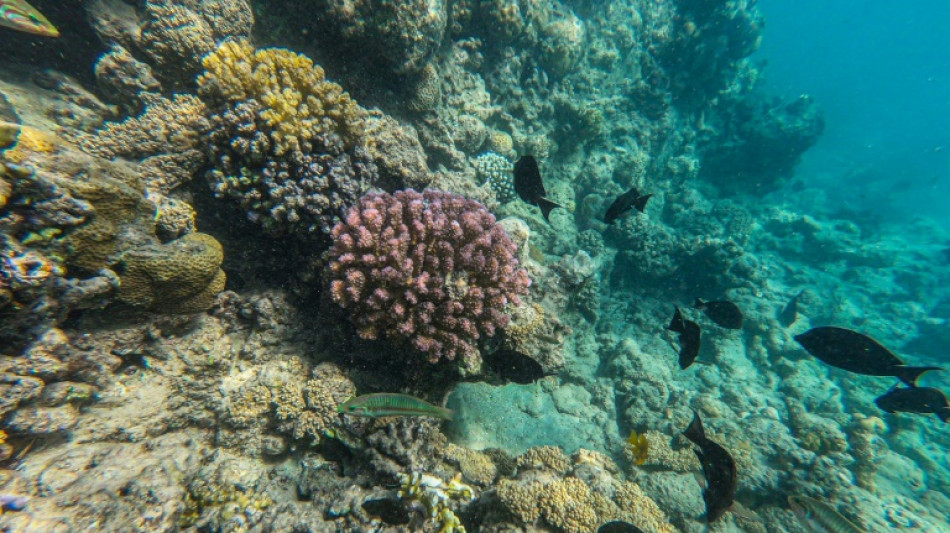
Marine heatwaves last longer in deeper water: study / Photo: Khaled DESOUKI - AFP

 Indonesia accepts Malaysia's help to tackle wildfires

 Indians living in Japan on stand-by to house Asian Games athletes

 Trump signs bill authorizing sweeping Russia sanctions

 Protesters form human chain at Kennedy Center after Trump threat

 Death toll from attack at police HQ in Pakistan rises to 31

 Trump says Denmark to give US 'permanent control' over Greenland security

 Kennedy Center: future unclear for iconic Washington arts hub

 Trump claims 'infinite' Greenland security deal with Denmark

 Helicopters battle wildfire threatening Ecuador's capital

 Brentford batter Chelsea to undo Alonso's promising start

 Kane hits Bundesliga century as Bayern rout Union

 Trump says CNN, MS NOW, Politico banned from White House

 Hushing and hedging: US companies retreat on climate

 Springboks to face Fiji before 2027 Rugby World Cup

 Nigeria miners struggled to breathe in cell before 37 died: survivors

 McIlroy on the charge at PGA Championship as Reed withdraws

 McIlroy on the charge at PGA Championship

 Crisis-wracked Volkswagen warns of 10-bn-euro hit to profits

 Costa Rica's Grynspan tops third informal poll for UN chief: diplomat

 Stock markets retreat after central bank rate hikes

 Russia labels director of Cannes Grand Prix winner a 'foreign agent'

 Macron warns of Russian 'hybrid' threat after meeting presidential hopefuls

 UN holds third informal poll for new chief

 Kulusevski return can spark Spurs: De Zerbi

 Shakira to cap off world tour with Madrid 12-gig run

Marine heatwaves may last longer and be more intense in deeper water, potentially threatening sensitive species as climate change makes the extreme events more frequent, researchers said on Monday.
Oceans have absorbed 90 percent of the excess heat produced by the carbon pollution from human activity since the dawn of the industrial age.
Marine heatwaves -- episodes of abnormally high water temperatures -- have become more frequent and intense.
These can have a particularly severe impact on species that cannot migrate to escape intolerably warm waters, like corals in the Great Barrier Reef and kelp forests off southern Australia and the northeastern Pacific.
In a new study published in the journal Nature Climate Change, researchers looked at impacts of temperature spikes in deeper waters, which lead author Eliza Fragkopoulou said was "the first attempt to look into marine heatwaves below the surface".
"Marine heatwaves and their effects have been studied mostly at the ocean surface and we did not know much about their characteristics in the deep ocean," she told AFP.
Using on-site observations and modelling, researchers examined global marine heatwaves from 1993 to 2019, including data up to 2,000 metres (6,562 feet) below the surface.
They found the intensity was highest at 50 to 200 metres below the surface, occasionally up to 19 percent stronger than the surface heatwave.
The duration also increased with depth, with warming persisting up to two years after temperatures returned to normal on the surface, the study said.
The scientists looked at a proxy measure of thermal stress known as cumulative intensity and mapped that against distribution of biodiversity at the edge of their maximum heat limits to see areas where marine creatures are potentially more vulnerable to changes.
These high stress conditions overlapped in up to 22 percent of the global oceans, they found.
Regional variability of marine heatwaves makes measuring biodiversity exposure complex, and their duration varied by location due to different oceanic conditions.
In general, Fragkopoulou, of the Centre of Marine Sciences at Portugal's University of Algarve, said the impact on biodiversity was likely greatest from the surface to a depth of 250 metres.
The largest portions of the oceans categorised as highly exposed were found in the North Atlantic and Indian oceans, at depths between 1,000 and 2,000 metres.
- Better monitoring 'urgent' -
A separate study published last month in the journal Nature suggested that some marine creatures can withstand the heat better than others, with a finding that ocean fish can endure marine heatwaves with no major impact on their numbers.
Fragkopoulou told AFP that more research was needed on heatwaves in the deeper oceans to unpick the potential impacts on tourism and fisheries.
"Considering that marine heatwave impacts on deep-sea biodiversity are still largely unknown, there is an urgent need for more and better monitoring of the global ocean to understand their effects," she told AFP.
X.M.Francisco--PC



