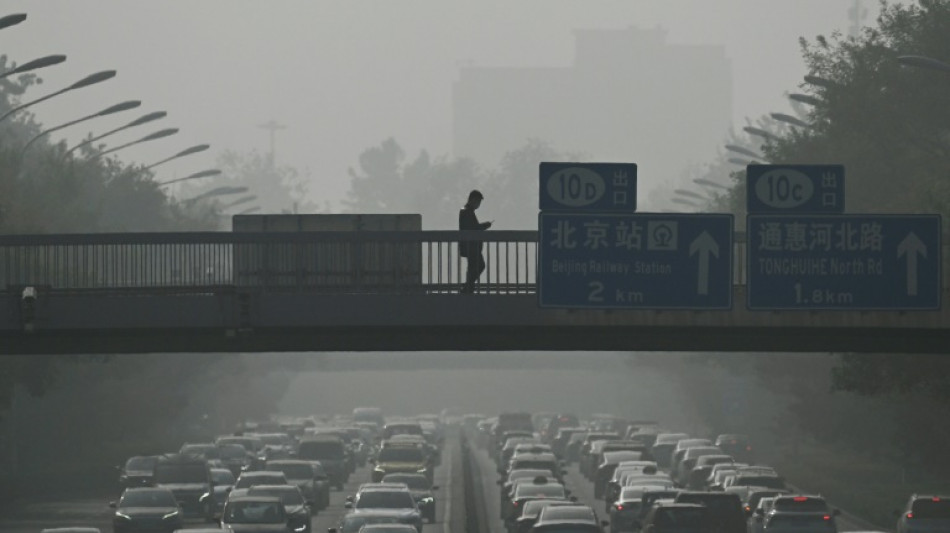
China's smog problem explained / Photo: Pedro PARDO - AFP

 Indonesia accepts Malaysia's help to tackle wildfires
 Indians living in Japan on stand-by to house Asian Games athletes
 Trump signs bill authorizing sweeping Russia sanctions

 Protesters form human chain at Kennedy Center after Trump threat

 Death toll from attack at police HQ in Pakistan rises to 31

 Trump says Denmark to give US 'permanent control' over Greenland security

 Kennedy Center: future unclear for iconic Washington arts hub

 Trump claims 'infinite' Greenland security deal with Denmark

 Helicopters battle wildfire threatening Ecuador's capital

 Brentford batter Chelsea to undo Alonso's promising start

 Kane hits Bundesliga century as Bayern rout Union

 Trump says CNN, MS NOW, Politico banned from White House

 Hushing and hedging: US companies retreat on climate

 Springboks to face Fiji before 2027 Rugby World Cup

 Nigeria miners struggled to breathe in cell before 37 died: survivors

 McIlroy on the charge at PGA Championship as Reed withdraws

 McIlroy on the charge at PGA Championship

 Crisis-wracked Volkswagen warns of 10-bn-euro hit to profits

 Costa Rica's Grynspan tops third informal poll for UN chief: diplomat

 Stock markets retreat after central bank rate hikes

 Russia labels director of Cannes Grand Prix winner a 'foreign agent'

 Macron warns of Russian 'hybrid' threat after meeting presidential hopefuls

 UN holds third informal poll for new chief

 Kulusevski return can spark Spurs: De Zerbi

 Shakira to cap off world tour with Madrid 12-gig run

A thick haze has this week smothered Beijing and surrounding areas, with tens of millions of people in northern China under severe pollution warnings.
Here's what you need to know about the smog in northern China:
- Just how bad is it? -
China's weather office has said "foggy and hazy" conditions are prevalent in the capital Beijing, the megacity of Tianjin, and parts of the provinces of Hebei, Shandong and Hubei, home to more than 100 million people in total.
Many of Beijing's 22 million residents donned face masks on Wednesday morning as they snaked through streets shrouded in a grey haze.
The pollution in some areas has been classified as "severe" and has at times lowered visibility to less than 50 metres (164 feet).
Beijing has experienced five days with "unhealthy" pollution levels in the last week, compared to just three such days in the past three weeks, air quality monitoring firm IQAir's data showed.
IQAir said Beijing was the third most-polluted major city on Earth on Wednesday, just ahead of Bangladesh's capital Dhaka.
Beijing's concentrations of hazardous PM 2.5 particles were more than 20 times higher than World Health Organisation guidelines, the firm said.
PM 2.5 particles, if inhaled, can have serious health risks, linked to premature deaths in people with heart or lung disease, as well as a host of breathing and other health issues, according to the US Environmental Protection Agency.
- Are things getting better? -
A decade ago, Beijing routinely choked in off-the-charts smog that stoked public health anxiety and was dubbed the "airpocalypse" by Western commentators.
China declared "war on pollution" after winning the Winter Olympics bid in 2015, shutting down dozens of coal plants and relocating heavy industries.
That has brought significant improvements, but air quality often remains below World Health Organization standards and severe pollution is common in China's capital.
In March and April, Beijing experienced six days when pollution levels were considered "very unhealthy" -- meaning air quality had reached emergency levels, data from the US embassy showed.
Beijing also experienced five days of "unhealthy" pollution levels around October and November last year.
China is the world's biggest emitter of the greenhouse gases driving climate change, such as carbon dioxide.
A recent jump in approvals for coal-fired power plants has added to concerns that China will backtrack on its goals to peak emissions between 2026 and 2030 and become carbon-neutral by 2060.
- What are the causes? -
The capital's location plays a role. Nestled between deserts to the north and dense industrial clusters to the south and east, the direction of the prevailing wind can often determine whether the city sees blue skies or dense smog.
But the bad air is also man-made: highly-polluting heavy industry, the common use of coal burning for electricity and vehicle emissions, IQAir said.
Beijing's city government has blamed "unfavourable weather conditions" such as high humidity and unseasonably hot temperatures.
It has said that colder weather may help dissipate the pollution.
- What steps have been taken? -
The second-highest air pollution alert is in place in Beijing until the end of Thursday.
The alert orders businesses, builders and transport firms to cut their emissions as a matter of urgency.
Further curbs, such as temporary bans on the use of some high-emissions vehicles, will come into force if the highest alert -- already in force in parts of Hebei province -- is triggered.
Authorities have also urged residents to reduce outdoor activities and strenuous exercise during periods of high pollution.
Ferreira--PC



