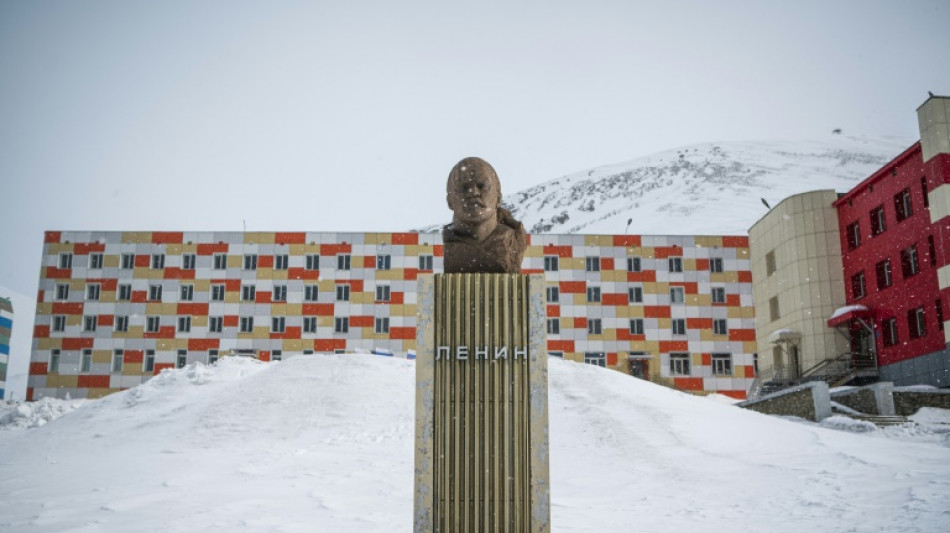
Russia's isolation takes toll on Arctic climate science / Photo: Jonathan NACKSTRAND - AFP

 Inter Milan and Italy icon Mazzola dies aged 83
 Saudi capital issues first air raid alert since renewed fighting in Yemen

 Martin edges title rival Marquez for Austrian MotoGP pole

 Indonesia accepts Malaysia's help to tackle wildfires
 Indians living in Japan on stand-by to house Asian Games athletes
 Trump signs bill authorizing sweeping Russia sanctions

 Protesters form human chain at Kennedy Center after Trump threat

 Death toll from attack at police HQ in Pakistan rises to 31

 Trump says Denmark to give US 'permanent control' over Greenland security

 Kennedy Center: future unclear for iconic Washington arts hub

 Trump claims 'infinite' Greenland security deal with Denmark

 Helicopters battle wildfire threatening Ecuador's capital

 Brentford batter Chelsea to undo Alonso's promising start

 Kane hits Bundesliga century as Bayern rout Union

 Trump says CNN, MS NOW, Politico banned from White House

 Hushing and hedging: US companies retreat on climate

 Springboks to face Fiji before 2027 Rugby World Cup

 Nigeria miners struggled to breathe in cell before 37 died: survivors

 McIlroy on the charge at PGA Championship as Reed withdraws

 McIlroy on the charge at PGA Championship

 Crisis-wracked Volkswagen warns of 10-bn-euro hit to profits

 Costa Rica's Grynspan tops third informal poll for UN chief: diplomat

 Stock markets retreat after central bank rate hikes

 Russia labels director of Cannes Grand Prix winner a 'foreign agent'

 Macron warns of Russian 'hybrid' threat after meeting presidential hopefuls

Glaciologist Andrew Hodson used to collaborate with his Russian colleagues in the Svalbard archipelago in the Arctic, but snowmobile excursions to see them have come to a halt since the war in Ukraine.
"We used to work with Russian permafrost scientists and hydrologists in the Barentsburg region. This doesn't happen now," the British scientist told AFP.
"We're sad that we can't use this basis for collaboration, but we're not at all happy with the actions of the Russian government, obviously," he said at his office at Longyearbyen University in the archipelago's capital.
Although a part of Norway, the islands have long had a strong Russian presence. But the frequently-cited diplomatic mantra of cohabitation there -- "High North, low tensions" -- no longer applies.
In the Arctic, as in the rest of the world, Western and Russian researchers have cut almost all ties since the start of the war in Ukraine.
Moscow's February 2022 invasion was the final nail in the coffin of their cooperation, already in decline in recent decades amid President Vladimir Putin's more aggressive policies.
The deep freeze has significantly affected scientific research in a region warming around four times faster than the planet as a whole, and which is therefore crucial to climate studies -- and where Russia plays a major role due to its vast size.
- Missing data -
"It's damaging because Russia is more than half of the Arctic," said Rolf Rodven, executive secretary of the Arctic Monitoring and Assessment Programme (AMAP). ]
The exchange of data from Russia has now completely dried up.
"We do not know what's happening on the ground there and of course, what's happening there will also affect the European, US and Canadian part of the Arctic," he said.
This deprives scientists of crucial information about permafrost -- present predominantly in Russia and a ticking time bomb for the climate of the entire planet -- and recent wildfires, which are believed to have been as devastating as those in North America.
Some data can be obtained through international databases such as the World Meteorological Organization or through satellite observations, but those are incomplete.
"We know that there will be more uncertainty in our estimates and as a consequence also more uncertainties in projections for the future," Rodven said.
Studies written by AMAP -- one of the Arctic Council's six working groups -- are all the more important since they are used in reports by the UN's IPCC climate panel.
The Arctic Council is a regional forum long held up as a model of cooperation, but now stands divided between the West (Canada, Denmark, Finland, Iceland, Norway, Sweden and the United States) and Russia.
A number of projects have been suspended and some studies have been delayed.
Not only have relations with Russian research institutes -- almost all state-run bodies -- been halted, but even the few independent researchers are reluctant to cooperate for fear of being accused of treason or espionage.
Already in 2019, Russian scientists expressed concern about restrictions imposed on their contacts with foreign colleagues, raising fears of a return to conditions that existed during the Soviet era.
- Brain drain -
Russia's research community has been plagued by a "brain drain" -- which began even before Moscow's invasion of Ukraine -- and funding that has been slashed in order to pay for the war effort.
"It's a double whammy," said Salve Dahle, a marine biologist at Norway's independent Akvaplan-niva institute.
"Not only do we no longer benefit from the exchange of data, but the collection of data in Russia itself is also cut back."
Dahle, who used to frequently work on projects in Russia, said his primary concern was for Siberia's main rivers, the Arctic Ocean's biggest source of freshwater.
Without being present in the field, it's impossible to measure the effects on the rivers of oil and gas drilling, industrial activities and mining.
"Everything that can be dissolved in water or be captured in ice is transported into the transpolar drift stream (an ocean current that flows from east to west) and flows out between Greenland and Svalbard," he said.
In Longyearbyen, British glaciologist Andrew Hodson is trying to be pragmatic.
"There's much to be gained from working with the expertise there," he said of his Russian research colleagues.
"But I won't pretend that it was ever easy... So no, I'm not that sorry."
P.Queiroz--PC



