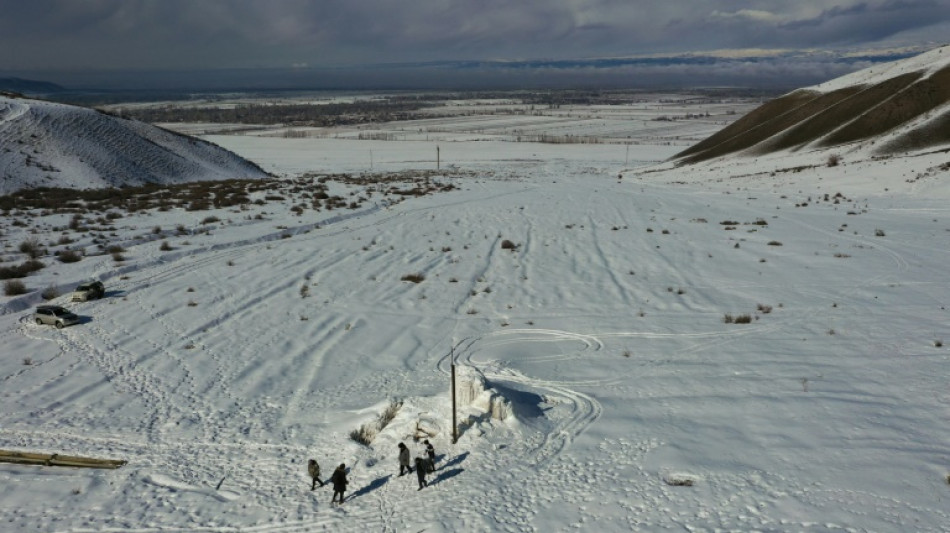
Artificial glaciers stave off drought in Kyrgyzstan / Photo: VYACHESLAV OSELEDKO - AFP

 Inter Milan and Italy icon Mazzola dies aged 83

 Saudi capital issues first air raid alert since renewed fighting in Yemen

 Martin edges title rival Marquez for Austrian MotoGP pole

 Indonesia accepts Malaysia's help to tackle wildfires

 Indians living in Japan on stand-by to house Asian Games athletes
 Trump signs bill authorizing sweeping Russia sanctions

 Protesters form human chain at Kennedy Center after Trump threat

 Death toll from attack at police HQ in Pakistan rises to 31

 Trump says Denmark to give US 'permanent control' over Greenland security

 Kennedy Center: future unclear for iconic Washington arts hub

 Trump claims 'infinite' Greenland security deal with Denmark

 Helicopters battle wildfire threatening Ecuador's capital

 Brentford batter Chelsea to undo Alonso's promising start

 Kane hits Bundesliga century as Bayern rout Union

 Trump says CNN, MS NOW, Politico banned from White House

 Hushing and hedging: US companies retreat on climate

 Springboks to face Fiji before 2027 Rugby World Cup

 Nigeria miners struggled to breathe in cell before 37 died: survivors

 McIlroy on the charge at PGA Championship as Reed withdraws

 McIlroy on the charge at PGA Championship

 Crisis-wracked Volkswagen warns of 10-bn-euro hit to profits

 Costa Rica's Grynspan tops third informal poll for UN chief: diplomat

 Stock markets retreat after central bank rate hikes

 Russia labels director of Cannes Grand Prix winner a 'foreign agent'

 Macron warns of Russian 'hybrid' threat after meeting presidential hopefuls

In the Tian-Shan mountains of Kyrgyzstan, villagers have made an artificial glacier to provide water for their drought-hit farms.
Standing on the ice hillock, farmer Erkinbek Kaldanov said he was optimistic about harnessing nature to counteract climate change.
"We won't have any more problems with water," said the farmer, who was worried for his sheep last year after some unusual temperature spikes.
"When the glacier melts, there will be enough water for the livestock and to water the land in Syn-Tash," the surrounding district, he said.
The glacier currently measures five metres (16 feet) high and about 20 metres long. At the height of winter it was 12 metres tall.
Local residents made it over a period of two weeks in autumn by re-directing water from the peaks of Tian-Shan, which tower more than 4,000 metres high in northern Kyrgyzstan.
Kaldanov and others are being forced to adapt since natural glaciers in Central Asia -- the main water source for the region -- are slowly disappearing due to global heating.
A 2023 study in the journal Science predicted that the acceleration in the melting of the glaciers would peak only between 2035 and 2055.
The lack of snow, also due to higher temperatures, does not allow them to regenerate.
- 'Less and less water' -
The extent of the problem can be seen in satellite images of Central Asia and in the regular warnings issued by the United Nations.
The problem has a knock-on effect on the lowlands of Central Asia, in more arid countries like Kazakhstan, Turkmenistan and Uzbekistan.
This in turn feeds into existing tensions between the different countries, which still share water resources under a complex and obsolete scheme inherited from the Soviet era.
"There is less and less water every year. The water tables are emptying out, the springs are drying up and we have problems with grazing," said Aidos Yzmanaliyev, a spokesman for the Syn-Tash farmers.
Finding solutions is urgent, particularly as farming represents around 10 percent of the fragile Kyrgyz economy and two thirds of its inhabitants live in rural areas.
In the north of Kyrgyzstan, a country accustomed to revolutions and uprisings, the lack of water has already stoked social tensions in previous periods of drought.
"Our main aim is to provide water for livestock since the majority of the 8,400 inhabitants of the Syn-Tash district are farmers," said district chief Maksat Dzholdoshev.
"We expect to create two or three additional artificial glaciers for farmland," he said.
- Simple concept -
The idea and its implementation are relatively simple. Each glacier costs around 550,000 som (around $6,200) to create.
"The water comes from a mountain source three kilometres away through underground piping. It gushes out and freezes, forming a glacier," said Yzmanaliyev.
"Apart from providing water when it melts, the glacier also helps lower the ambient temperature and create humidity.
"(That) helps the surrounding vegetation, which is grazed by cattle from spring to autumn," Yzmanaliyev said.
Artificial glaciers were first created in the Indian Himalayas in 2014 and have gone global -- cropping up in Chile and Switzerland.
In Kyrgyzstan, their introduction was spearheaded by Abdilmalik Egemberdiyev, head of the Kyrgyz association of pasture users.
Egemberdiyev pointed to an additional benefit.
The glaciers allow farmers to keep livestock on spring pastures for longer before sending them to summer pastures, thus slowing soil erosion.
"We now have 24 artificial glaciers around the country and more still to be created," he said.
P.Queiroz--PC



